Tru-Vue Home | History | Viewers | Filmstrips | Cards | Boxes | Cases | Special Sets | Sales & Advertising
Tru-Vue Sales & Advertising Tools
The Tru-Vue team was clearly skilled at sales & marketing. We’ve admired their investment in packaging design but compared to other 3D products, their sales and advertising materials were top-notch.
In assimilating our Tru-Vue collection, we’ve obtained a number of these materials. All of the pieces you see here are original items in our collection, not reproductions or downloaded images.
It’s a long page, so if you’re short on time, you can use these links to jump to a section of interest.
Page Sections (click link to jump to the section, click browser back arrow to come back here)
Door-to-Door - professional salesmen selling Tru-Vue in person to homes and businesses
Mail-Order - includes Tru-Vue correspondence, envelopes, price lists, brochures, and other promo inserts)
Community Selling - everyday, amateur folks are enticed to sell Tru-Vue to friends to earn extra money
Consumer Publications - ads to get Tru-Vue in front of consumers
Dealer Advertising - ads to encourage dealers to stock Tru-Vue in their stores
Point-of-Sale Displays - what you’d see in stores to attract buyers to Tru-Vue
Location & Event Selling - special sets designed to sell Tru-Vue on-the-spot at tourist locations and special events
Factory Stock - a couple of items in our collection that show pre-sales packing & storing
Disney Art Boards - just a little something to highlight the Disney characters as a selling strategy
Tru-Vue Door-to-Door Sales
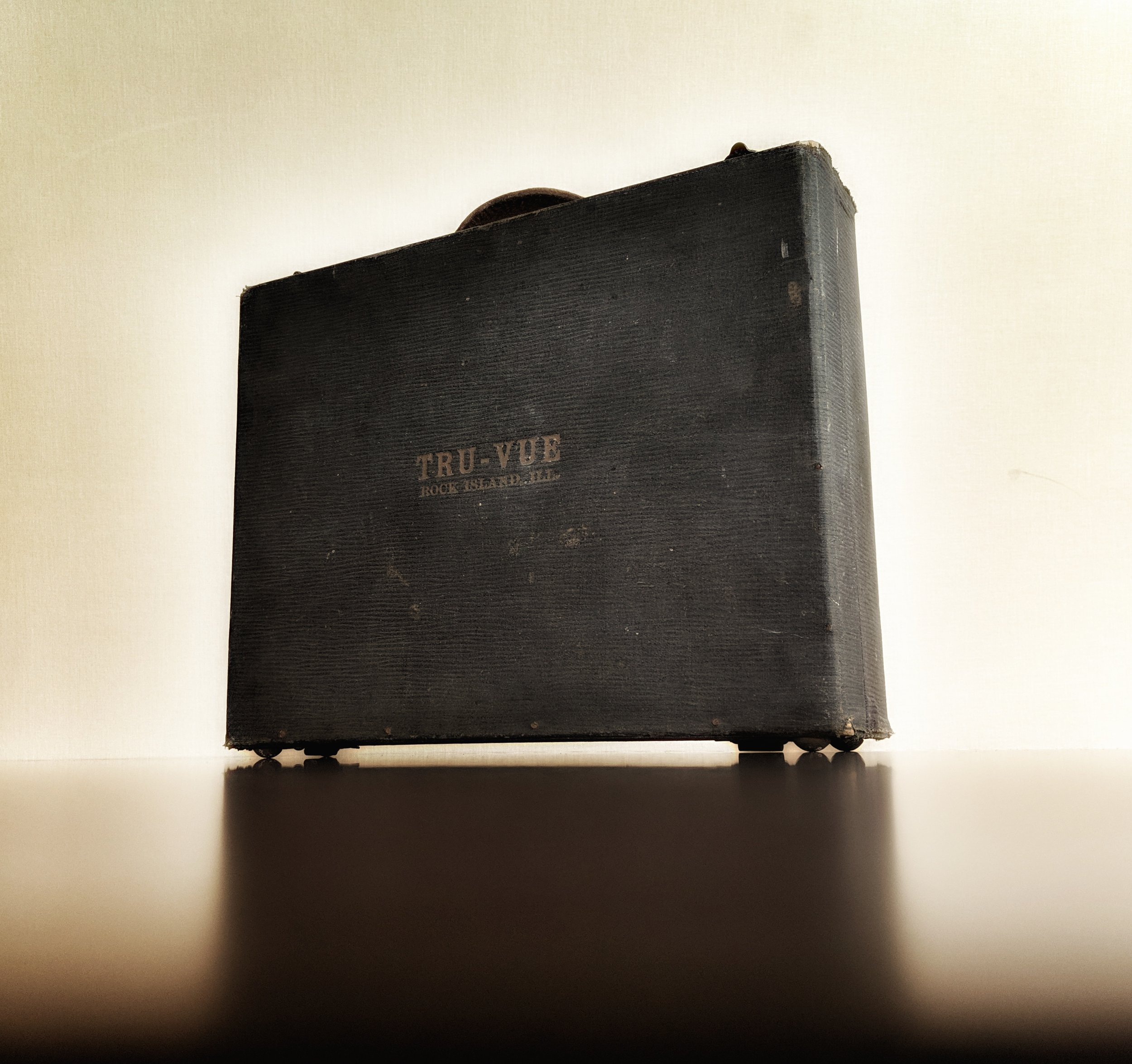
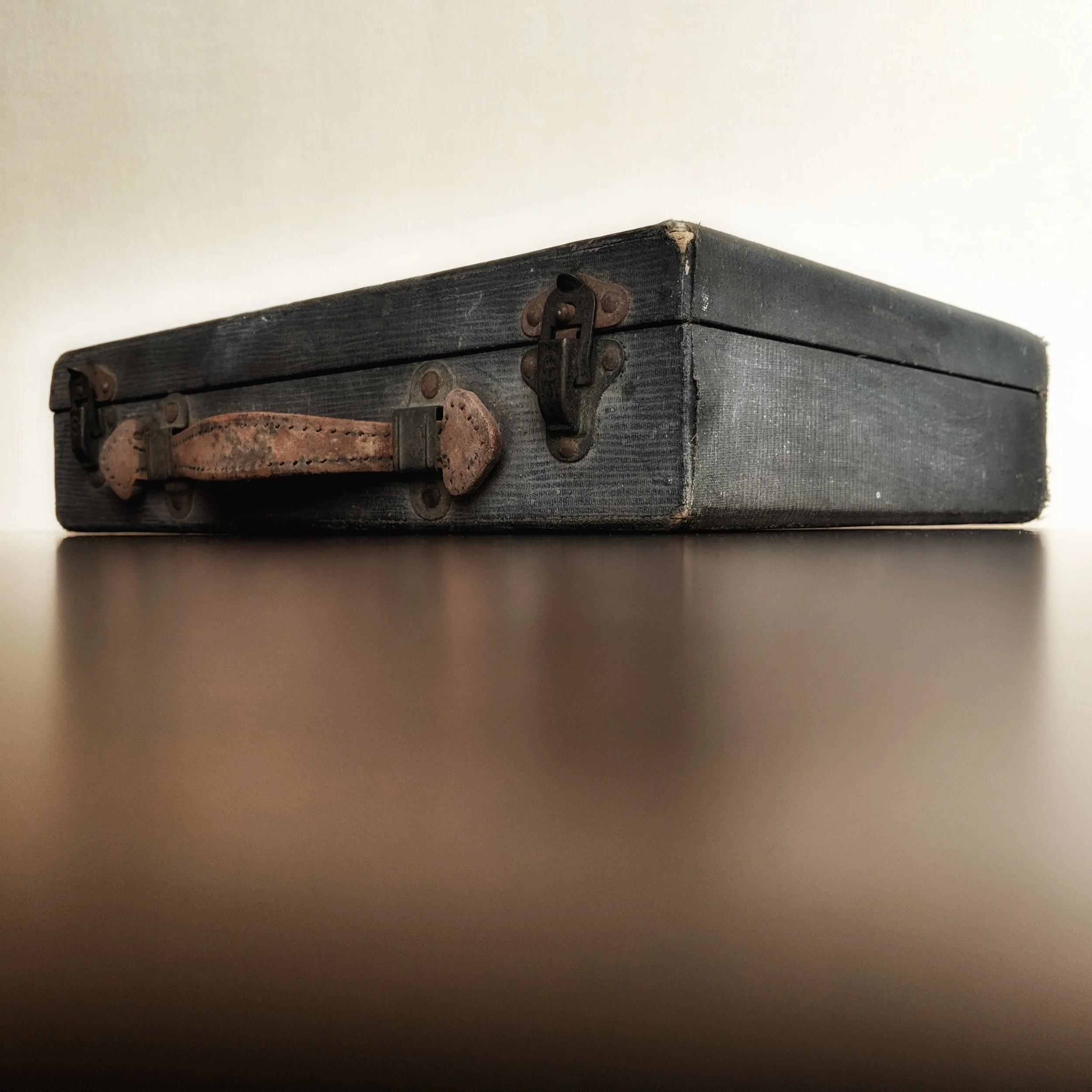
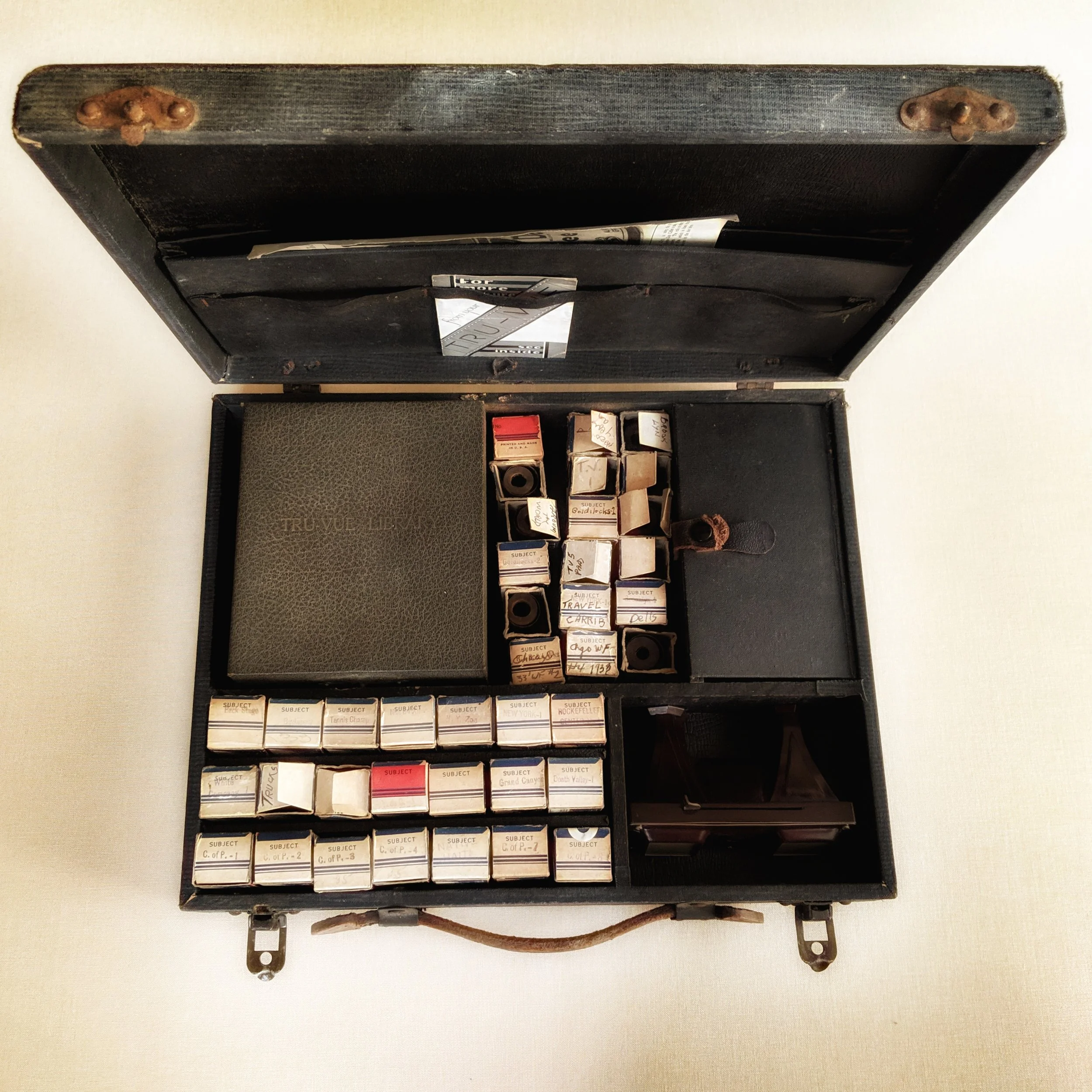
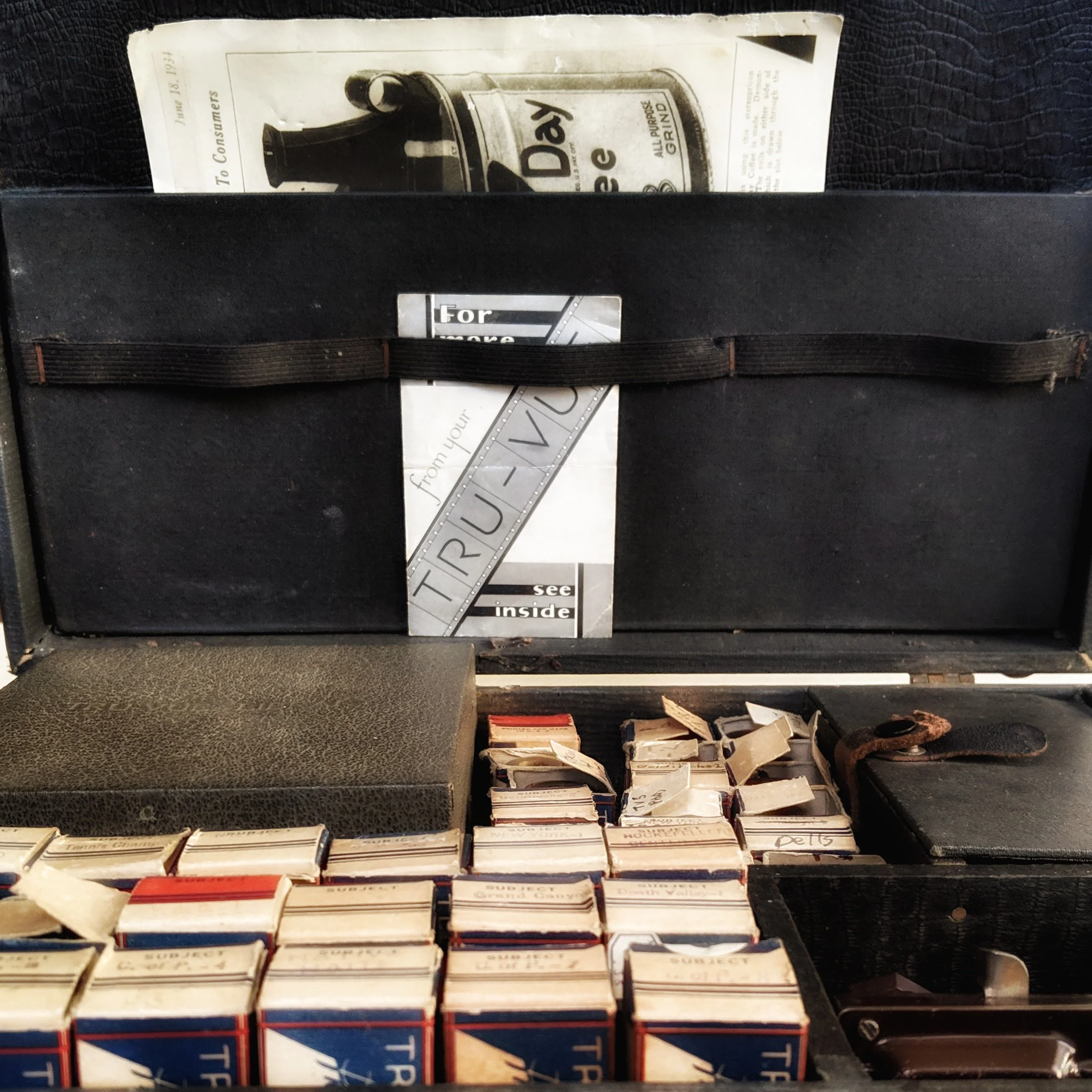
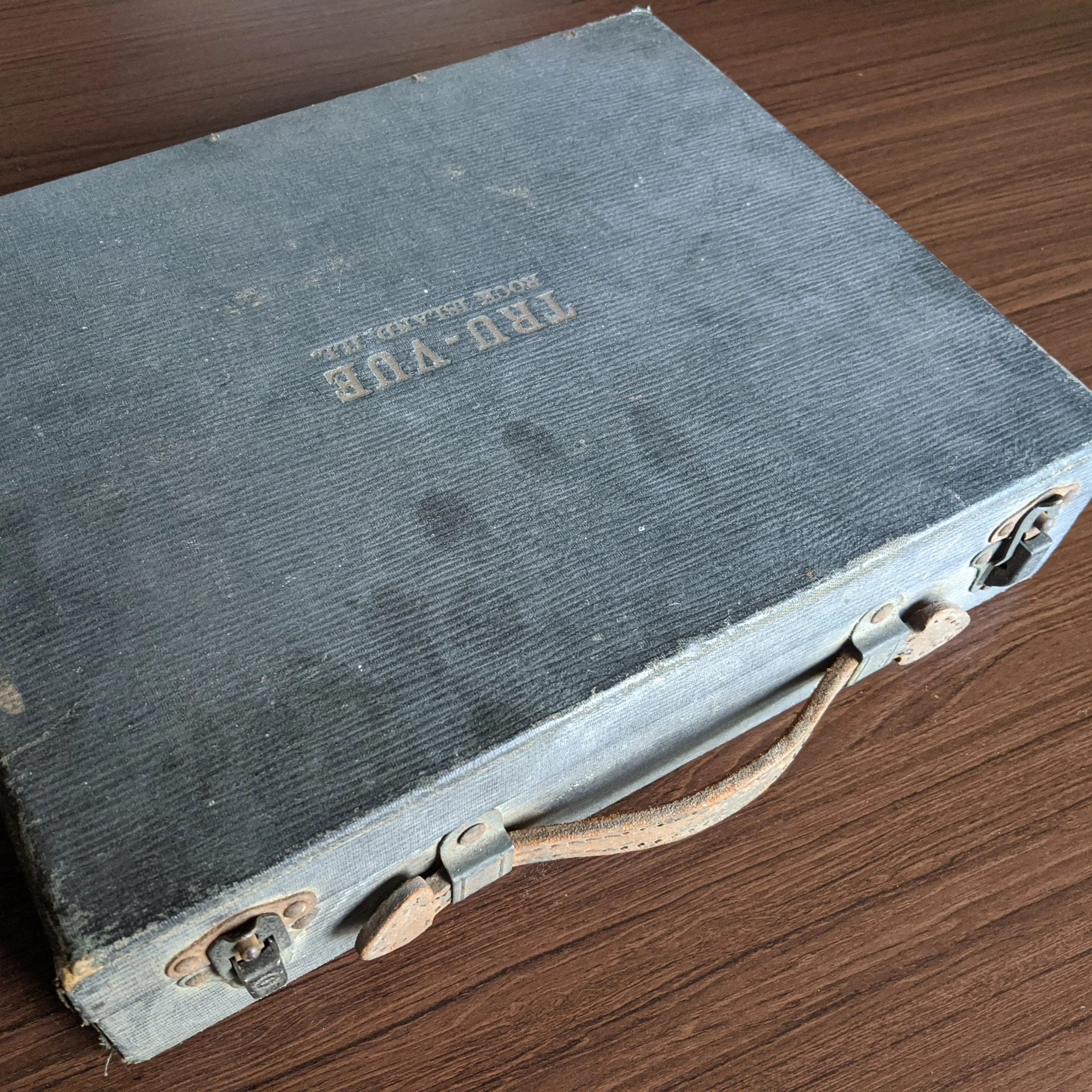
One of the prized Tru-Vue items in our collection is this original salesman’s briefcase.
By the end of 1933, Tru-Vue had gone from producing 300 stereoscopes a month to 50,000 per month, with orders coming in from all corners of the country. That kind of demand required 30 men working 6 days a week, 50 salesmen selling nationwide.
A classified ad in the March 25, 1934 issue of the Chicago Tribune put the call out for salesmen:
Salesman - Represent old est. co.: new product of proven acceptance: World’s Fair tie-in: perm. conn., protected terr., lib. comm.: must have car. Tru-Vue Picture Viewer. 1531 Merchandise Mart.
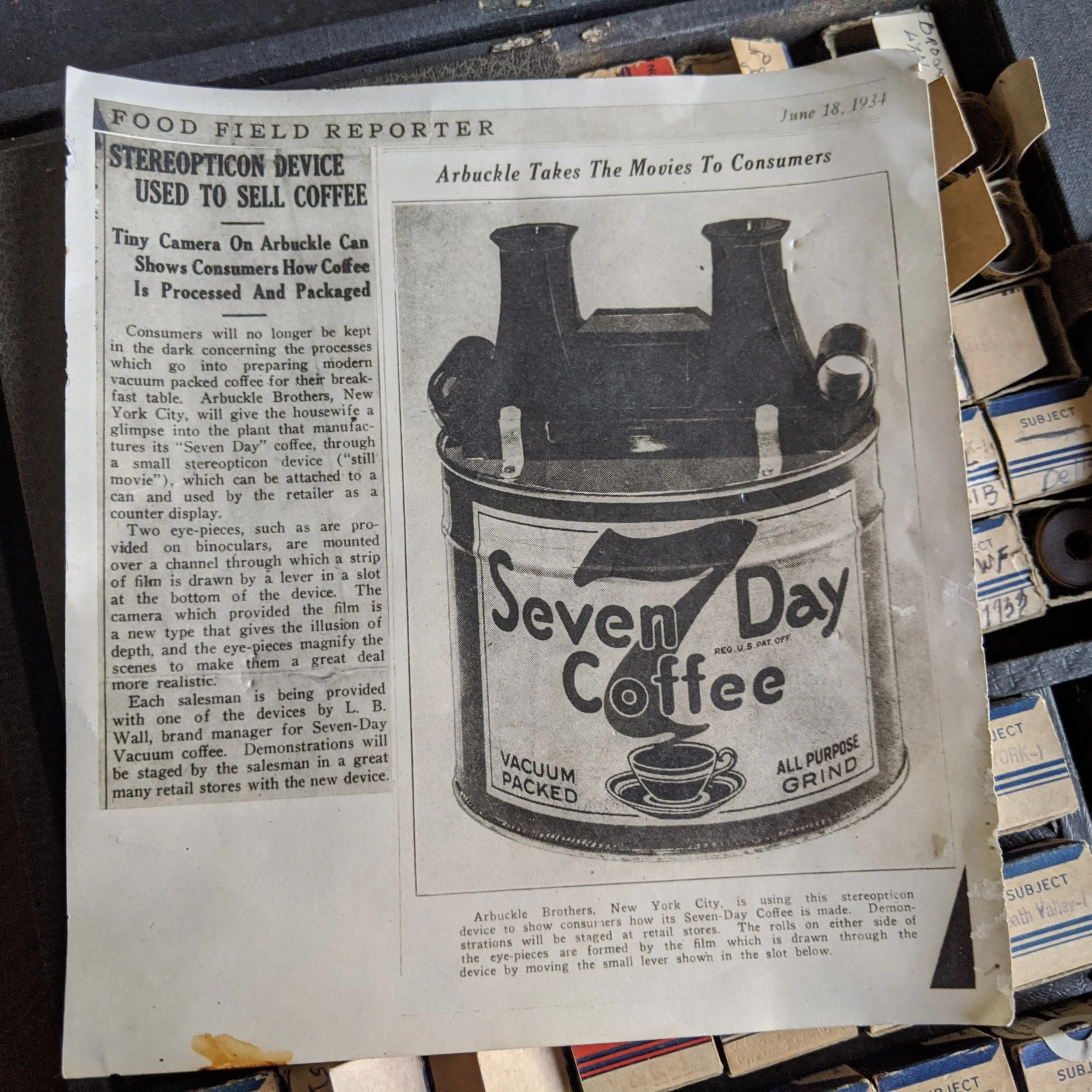
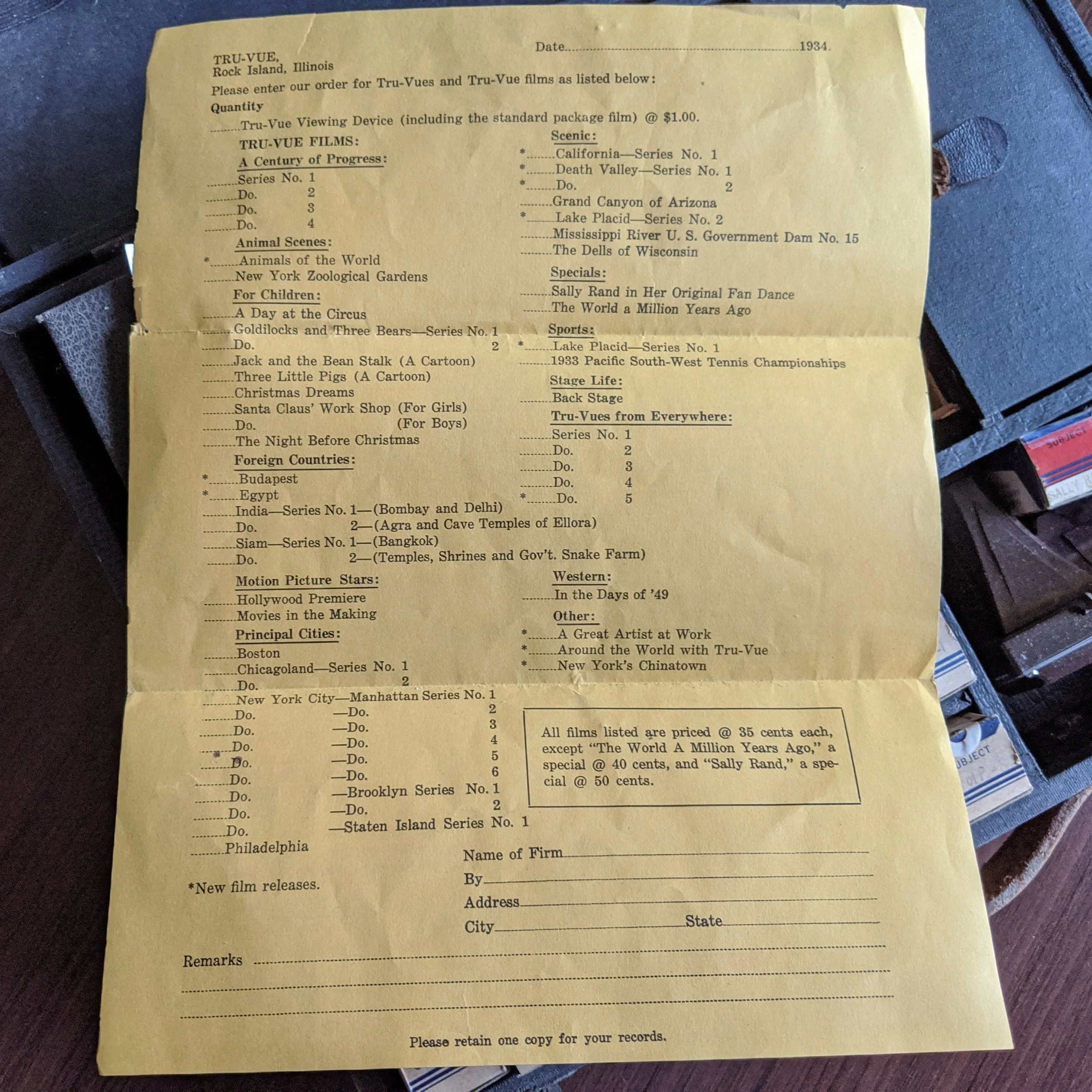
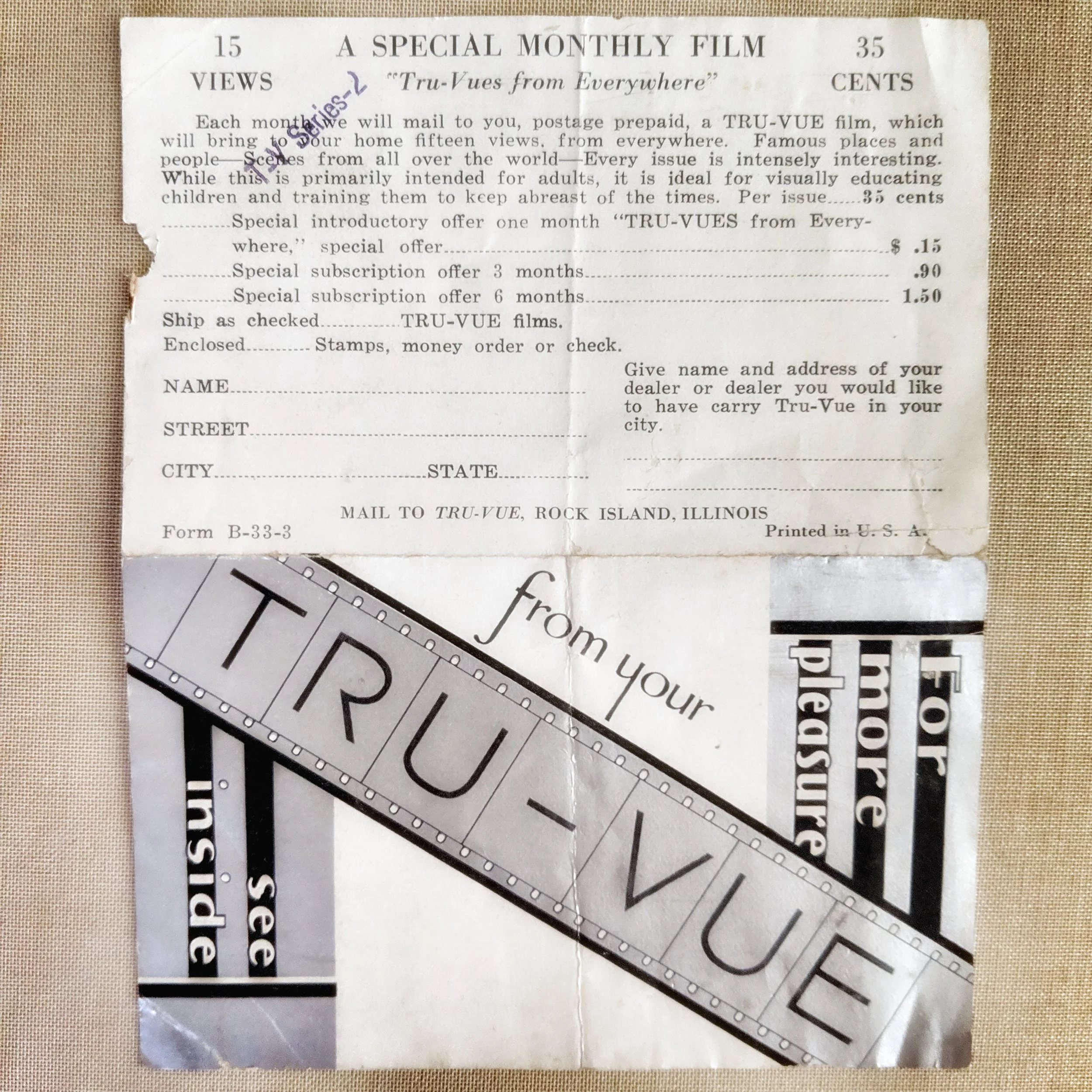
This briefcase was likely carried by one of those salesmen. It contained filmstrips in early blue film boxes, an Art Deco viewer, an early case, early film lists, and a reproduction of a Food Field Reporter article from June of 1934.
Tru-Vue Mail Order Sales
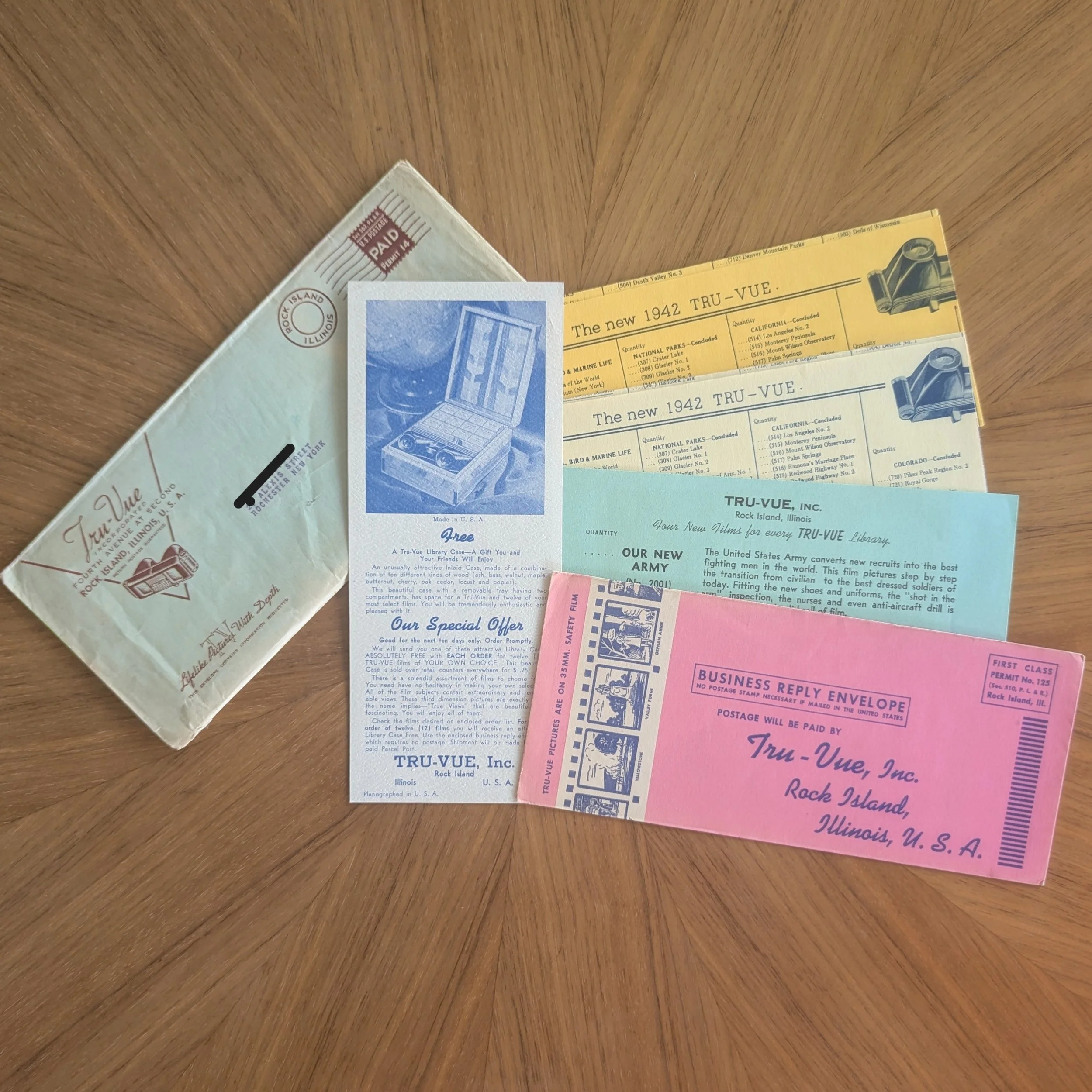
Besides door-to-door sales, mail order was a big source of sales for Tru-Vue. They took advantage of that postal access with enticing brochures that combined pictorial advertising with film list and order form. Sometimes there would be specially printed enclosures showing the latest library — typically sent in specially printed envelopes and with equally nice reply envelopes.
Sometimes, letters personalized to the recipient would be enclosed. Occasionally, the letter would be signed by a Tru-Vue executive.
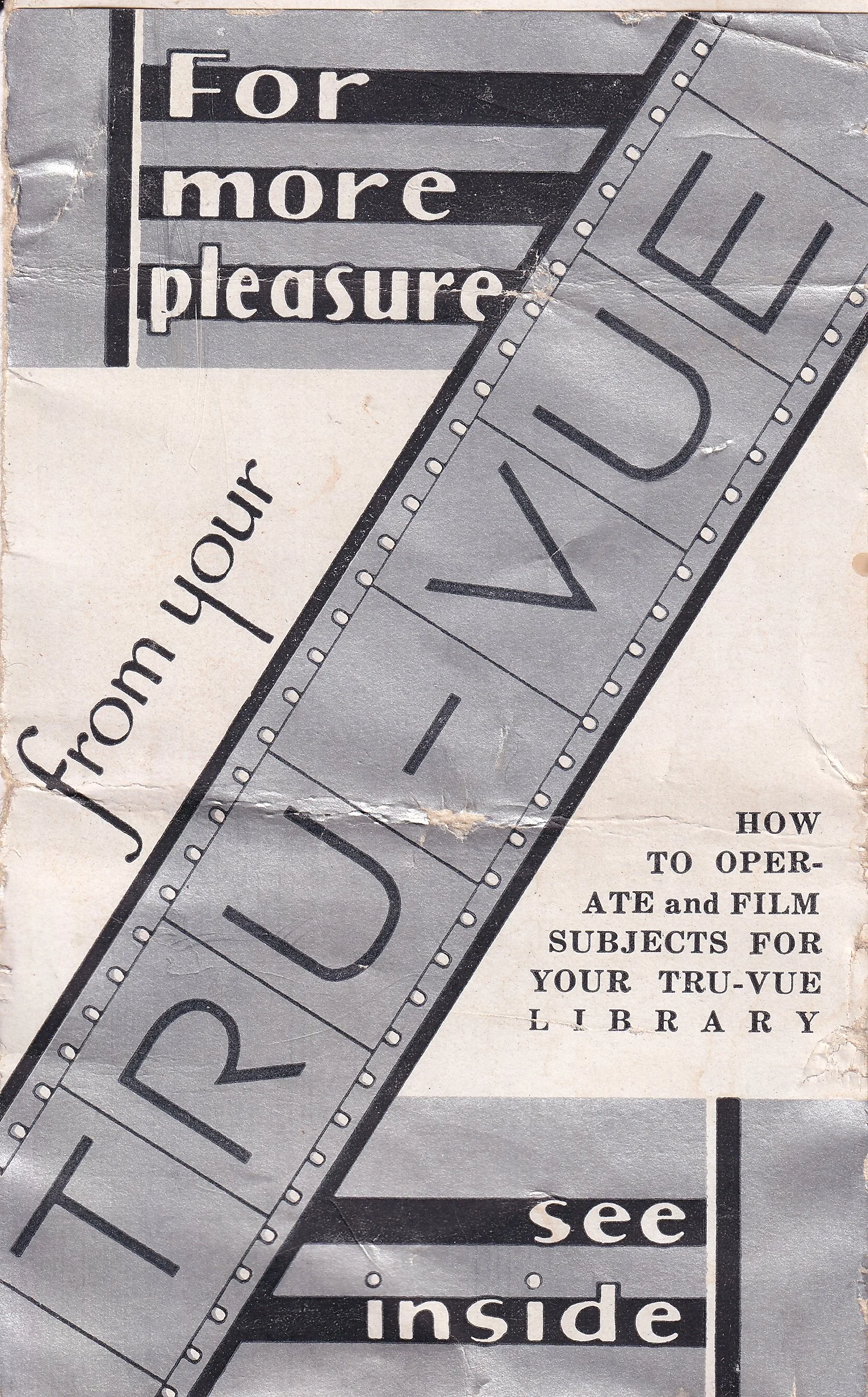
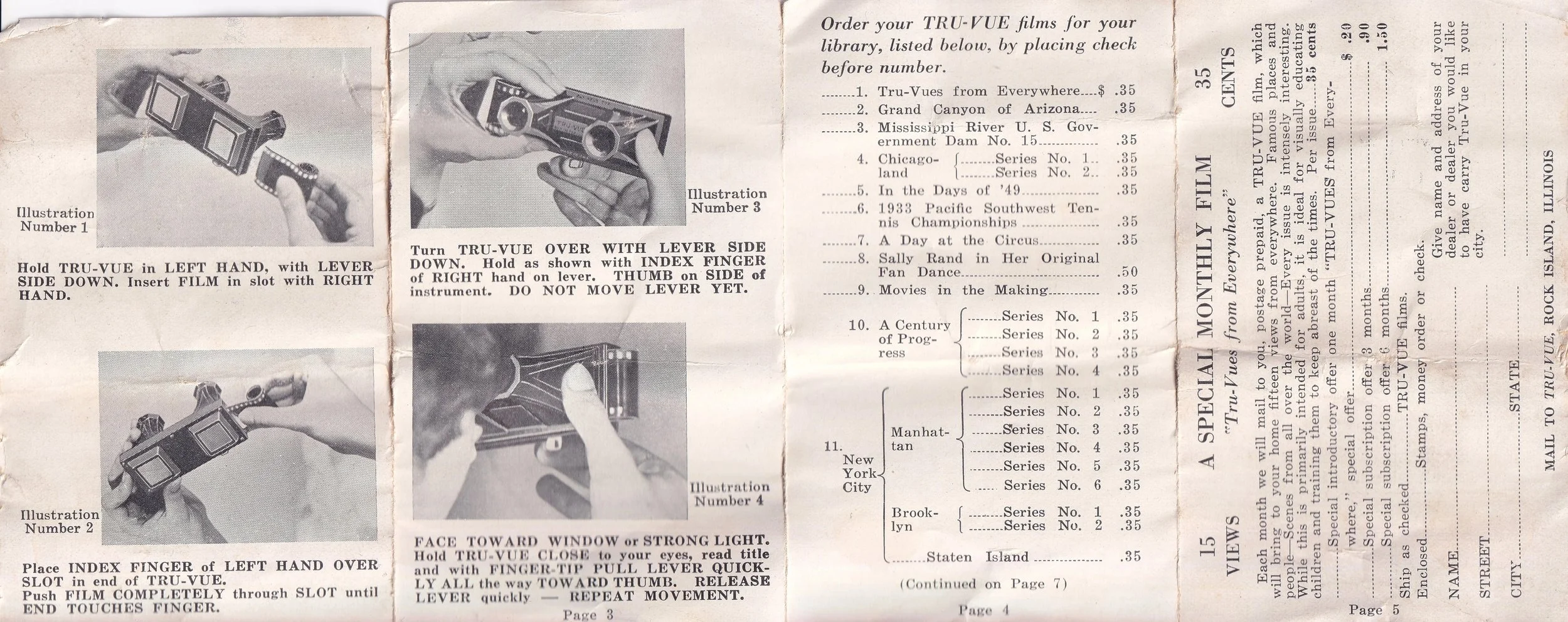
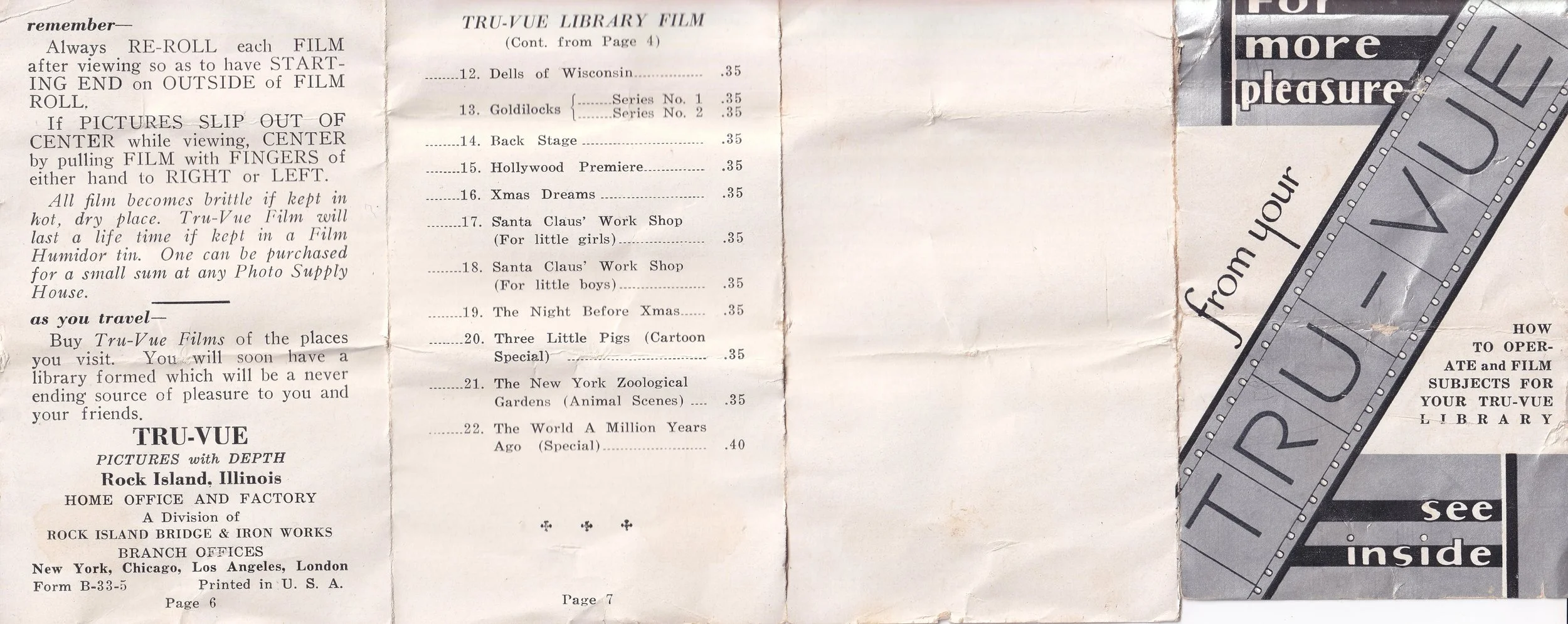
1930s Silver-and-Black Tru-Vue Film Brochure
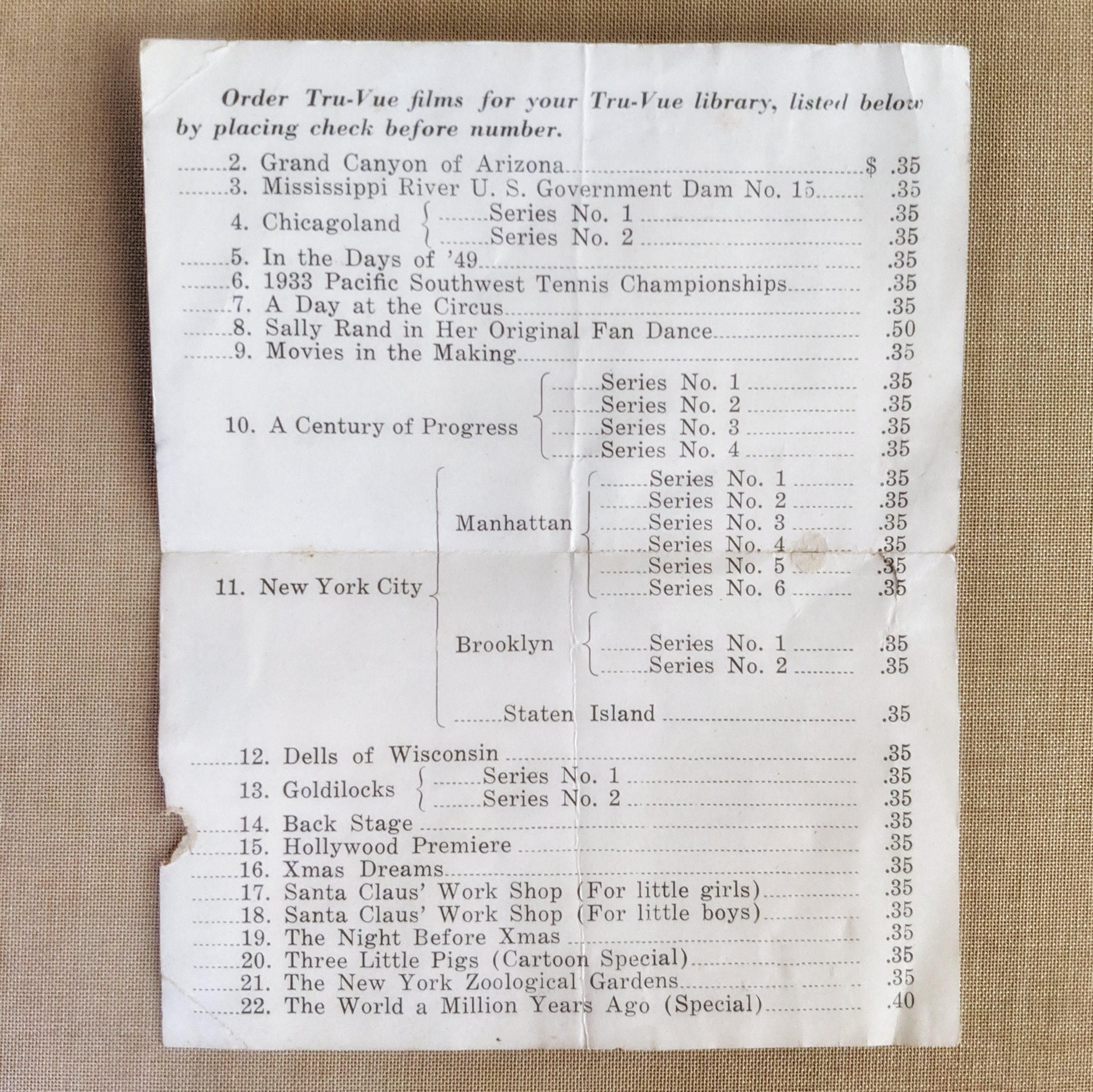
This early 4-panel brochure (Form B-33-5) has a demonstration of operating the early Art-Deco Tru-Vue viewer, an order list with 22 film subjects (34 films total), and an order form for the monthly subscription to “Tru-Vues from Everywhere.” The films are 35 cents each, except for “The World A Million Years Ago” which was 40 cents. At the time of printing, there were already branch offices in New York, Chicago, Los Angeles, and London.
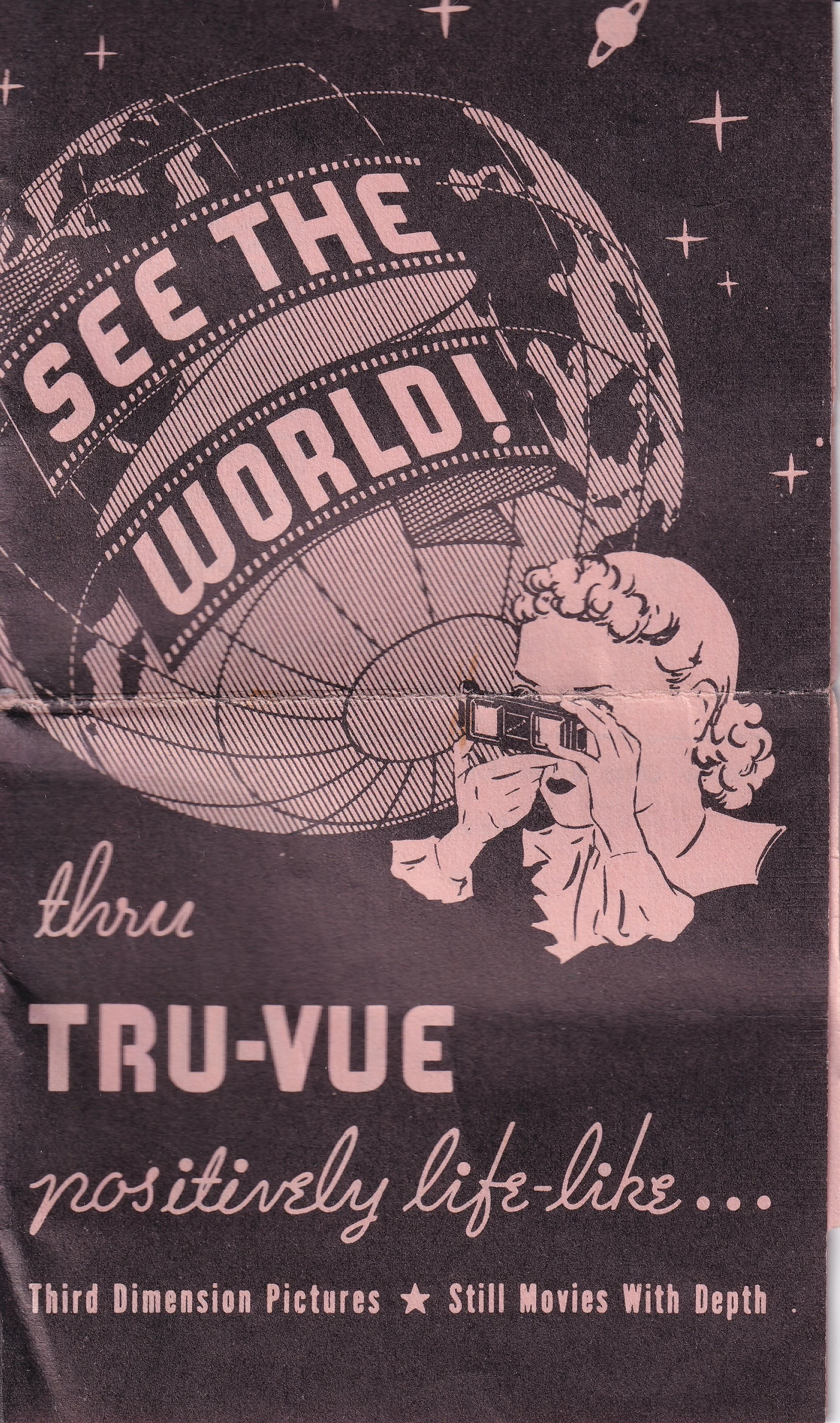
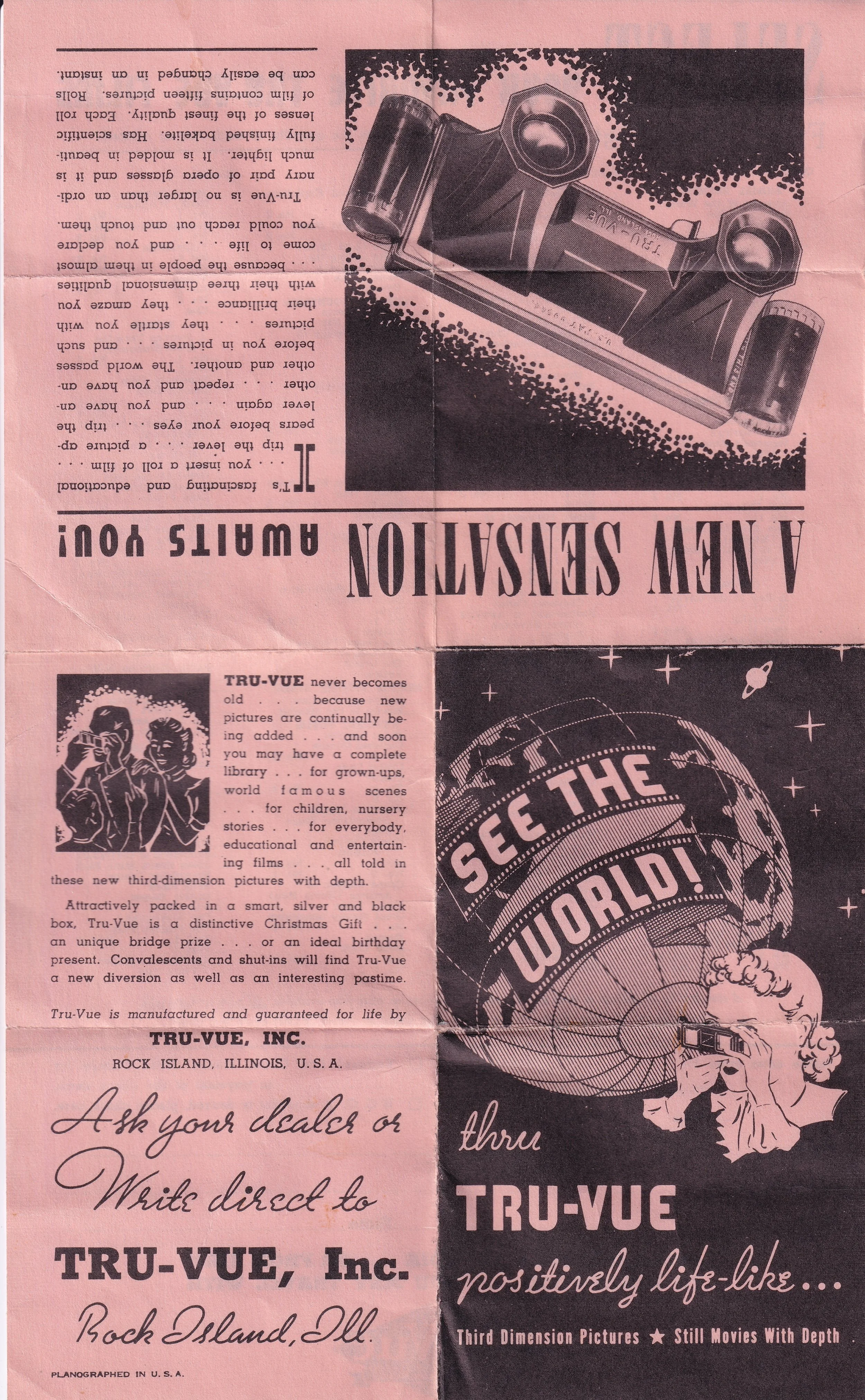
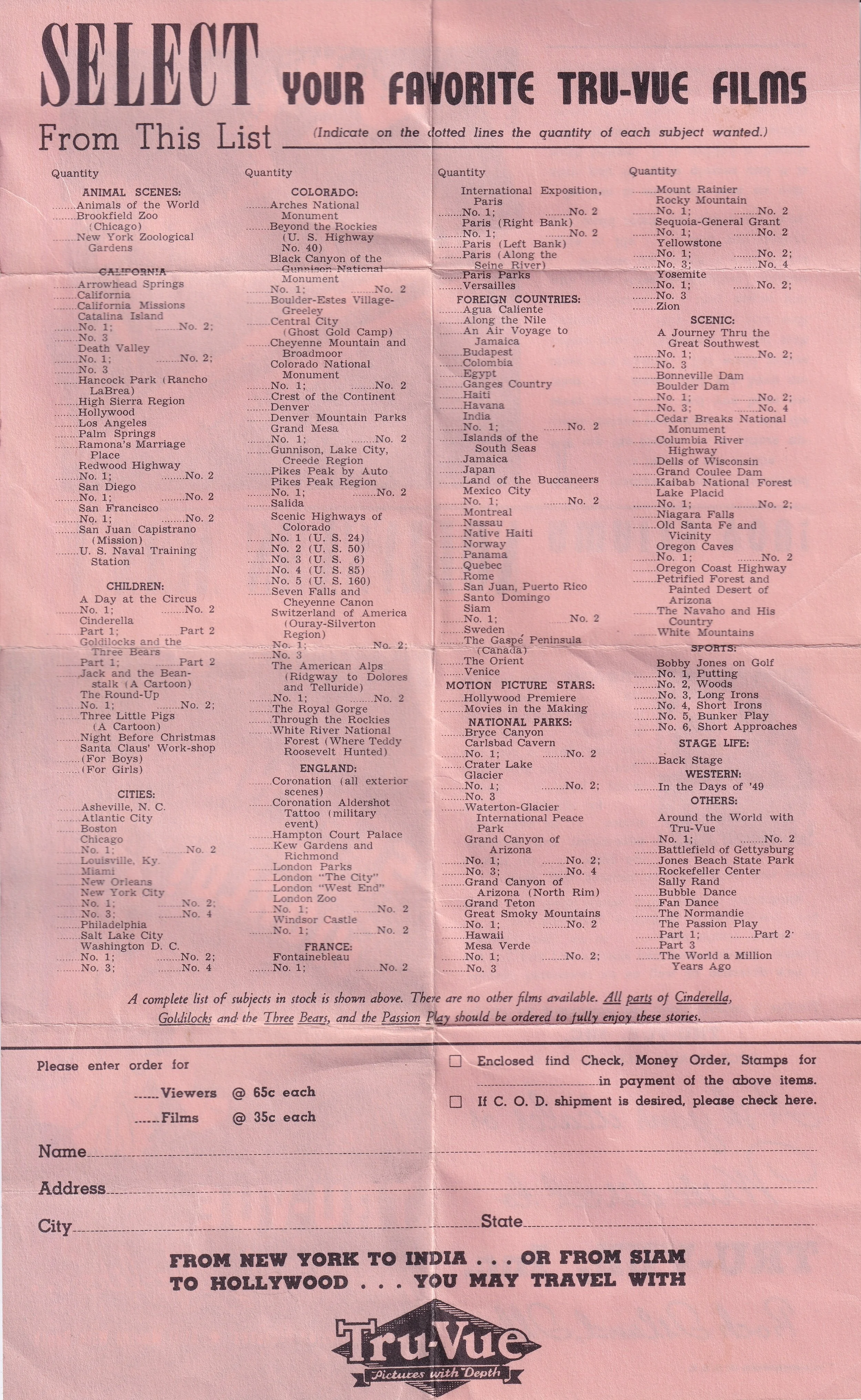
1930s Pink-and-Black Tru-Vue Film Brochure
This early pink-and-black film brochure features the Art Deco viewer, “See the World!” globe design, and the “positively life-like” slogan. While the film list has grown significantly, many of the earliest films are no longer listed — for example, Tru-Vues from Everywhere, the Century of Progress series, and the Pacific Southwest Tennis Championship filmstrips. In fact, they make a point of saying that this is a complete list of current stock and “there are no other films available.” Another big change is the introduction of “Tru-Vue, Inc.” — Tru-Vue is an incorporated company, no longer advertised as a division of Rock Island Bridge & Iron Works. The films are still 35 cents each, and the viewer can be purchased for 65 cents.
1930s Inlaid Wood Box Promotional Insert
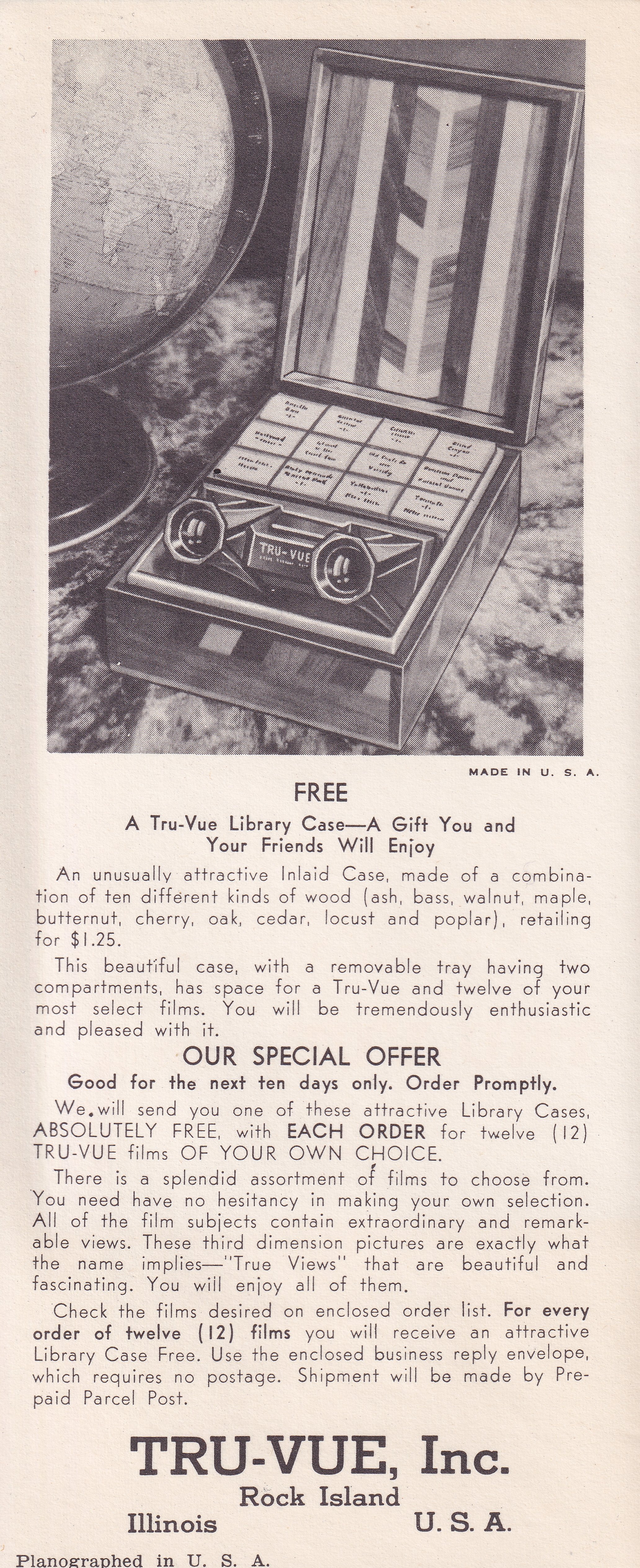
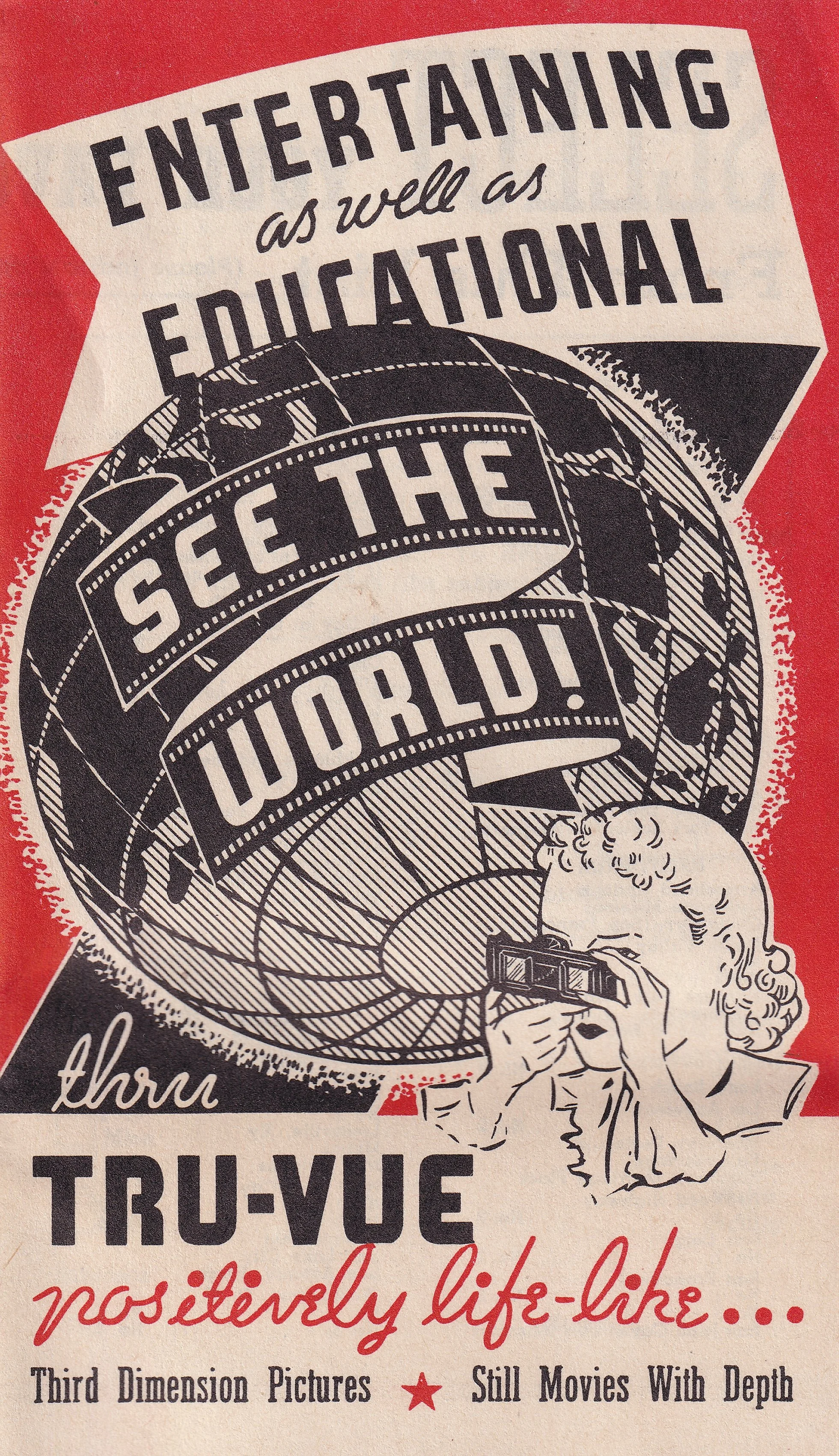
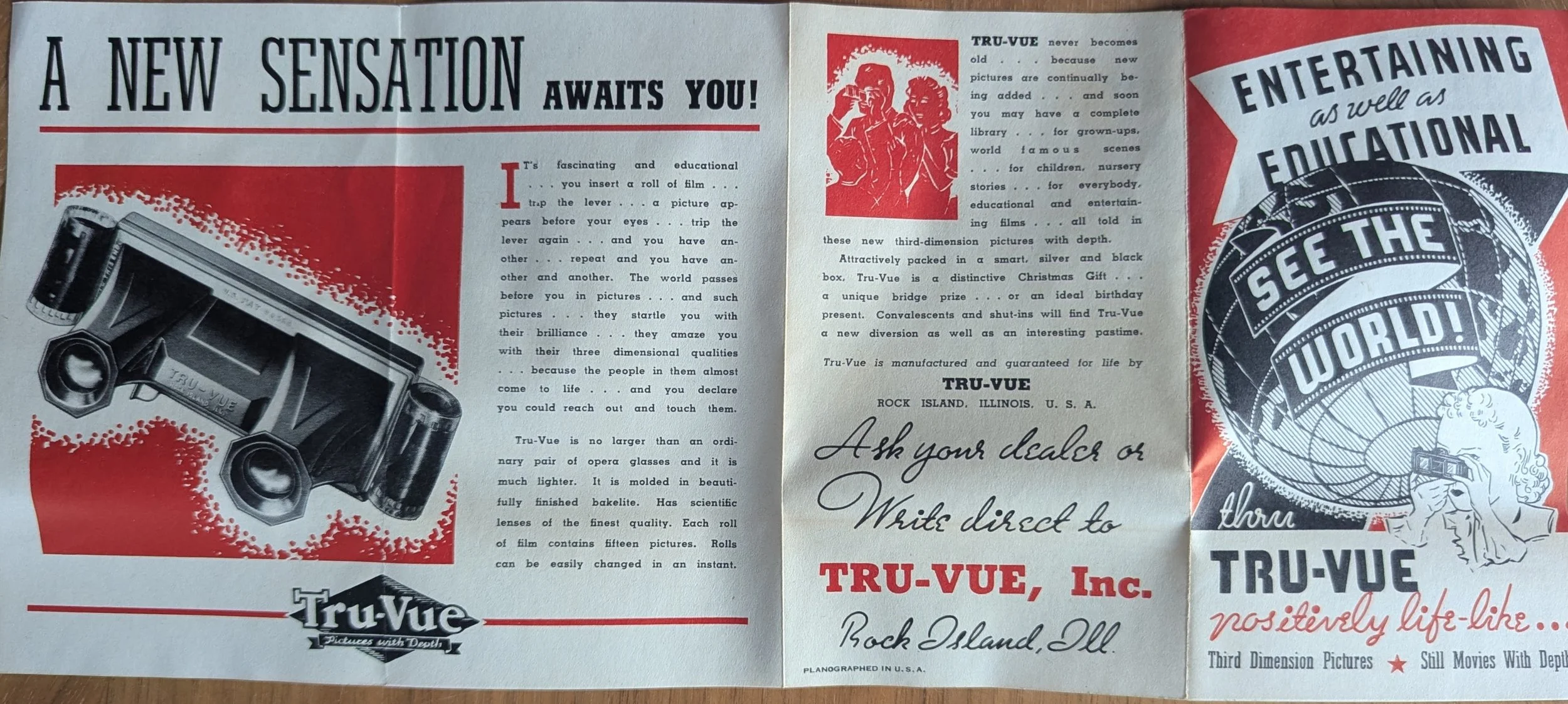
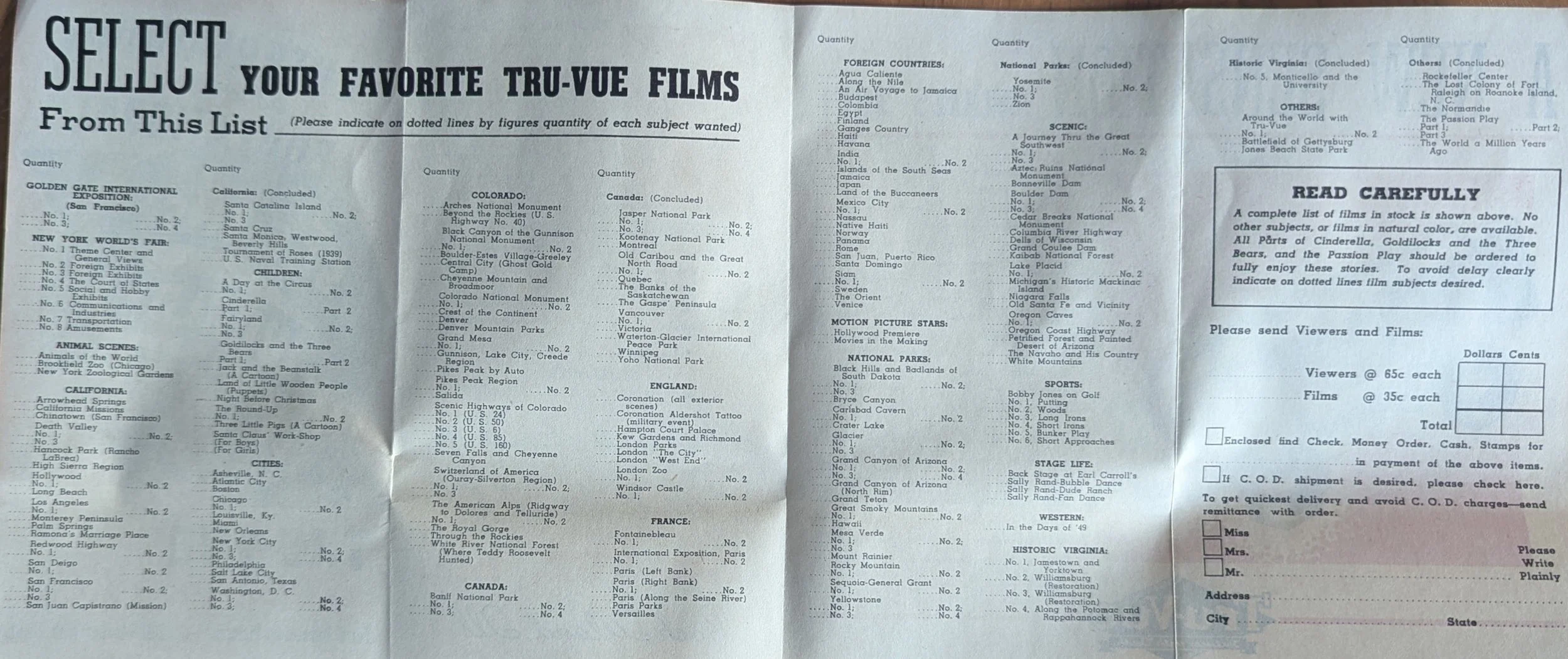
1930s Red-Black-White Tru-Vue Film Brochure
This early film brochure was included in wooden library cases. It continues to show the Art Deco viewer, the “See the World!” globe design, and “positively life-like” slogan. They also continue to say that no other film subjects are available but additionally state that “films in natural color” are not available. This brochure introduces filmstrips for Canada.
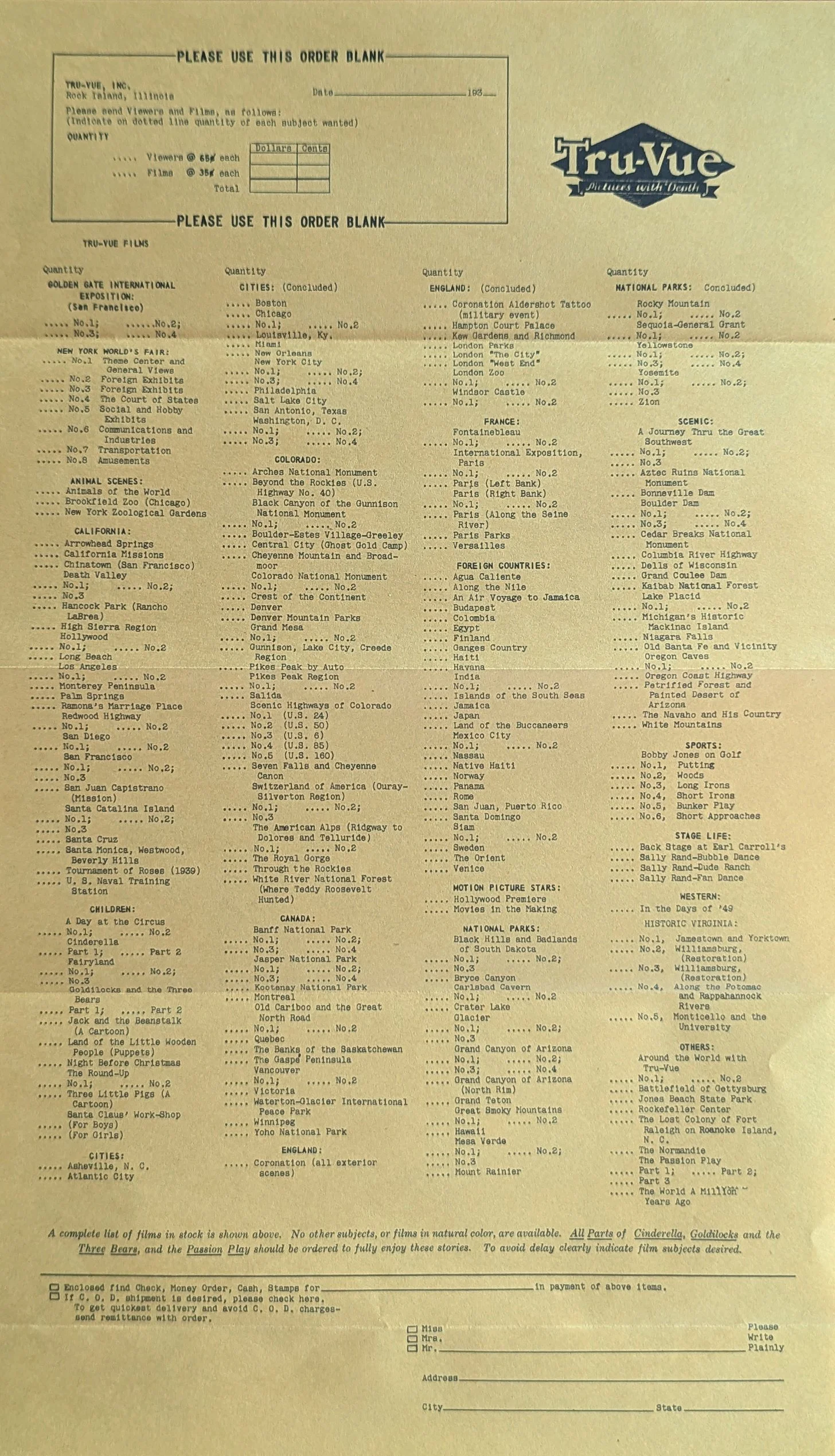
1930s Large Gold Sheet Film List
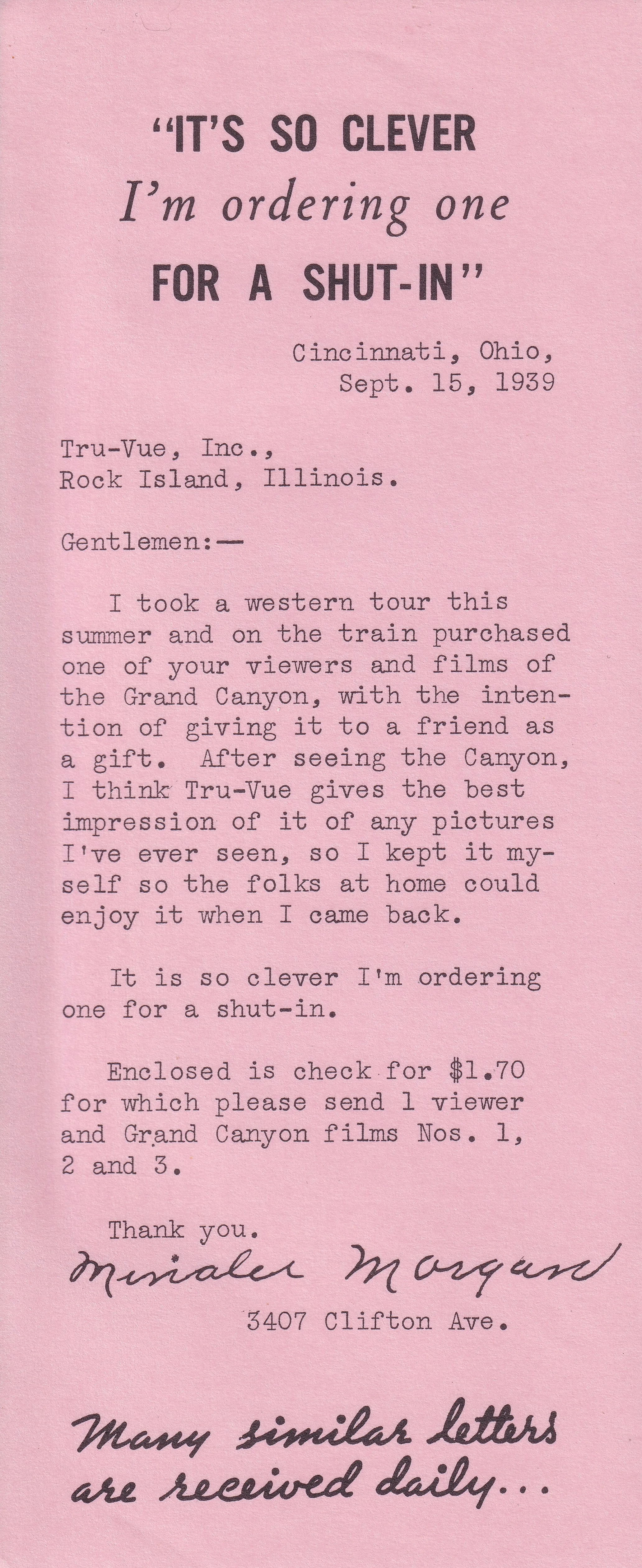
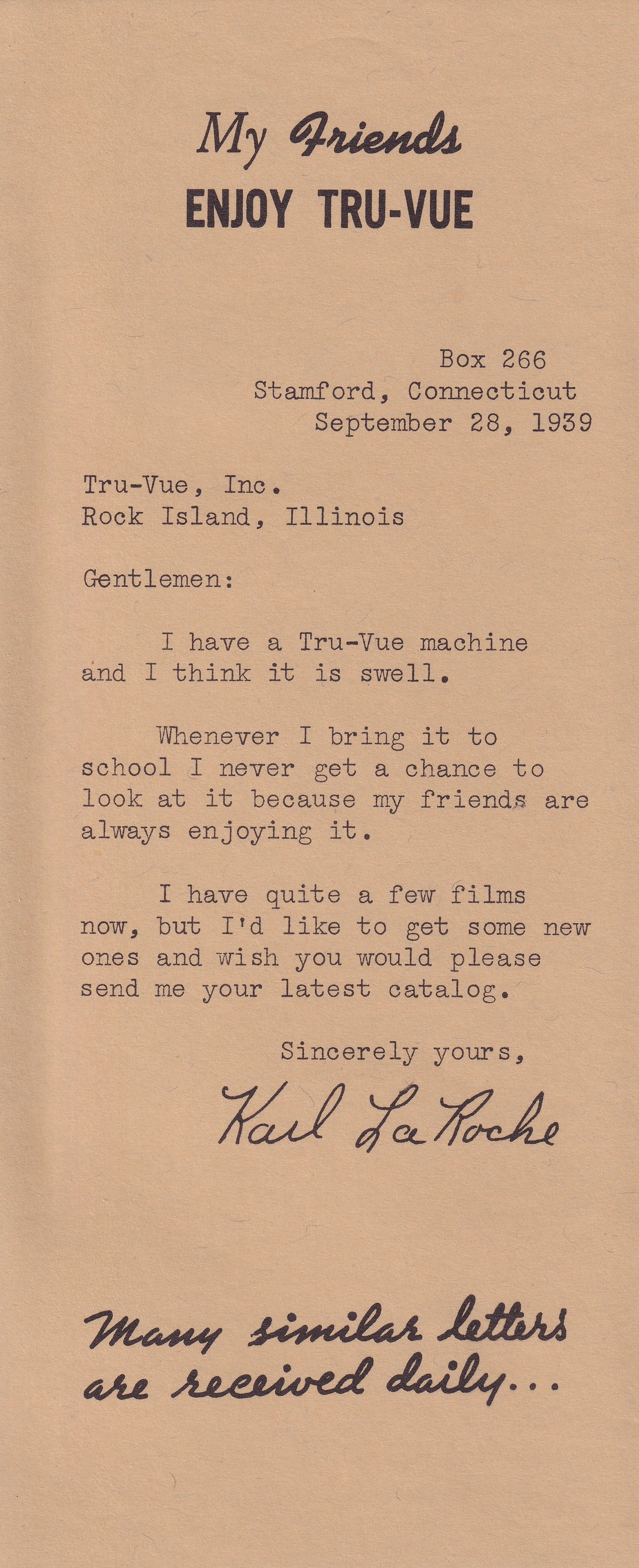
1930s “Customer Letters” as Promotion — Individual Inserts
The mail inserts appear to show actual letters from happy Tru-Vue customers.
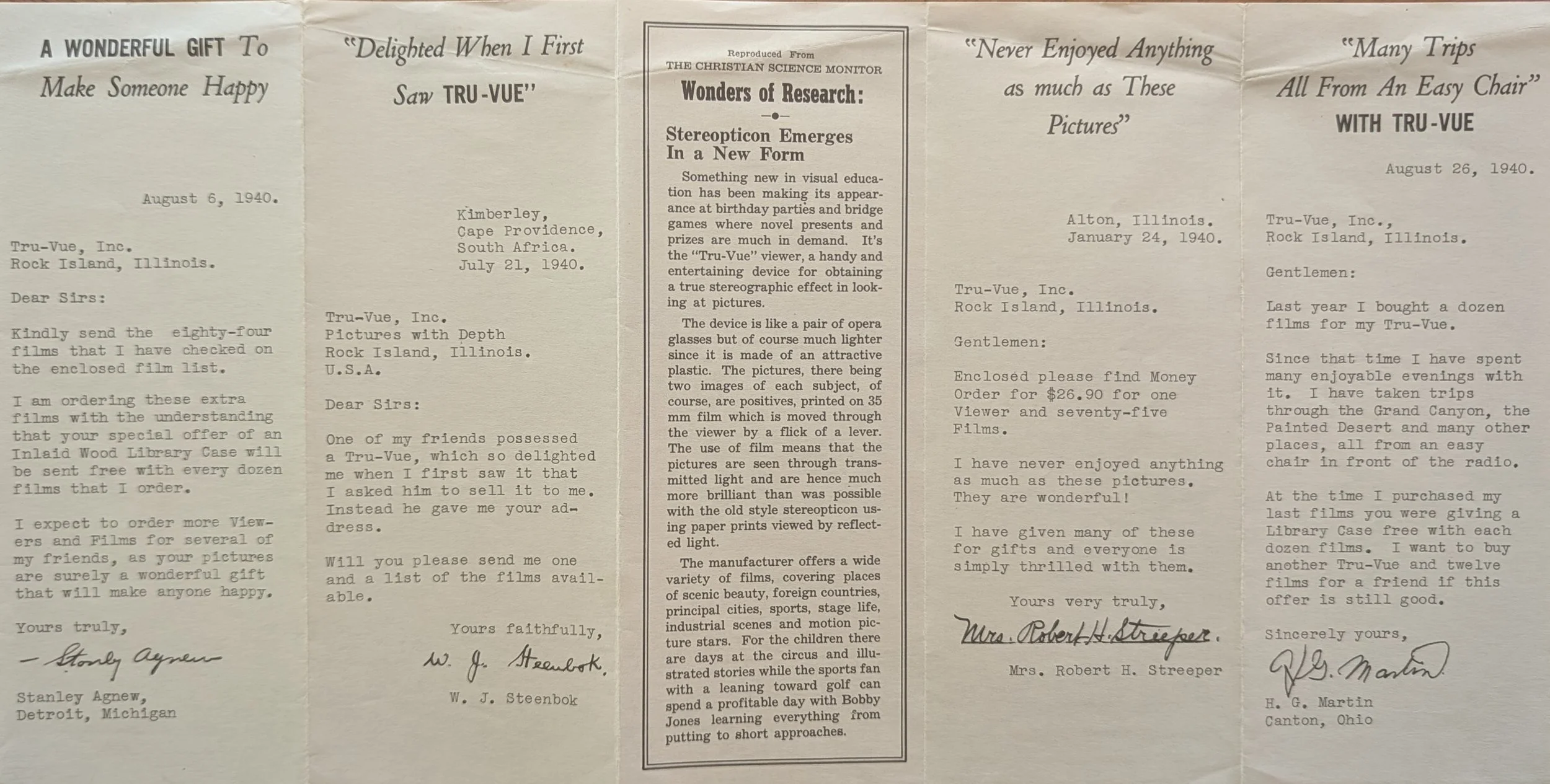
1940s “Customer Letters” as Promotion — Brochure
This 5-panel brochure has more customer letters as well as an article reproduced from The Christian Science Monitor.
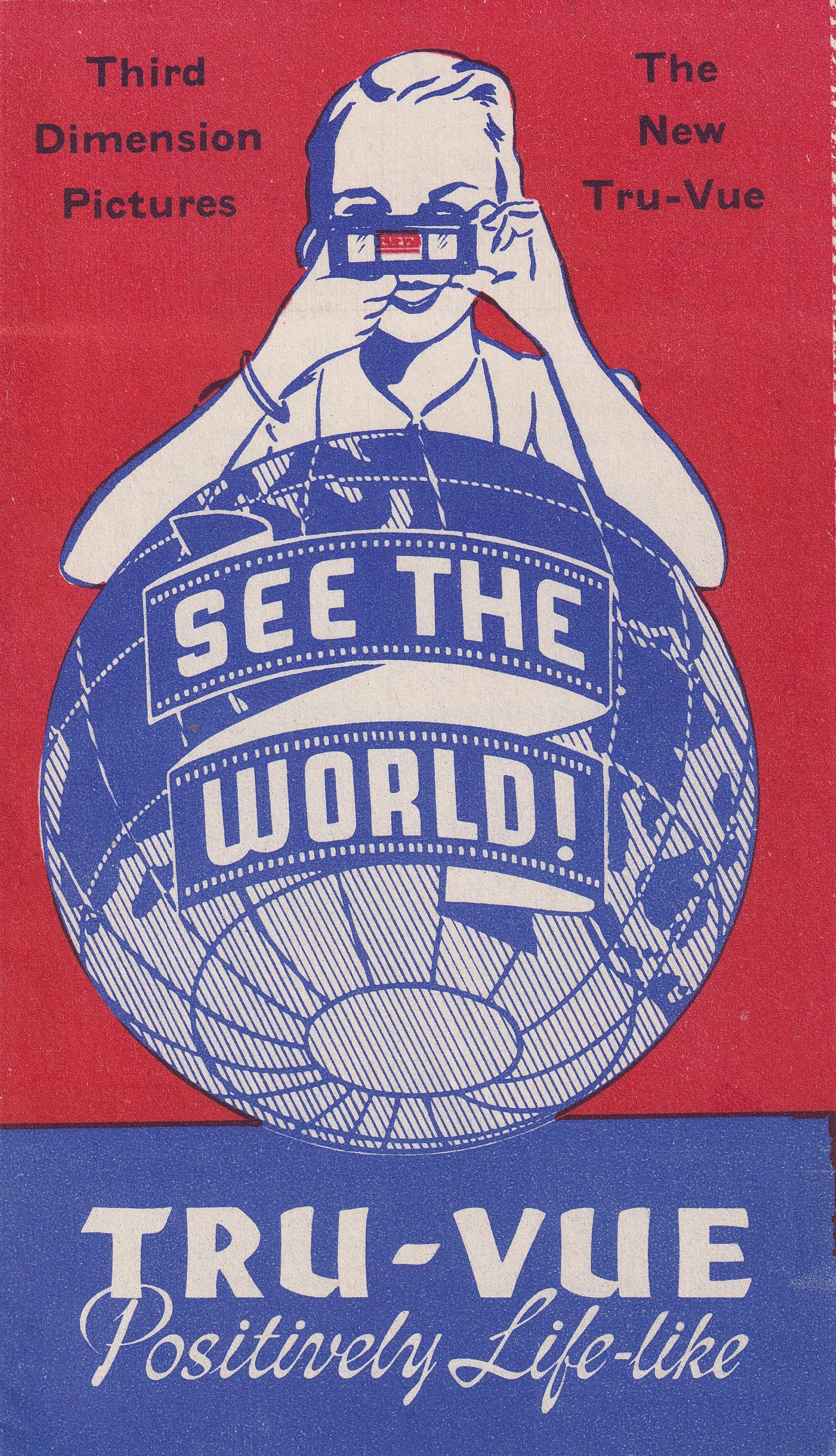
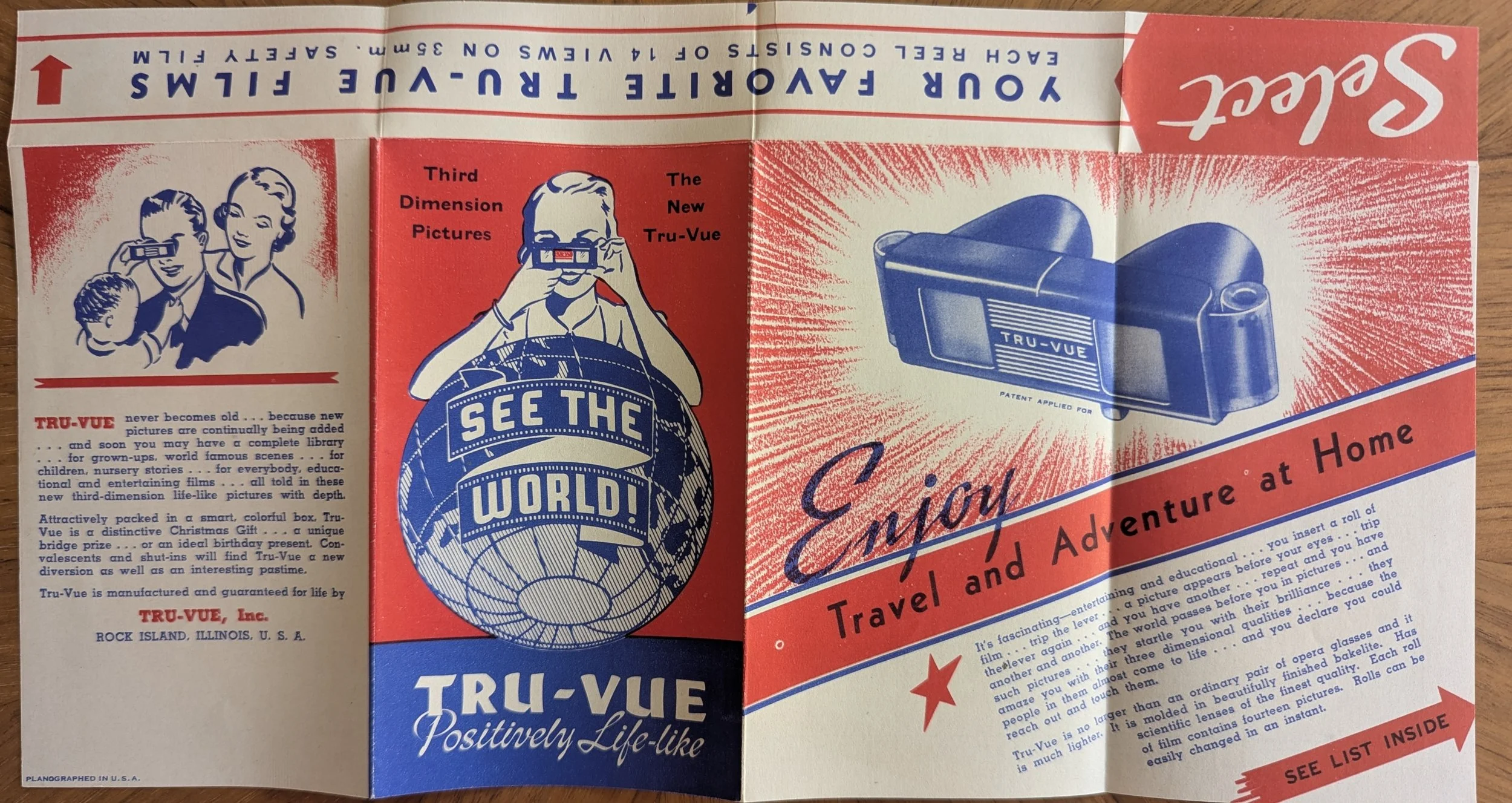
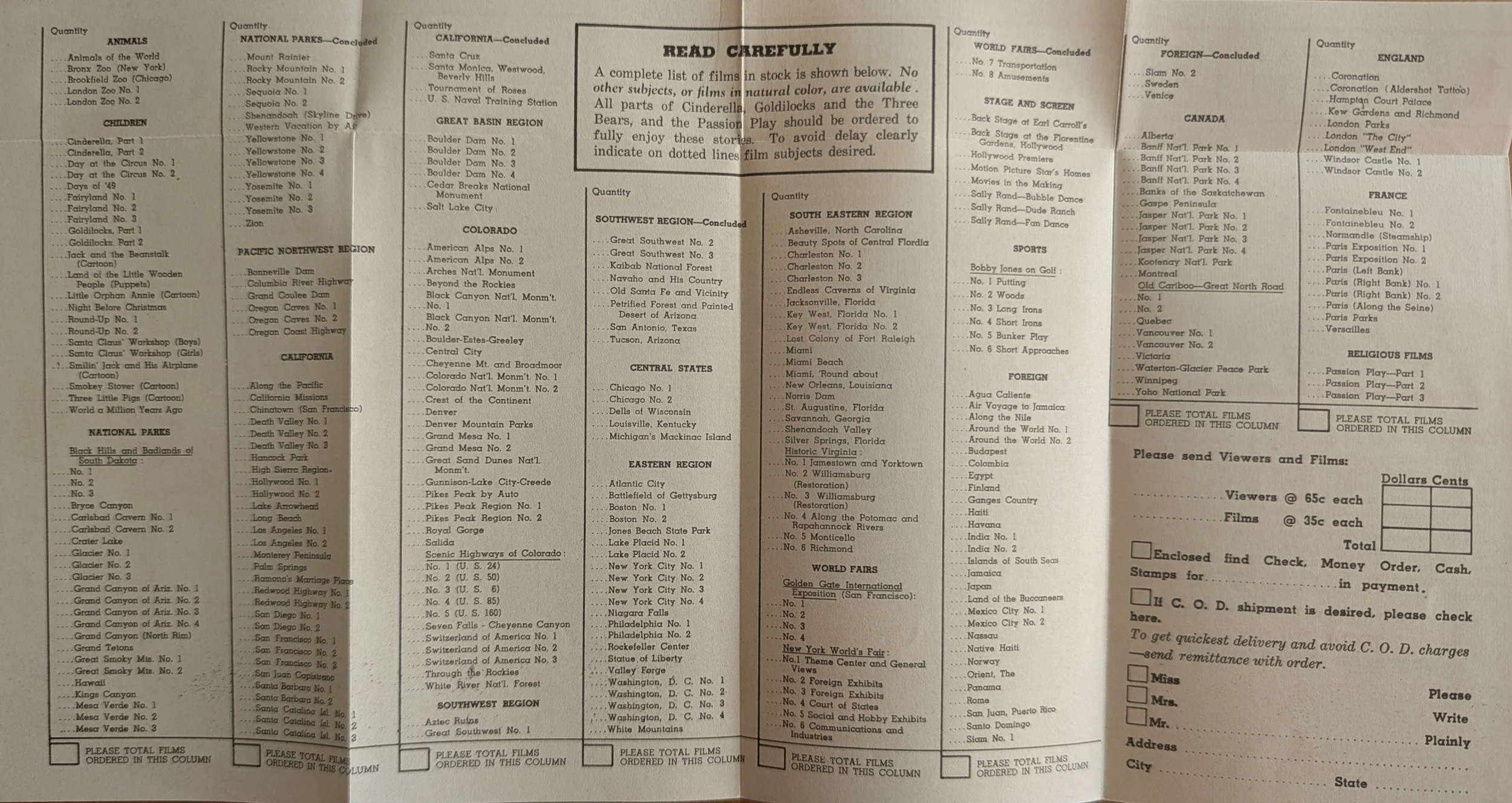
1940s Red-White-Blue Tru-Vue Film Brochure
The biggest change in this brochure is the viewer pictured: the new single-color streamlined Tru-Vue. Interestingly, the standard Tru-Vue logo is missing.
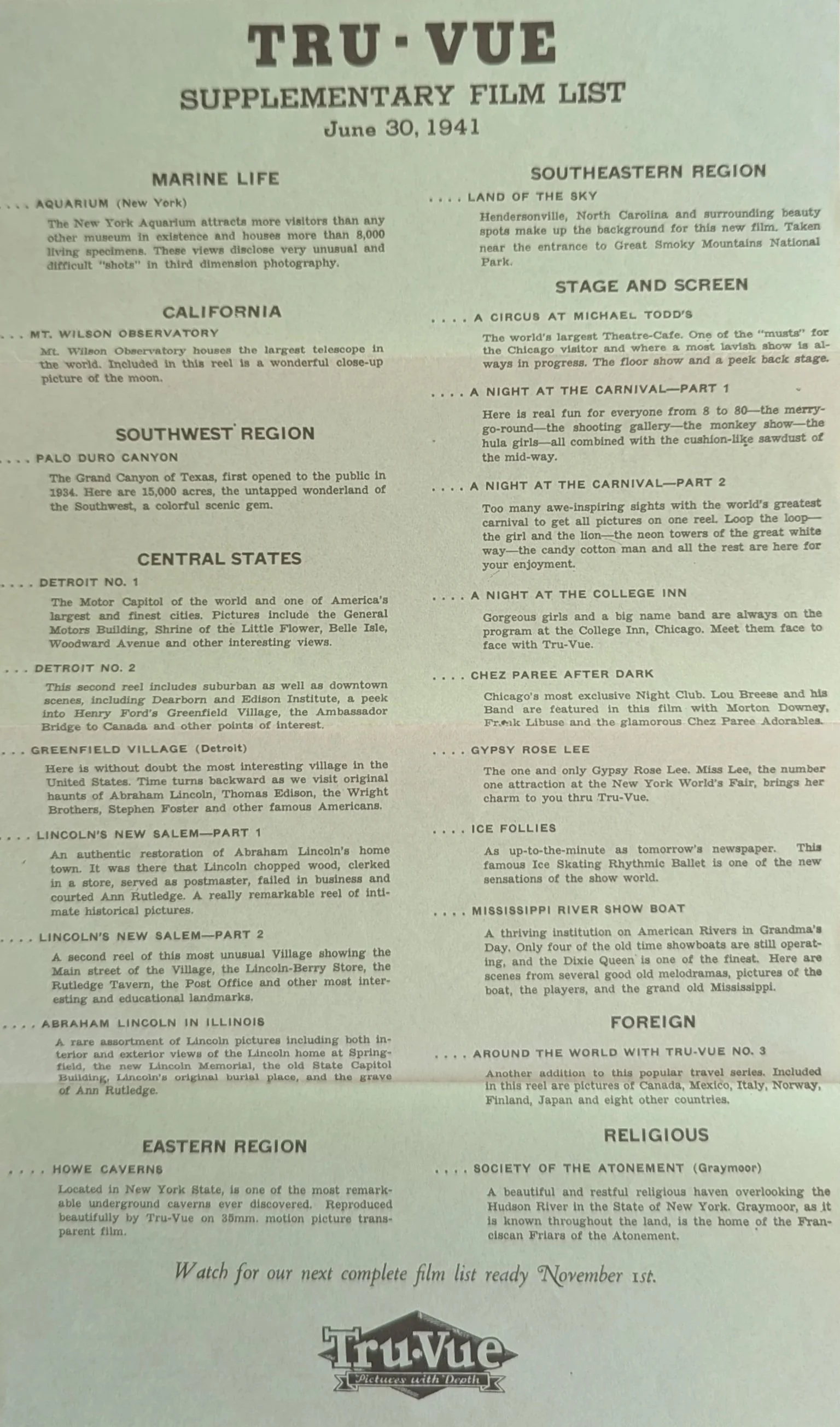
June 1941 Supplementary Film List
This enclosure promotes new film titles that hadn’t yet made it to the official film list brochure.
The Stage and Screen category had the most new additions with the popular, harder-to-find, collector favorites: A Circus at Michael Todd’s, A Night at the Carnival, A Night at the College Inn, Chez Paree After Dark, Gypsy Rose Lee, Ice Follies, and Mississippi River Show Boat.
Design-wise, it’s plain, but it does have the standard Tru-Vue logo.
Updated 1940s Red, White, & Blue Tru-Vue Film Brochure
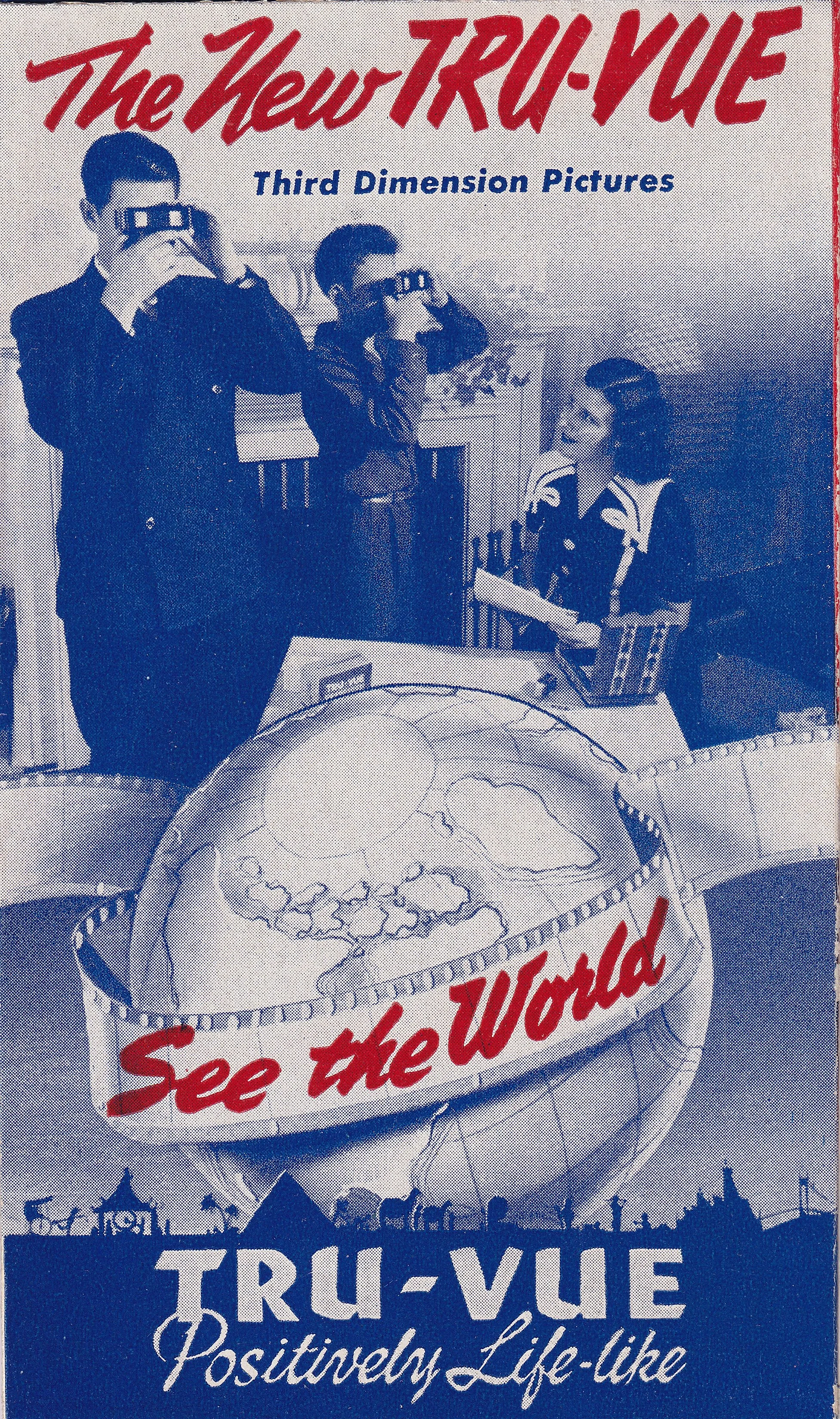
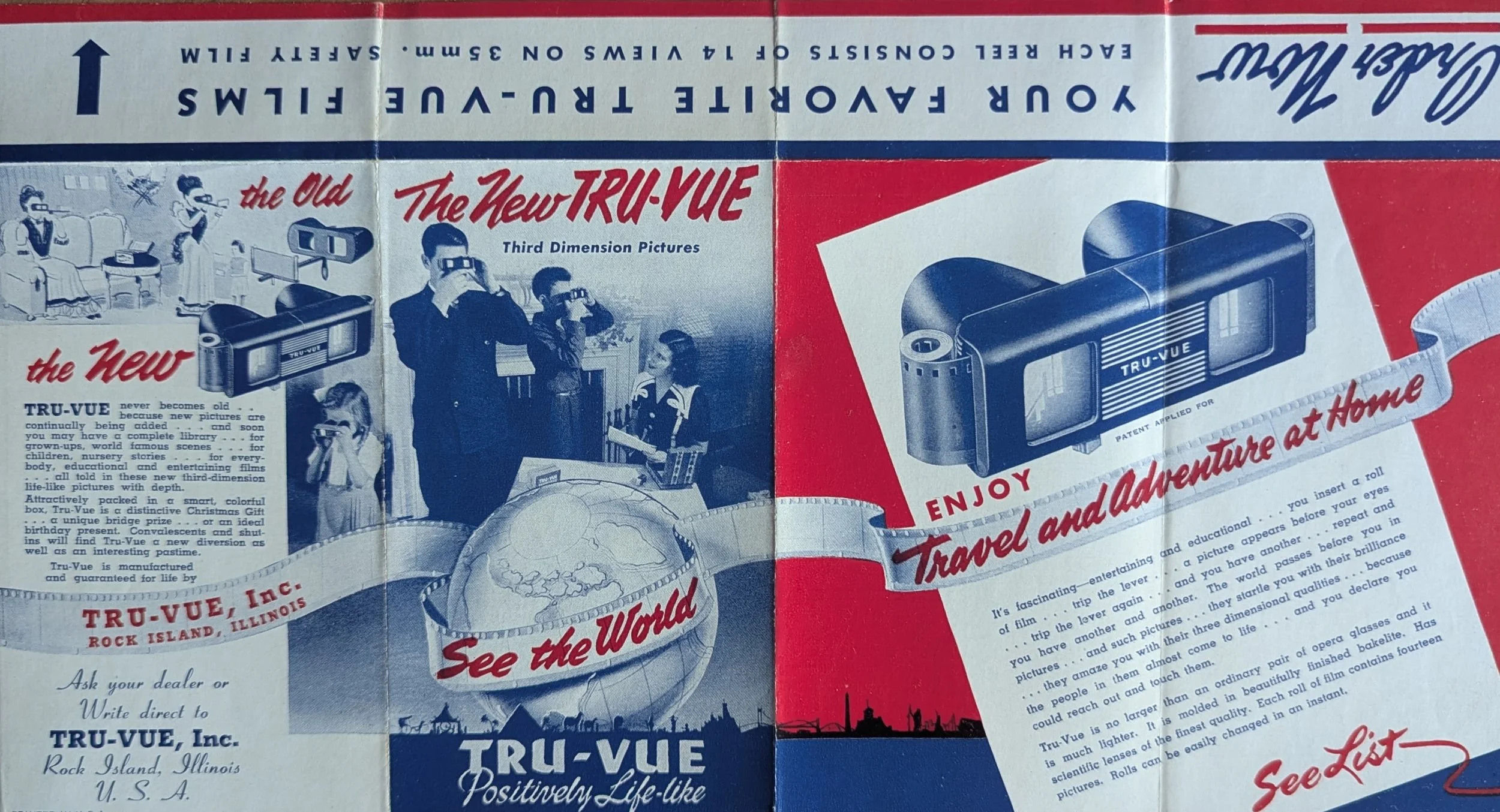
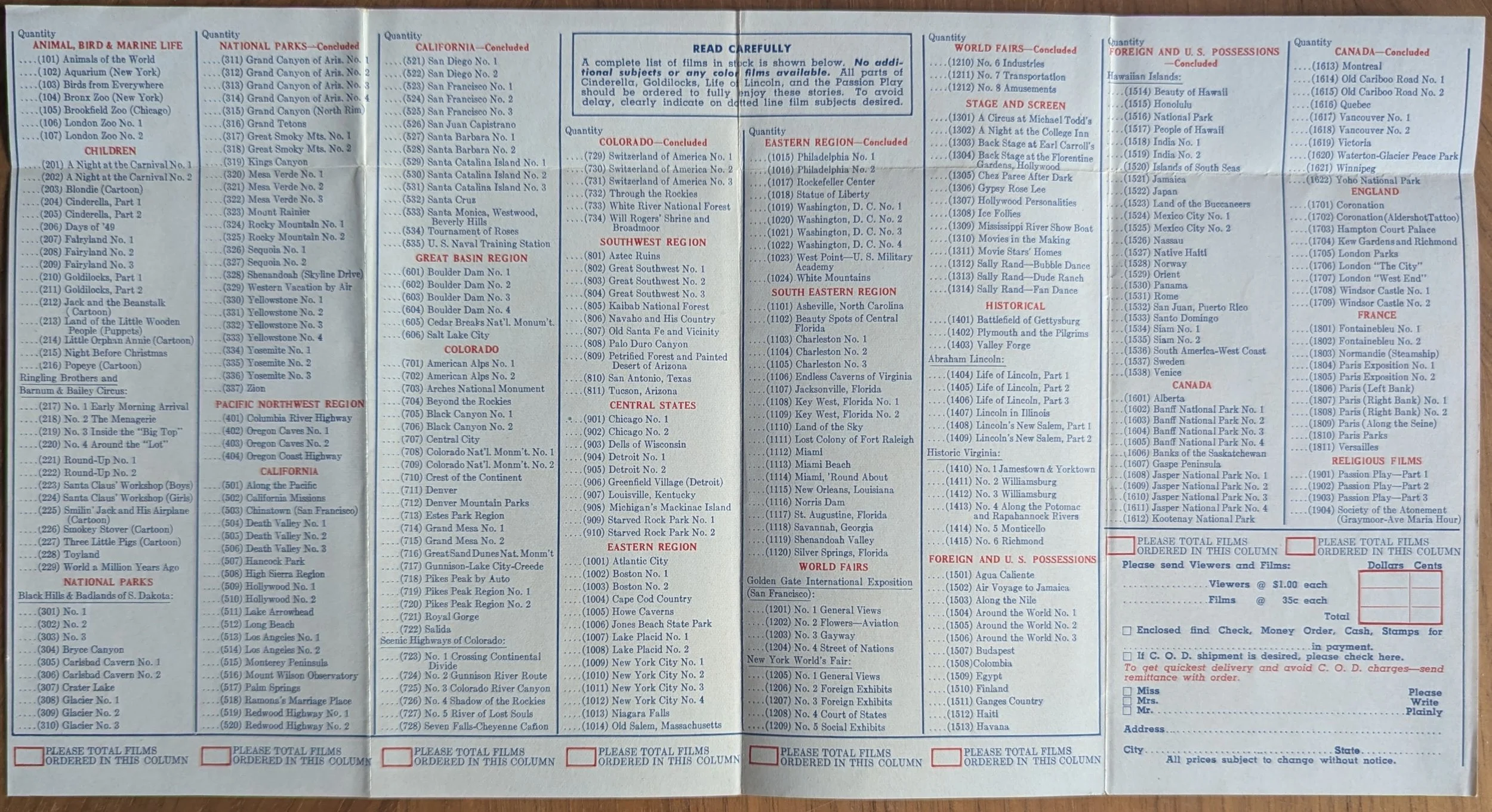
This updated brochure still shows the single-color streamlined Tru-Vue viewer, but now promotes “The New Tru-Vue.” The biggest changes in this more modern-looking film brochure are the addition of filmstrip numbers, an updated “See the World” globe design and font, and real photos of people using the Tru-Vue. And note the inclusion of the inlaid wooden library case.
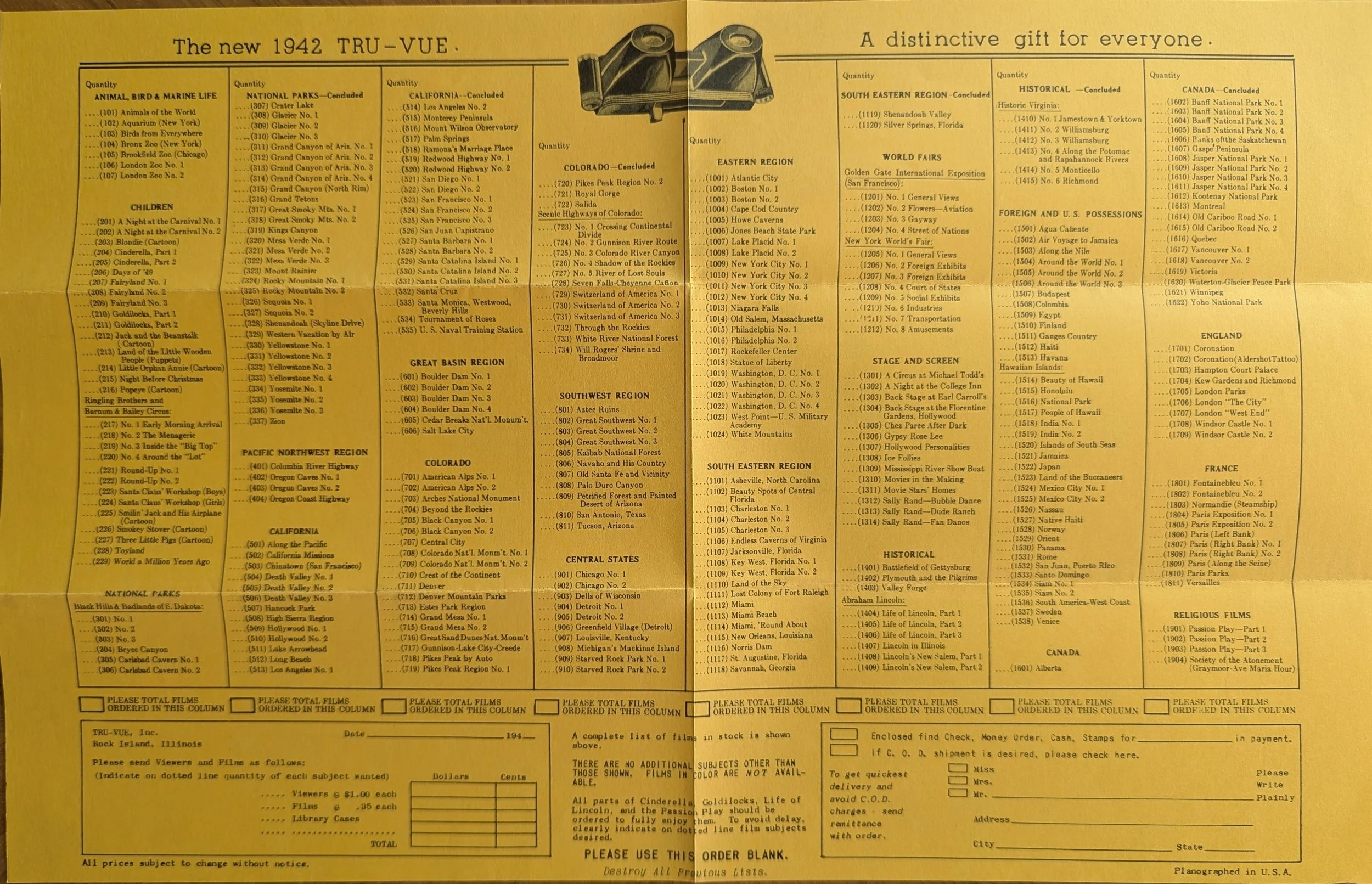
“The New 1942 Tru-Vue” Gold Film List
This order form, printed on a large sheet of plain gold paper, shows the single-color streamlined Tru-Vue viewer while promoting that Tru-Vue is “a distinctive gift for everyone.” It has the standard text letting readers know this is a complete listing of what’s in stock and that no other films are available. A note at the very bottom says “destroy all previous lists.”
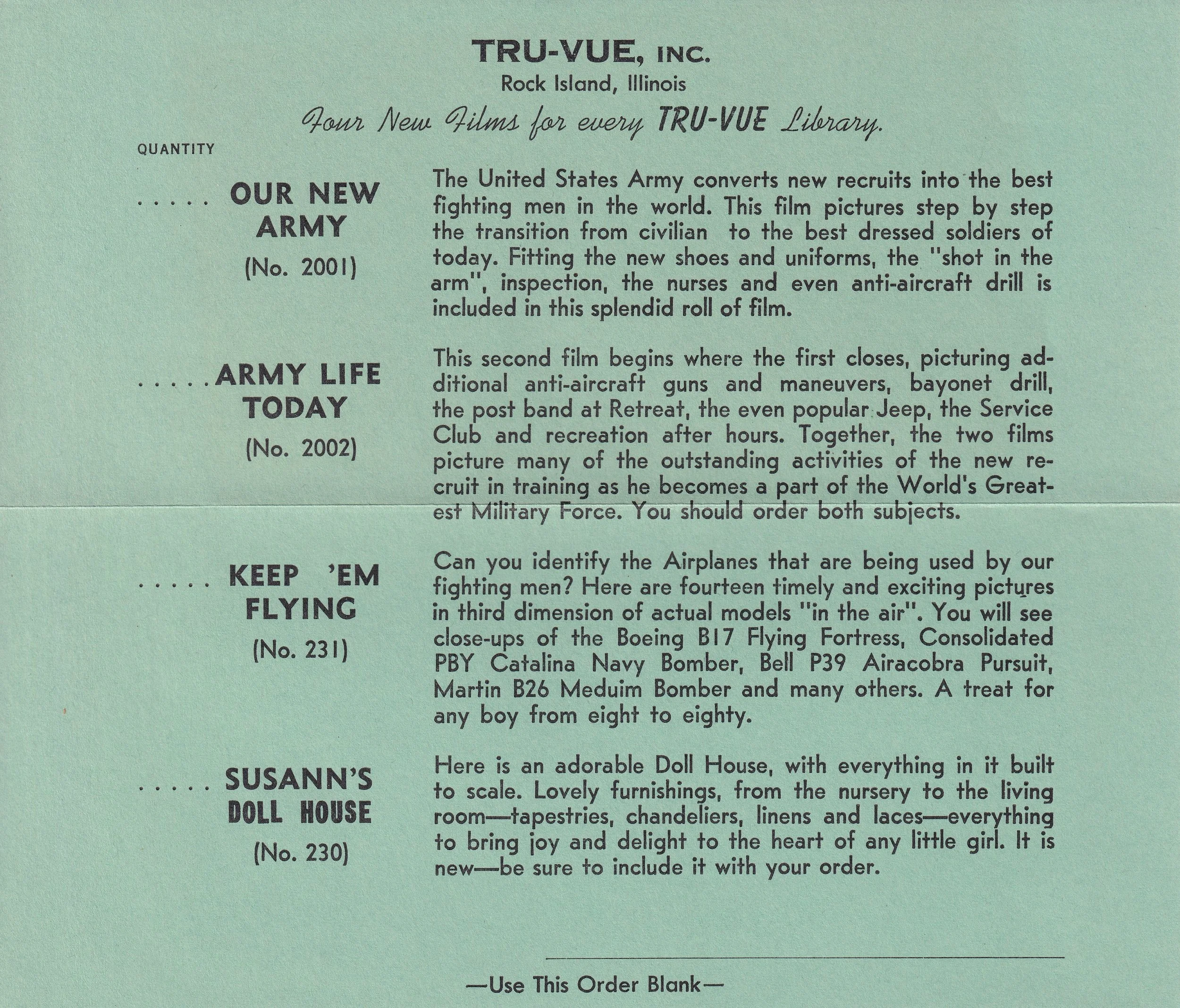
Supplementary Film List
This undated supplementary list, printed on plain green paper, promotes 4 new films that hadn’t yet made it to the official film brochure.
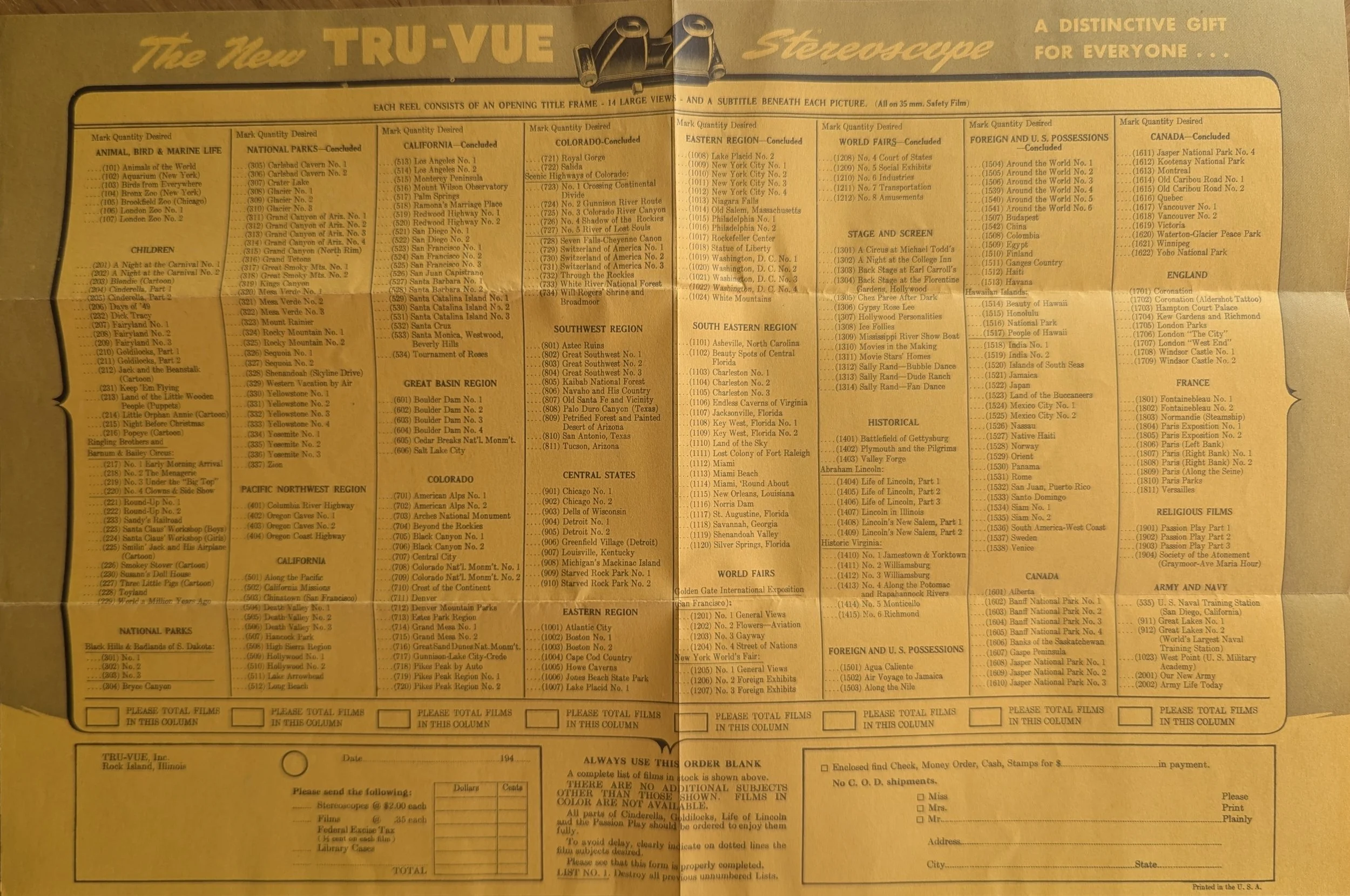
Updated Gold Film List
This gold-colored film list continues the promotion that Tru-Vue is “a distinctive gift for everyone” but has more design to it than the previous gold-colored list. It asks that you “destroy all previous unnumbered lists.”
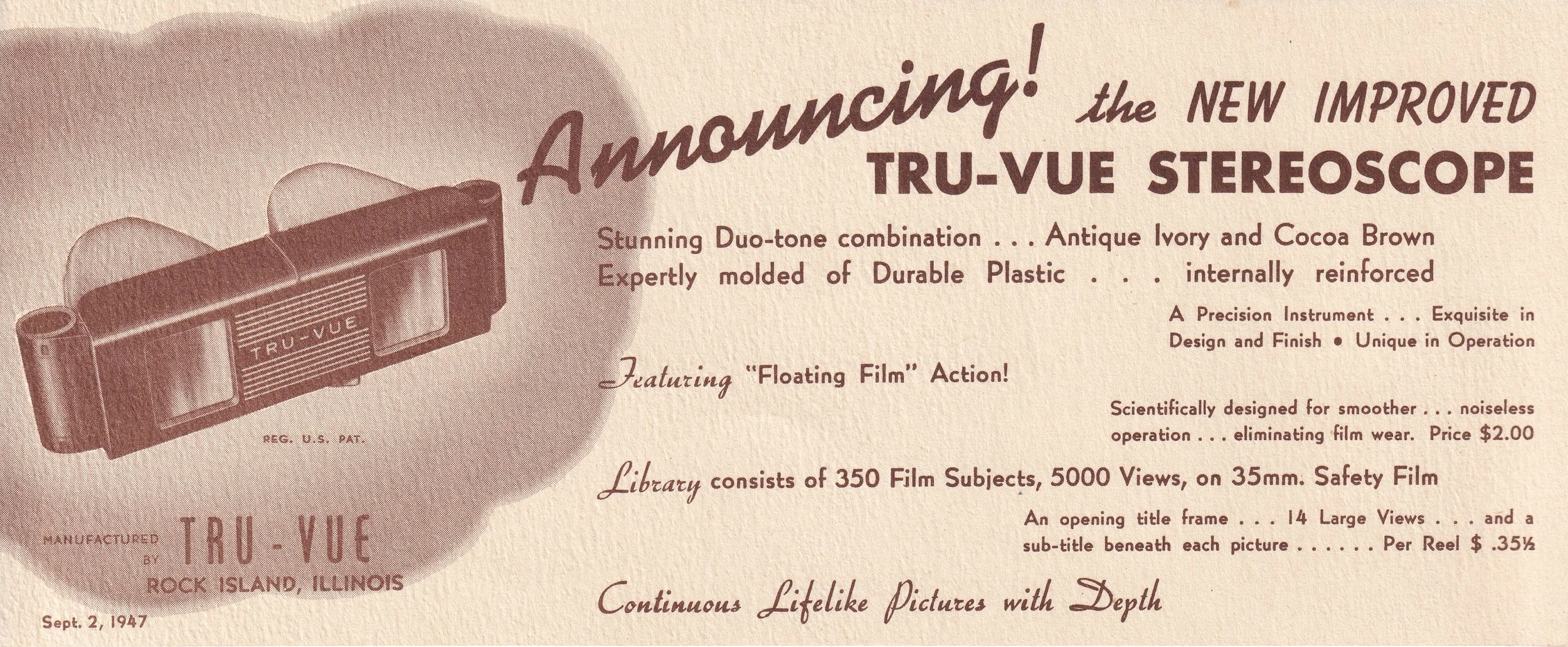
September 1947 Promotional Enclosure
This special enclosure announces the “stunning duo-tone” Tru-Vue viewer in antique ivory and cocoa brown. It’s touted as “a precision instrument … exquisite in design and finish” and “scientifically designed.” We can see the patent is no longer pending and that it features “floating film” action.
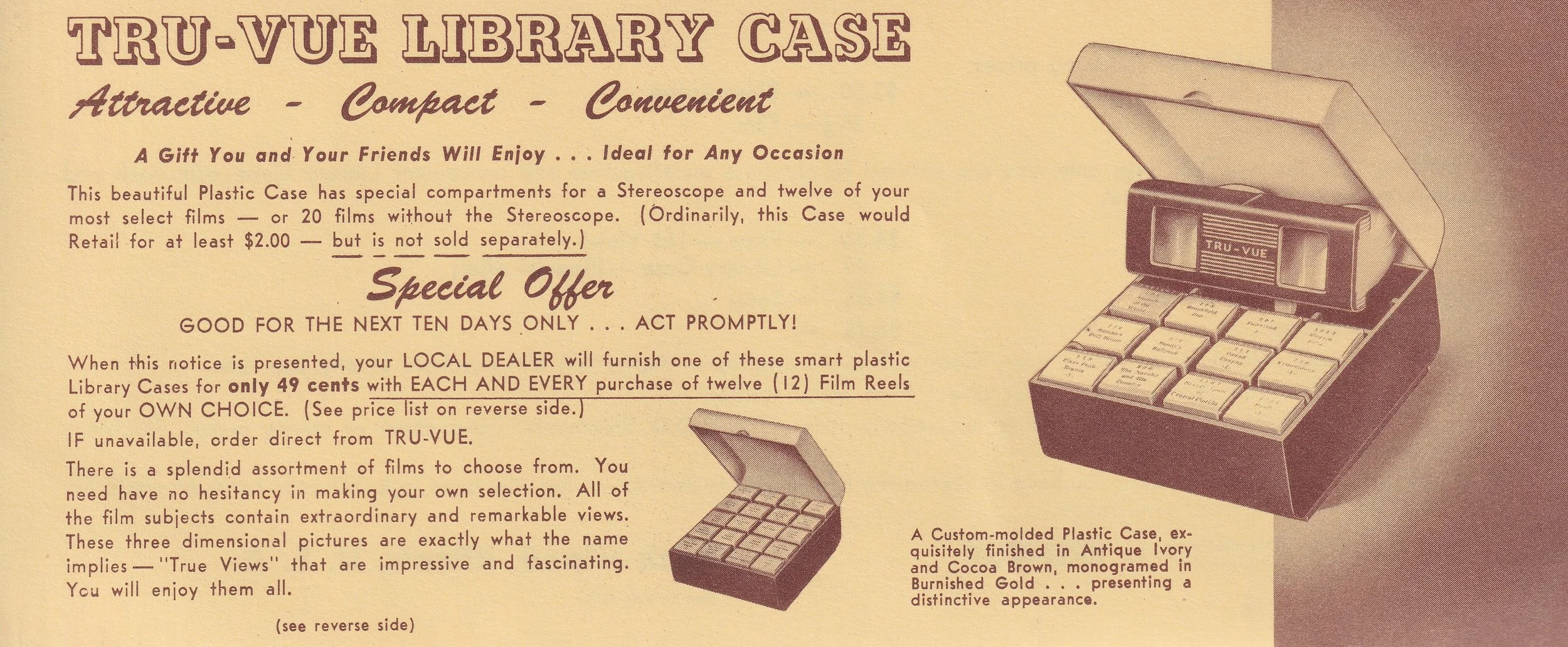
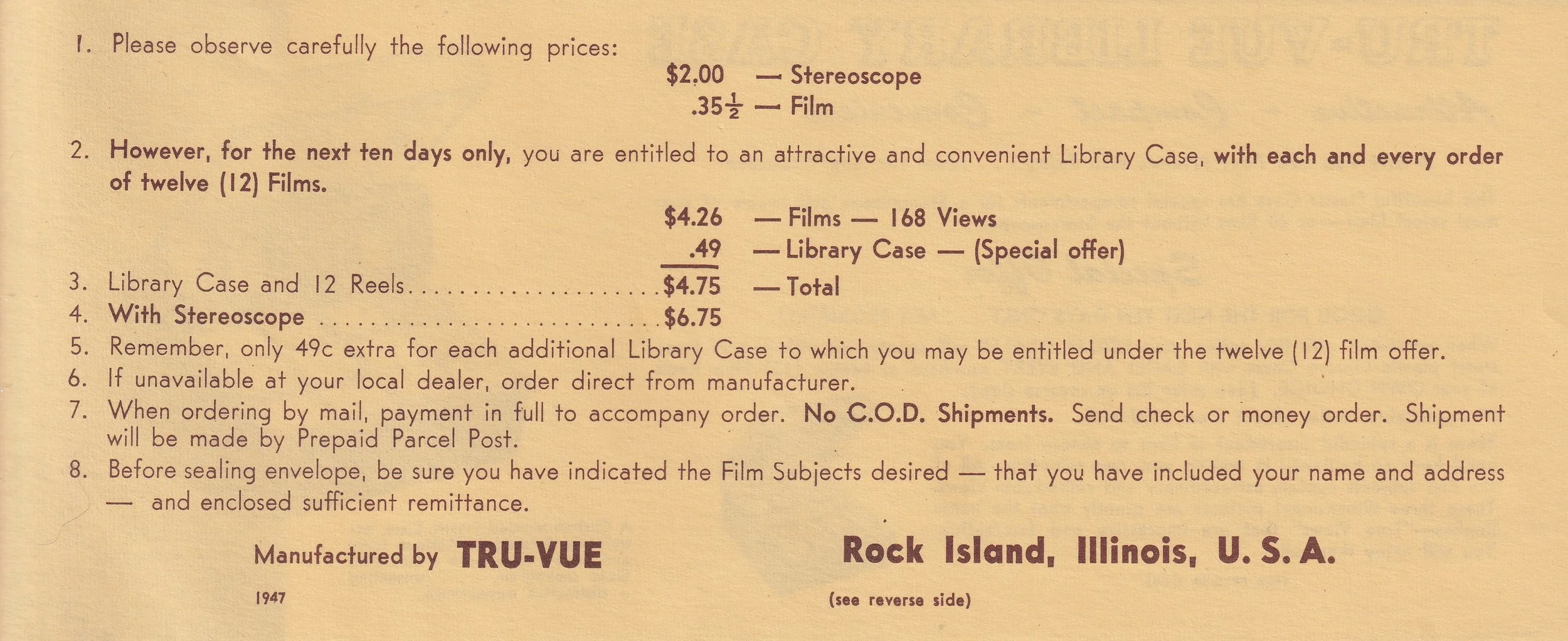
1947 Plastic Library Case Promotional Enclosure
This half-sheet enclosure promotes the new plastic library case. The case was designed in the same cocoa brown and ivory as the newest streamlined Tru-Vue viewer and could hold either 1 viewer and 12 films, or 20 films. The promotion uses classic “act-now” language by saying the special offer is good “for the next ten days only!” The sheet acted as a coupon — it had to be presented to a dealer to take advantage of the offer.
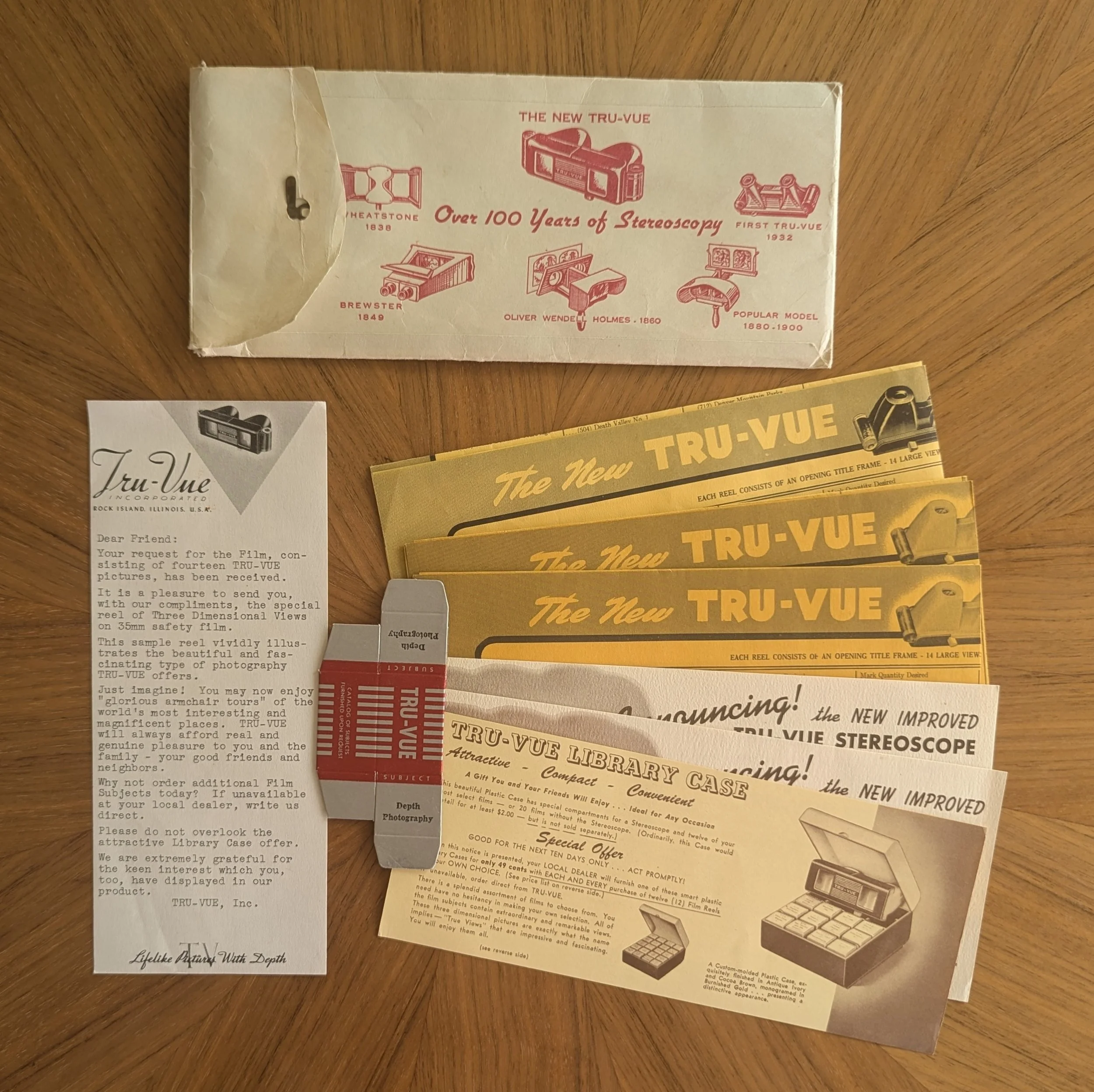
Late 1940s Correspondence Set
This correspondence set brings together several of the items shown above: two of the duo-tone viewer promotions, three of the better-designed gold film lists (note that two of them have the newer duo-tone cocoa brown & ivory viewer), and the plastic library case promotion. Additionally, it has a generic “Dear Friend” letter that indicates a sample film reel was included with the correspondence. A flattened Depth Photography film box was also included — it appears to have never been folded into its box shape. So perhaps the film roll was loose in the envelope, which was the non-standard side-opening kind with a metal clip.
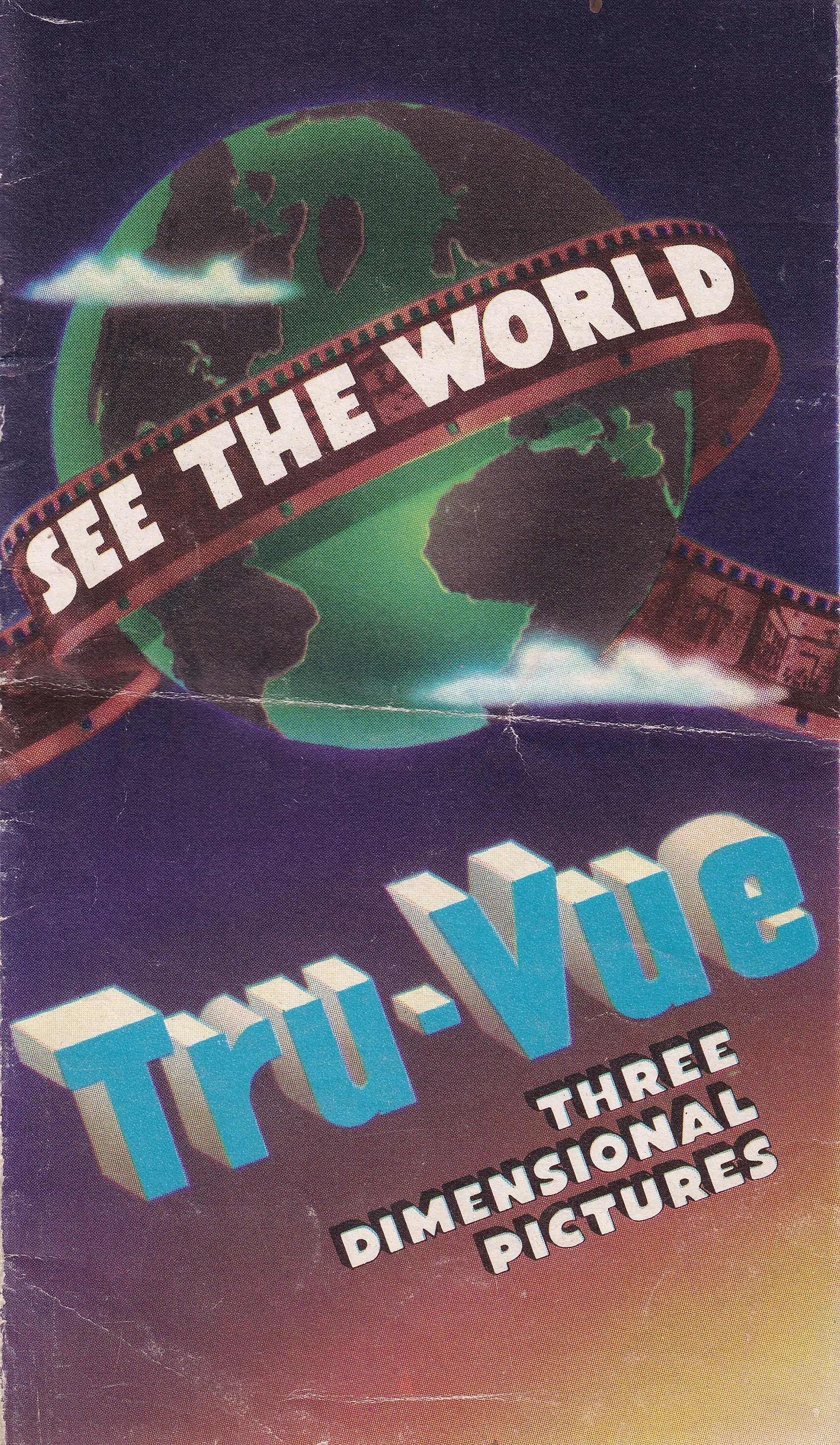
1940s Tru-Vue Film Brochure
This full-color promotional brochure introduced new graphic design elements from the gradient background to the updated “See the World” globe and font, and the “3D” block font used for the words “Tru-Vue.” It features the dutone cocoa brown & ivory viewer.
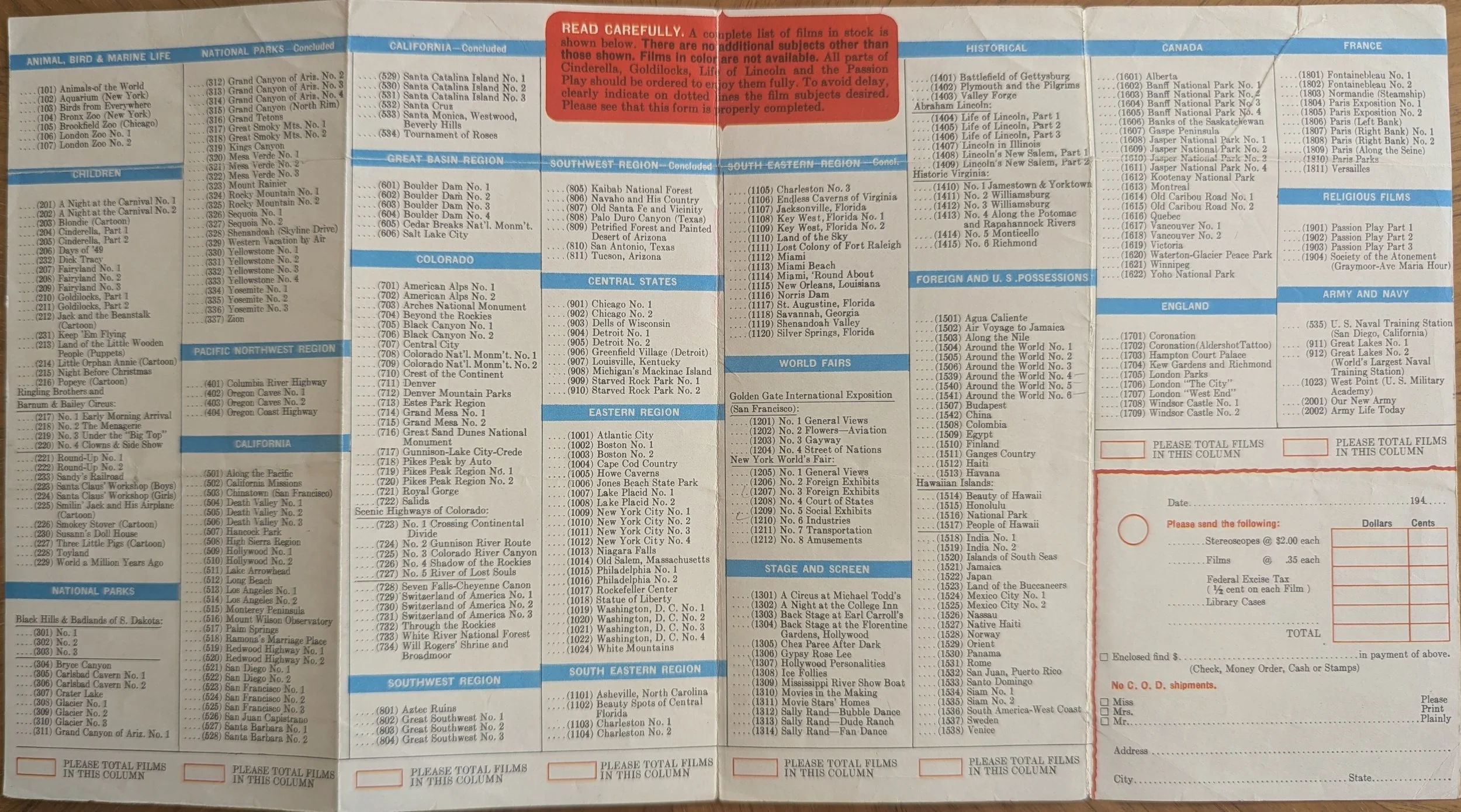
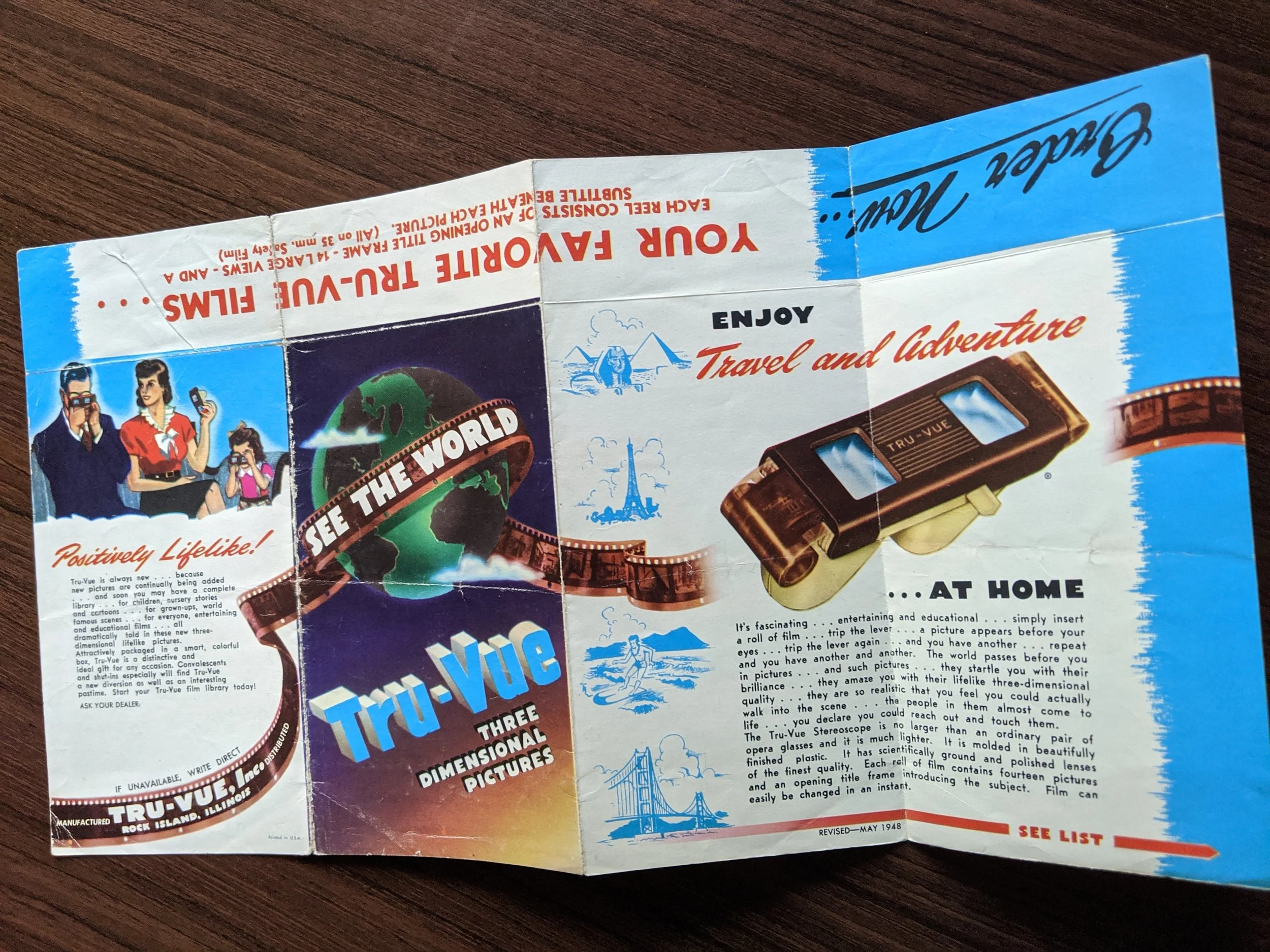
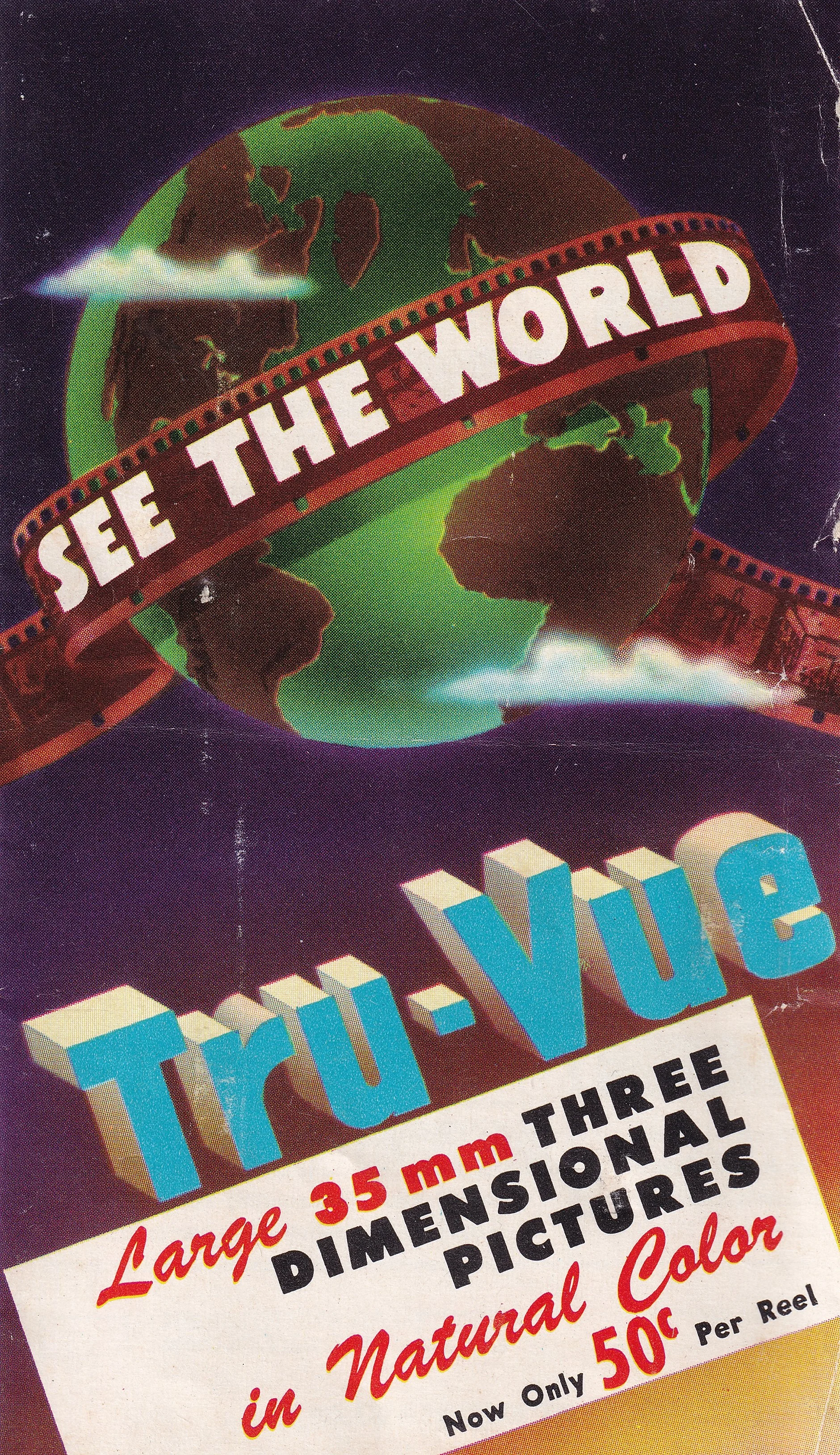
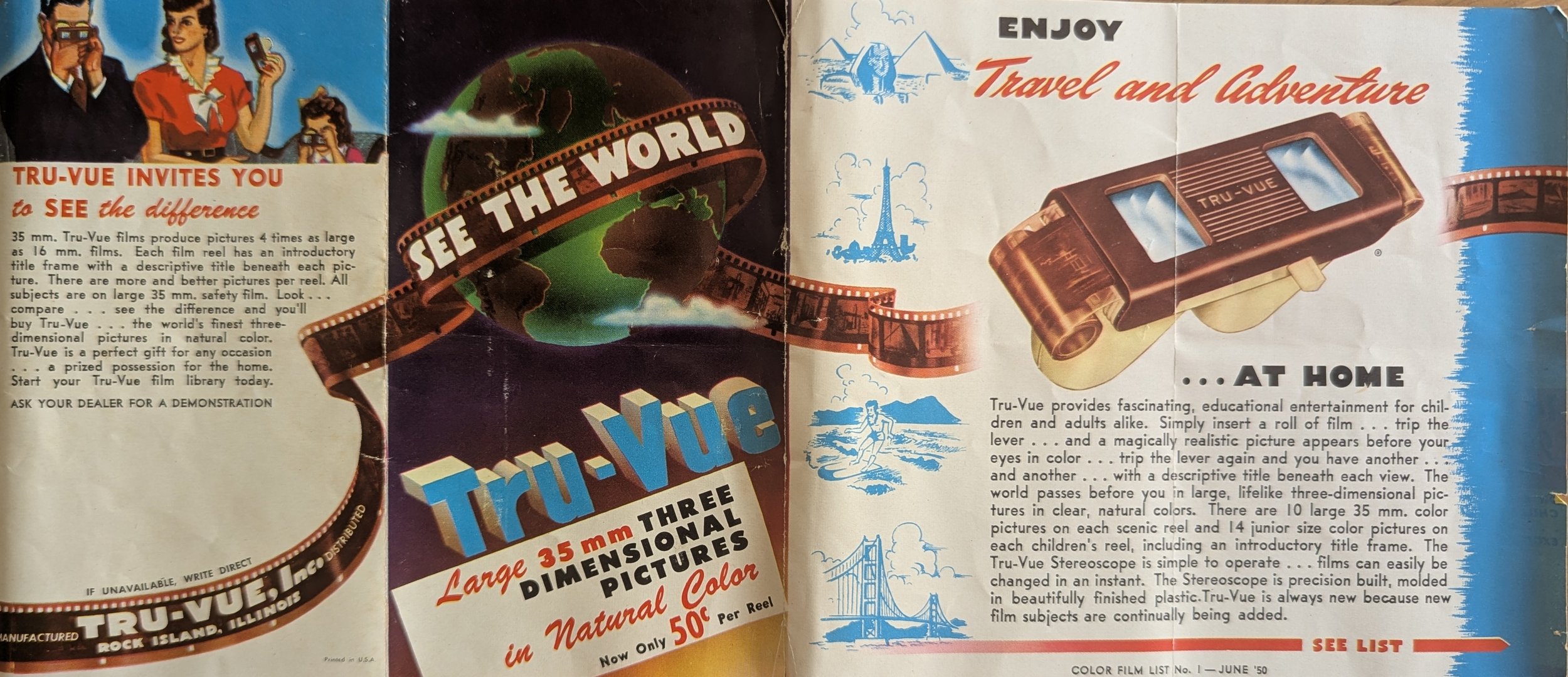
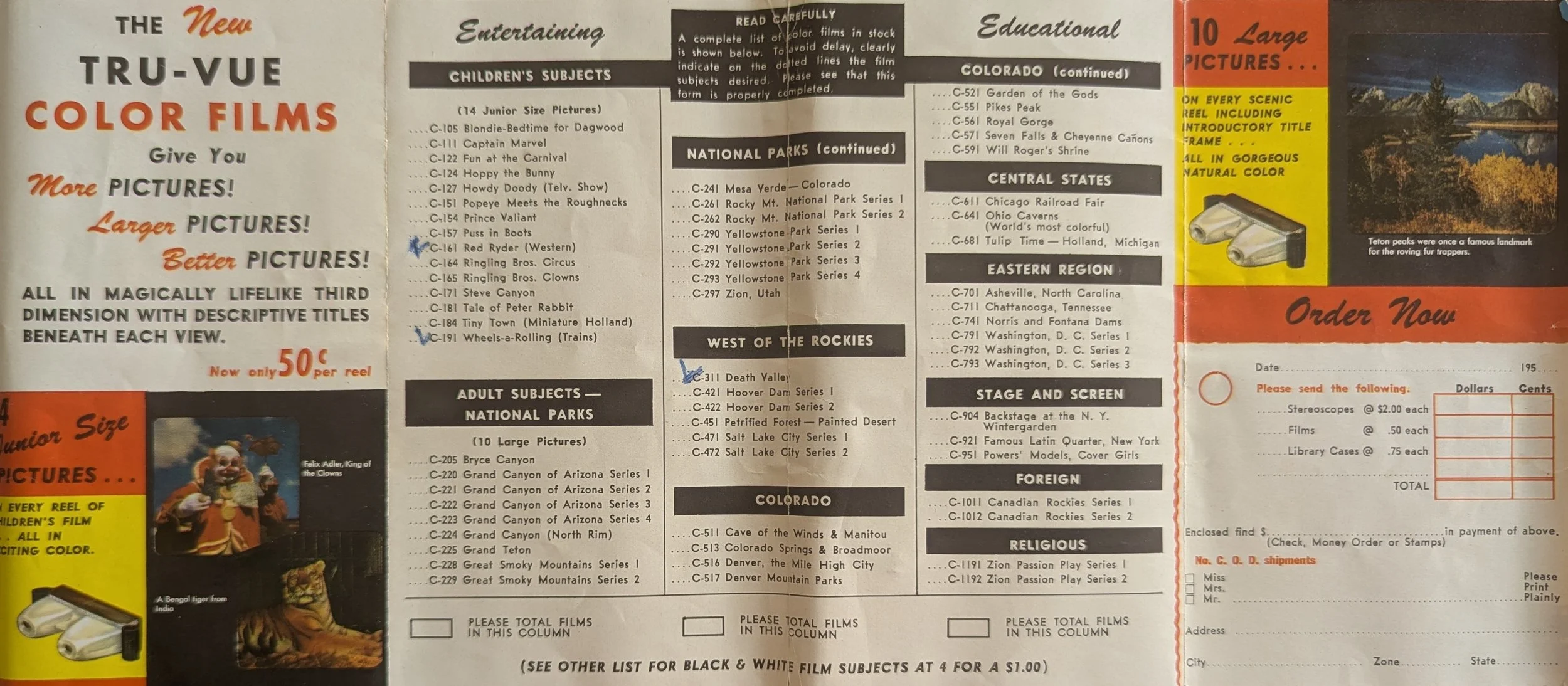
June 1950 Color Film List Brochure
This brochure is designed similarly to the one above but lists only color films. These color films, previously $1.00 each, are now being sold for only 50 cents. A 75-cent price is now listed for the library cases. This brochure also includes an actual image from one of the filmstrips.
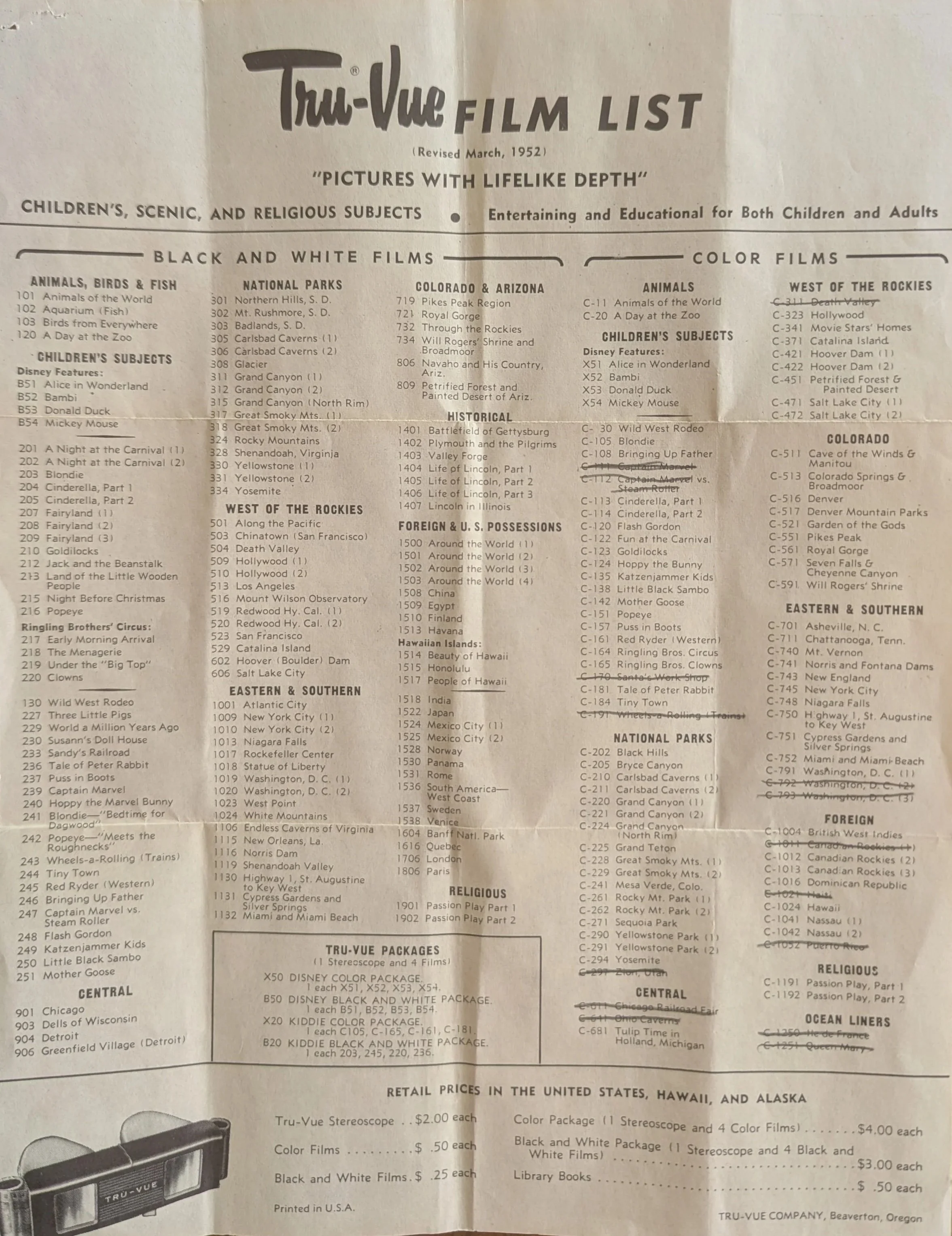
1952 Combination B&W and Color Film List
This promotional film list was published after the 1951 sale of Tru-Vue to Sawyer’s. It has the new Tru-Vue logo and shows the new Beaverton, Oregon, location.
In addition to listing both black & white and color films, we can see the promotion of four stereoscope+film packages:
Disney Color Package
Disney Black and White Package
Kiddie Color Package
Kiddie Black and White Package
Also, note the decrease in price for the black-and-white filmstrips — they’re now 25 cents instead of 35 cents. This price reduction further reflects Tru-Vue’s move away from black-and-white 3D and was likely a good way to reduce its stock. The color films are still at the previously reduced price of 50 cents.
Post-Sawyer’s Purchase Correspondence Set
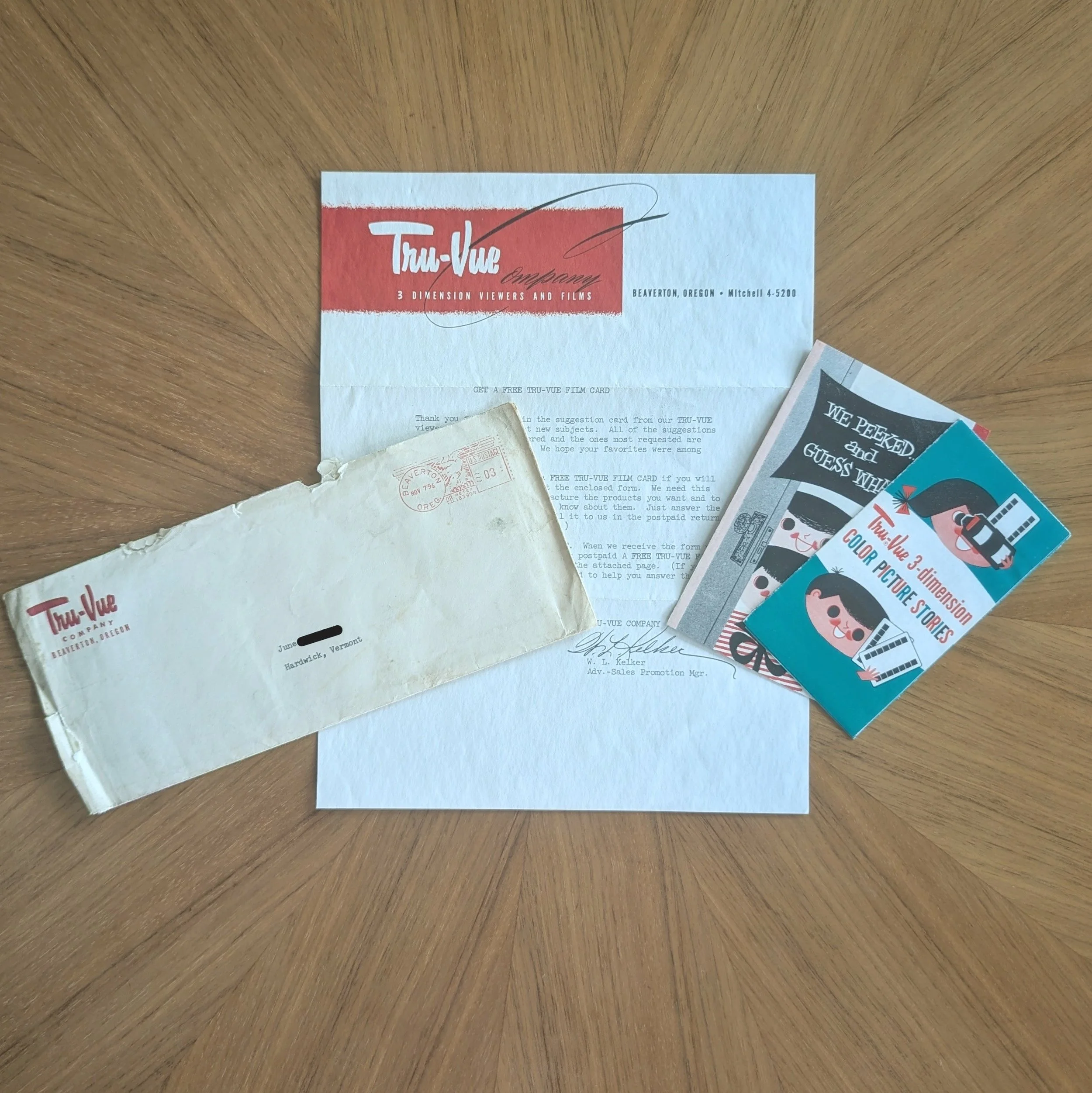
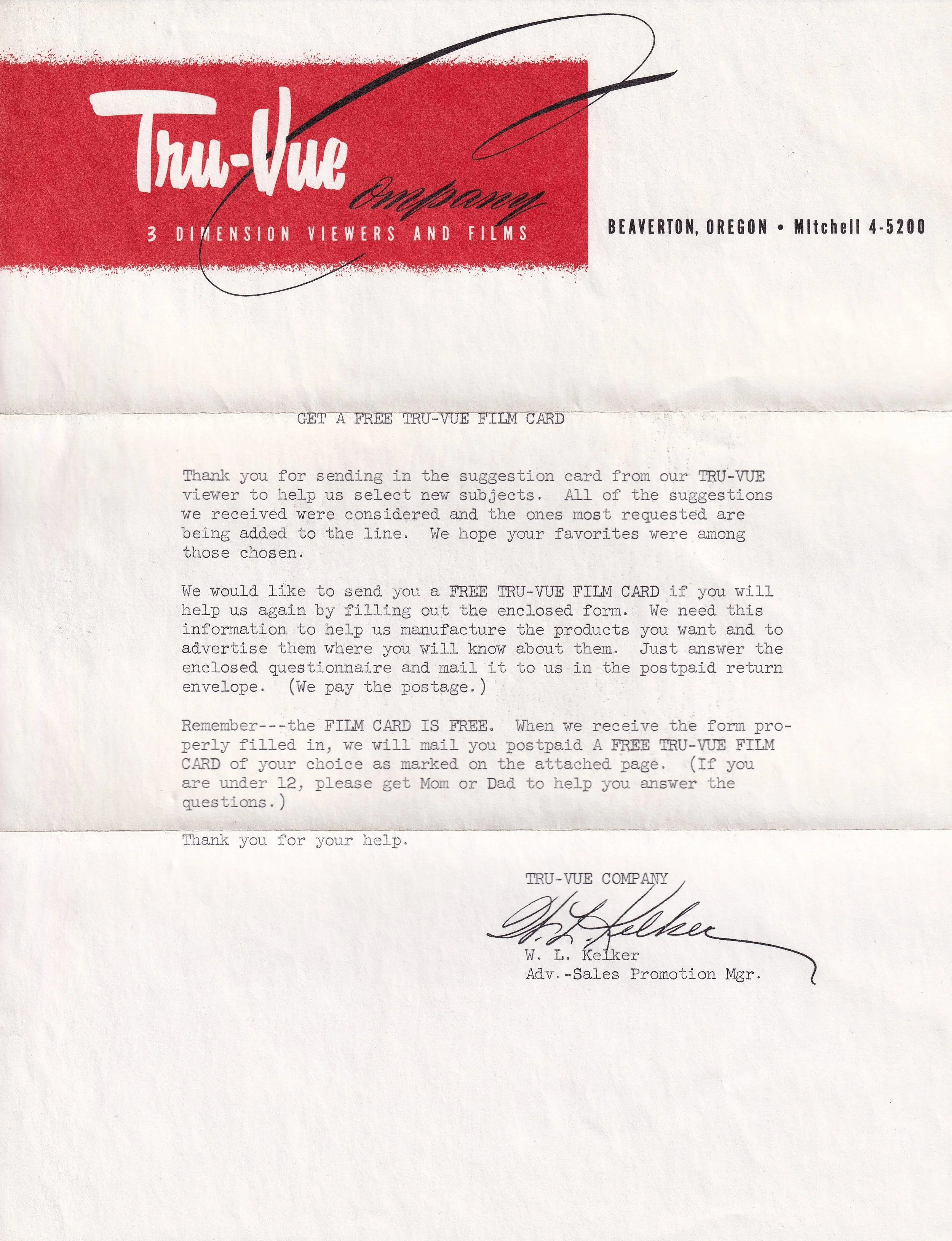
This typewritten and signed letter comes from W. L. Kelker, Tru-Vue’s Advertising-Sales Promotion Manager. It appears to be both a thank-you for a completed subject suggestion card and a research request. Mr. Kelker promises a free film card in return for information that will help them create and better advertise their products.
Tru-Vue Mailing Envelopes
Tru-Vue didn’t miss an opportunity to advertise, including on the fronts and backs of their mailing envelopes.
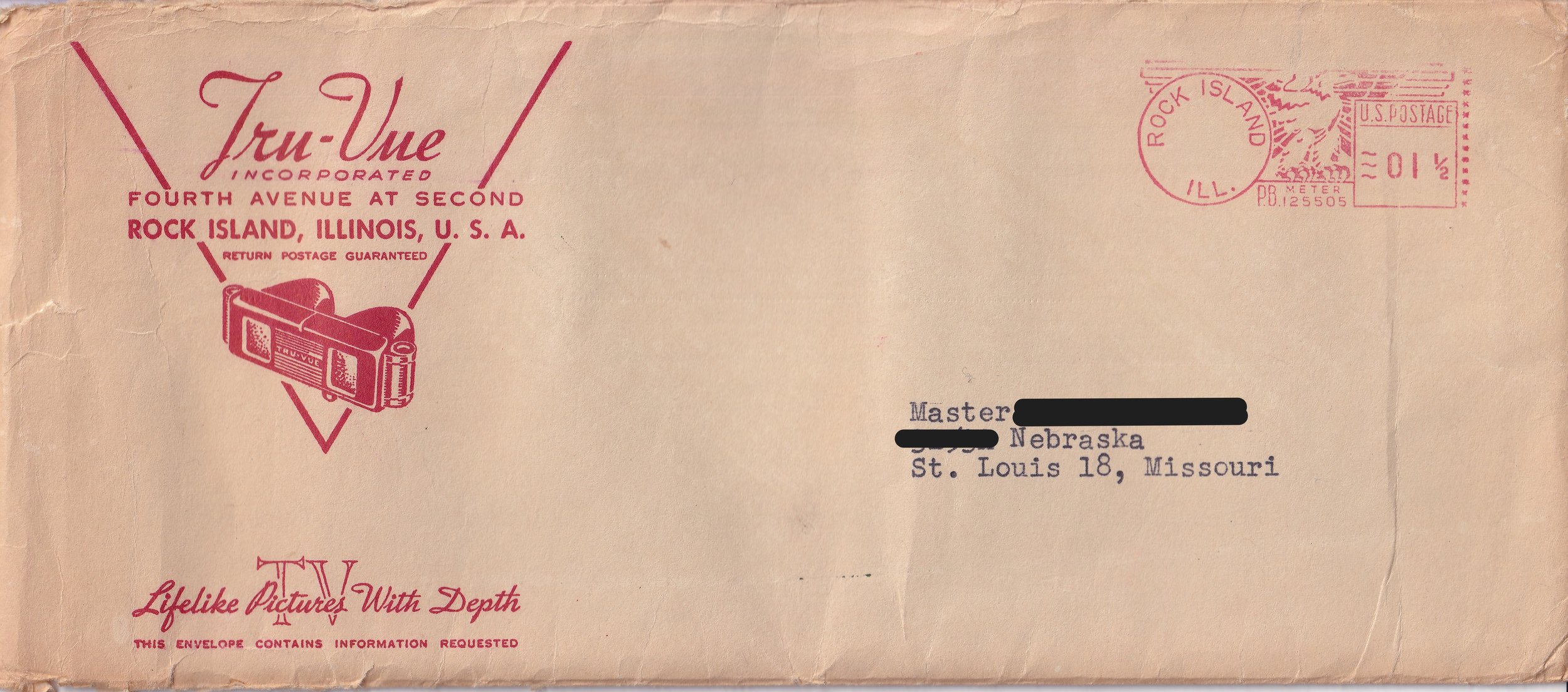
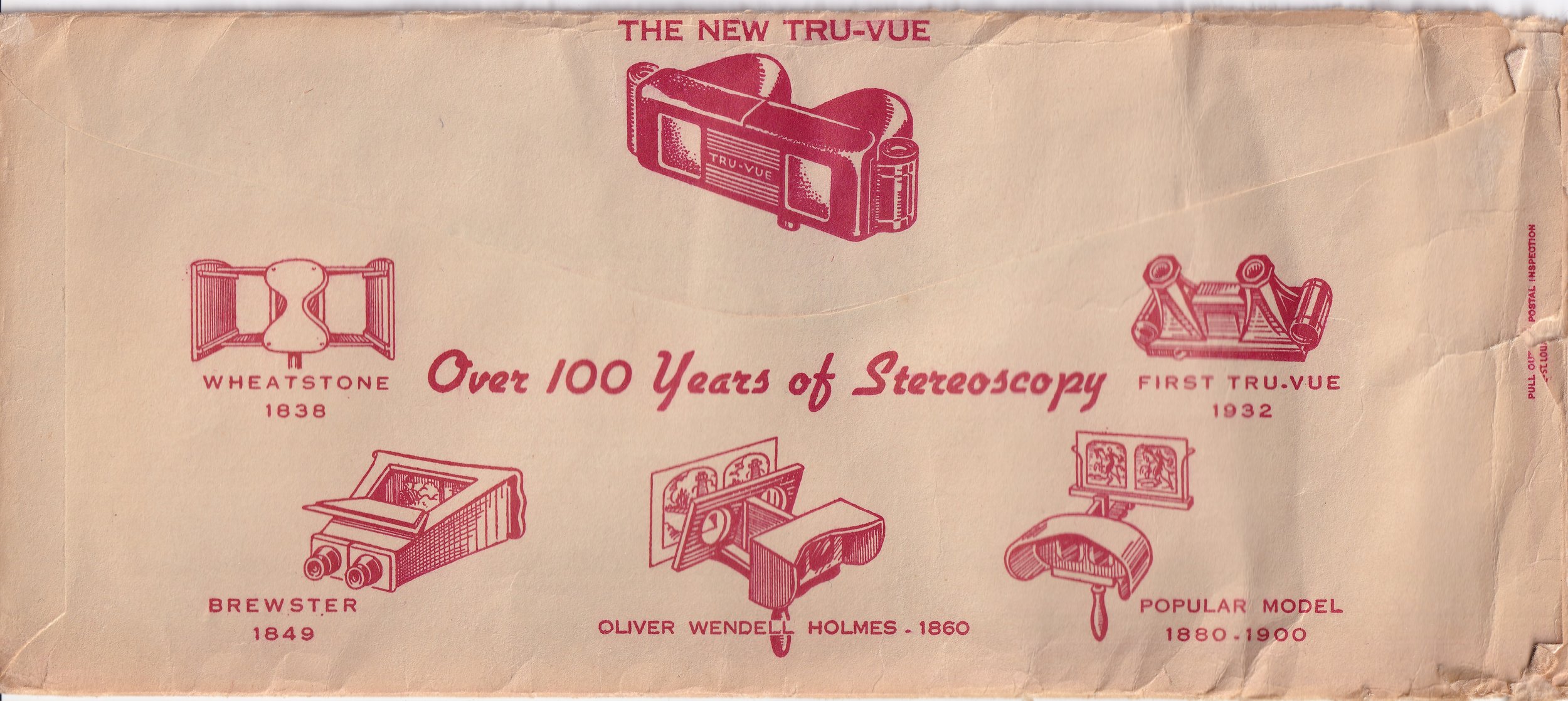
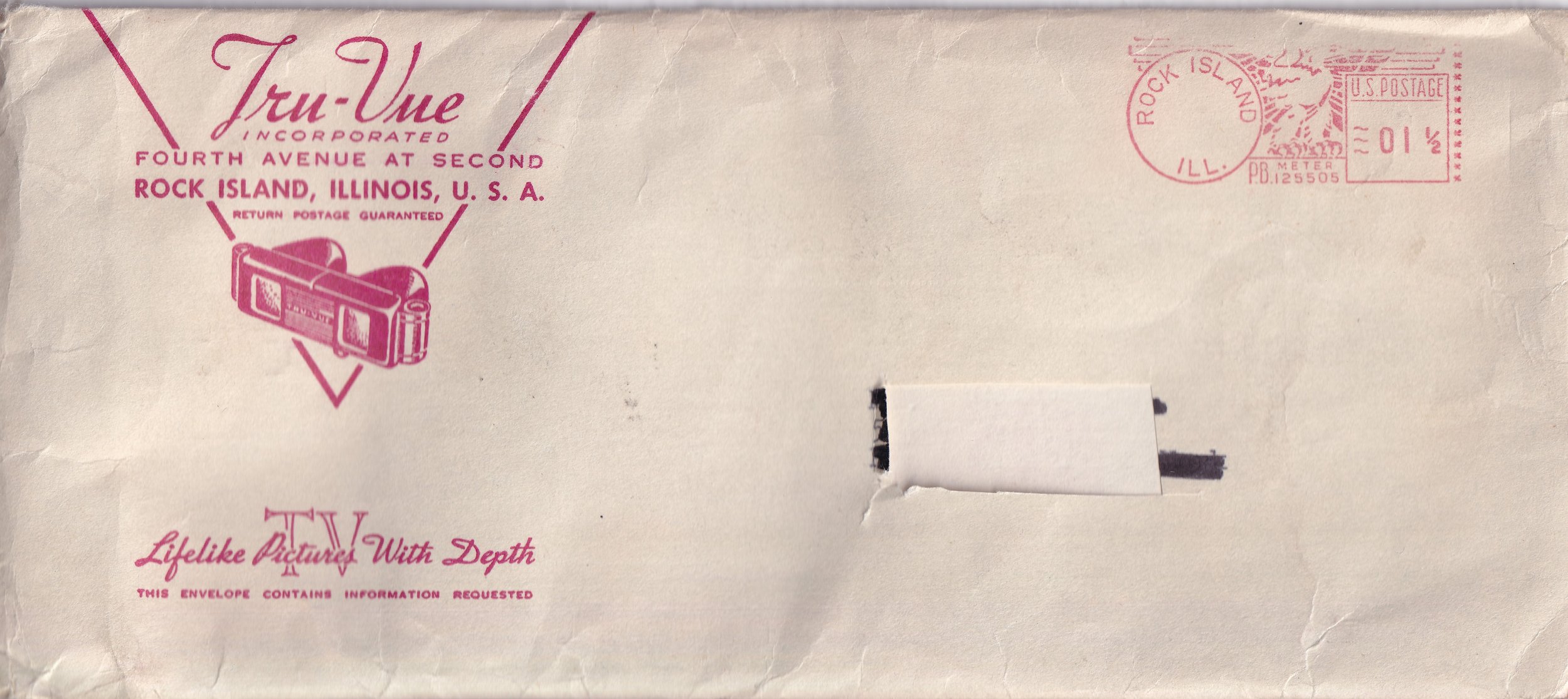
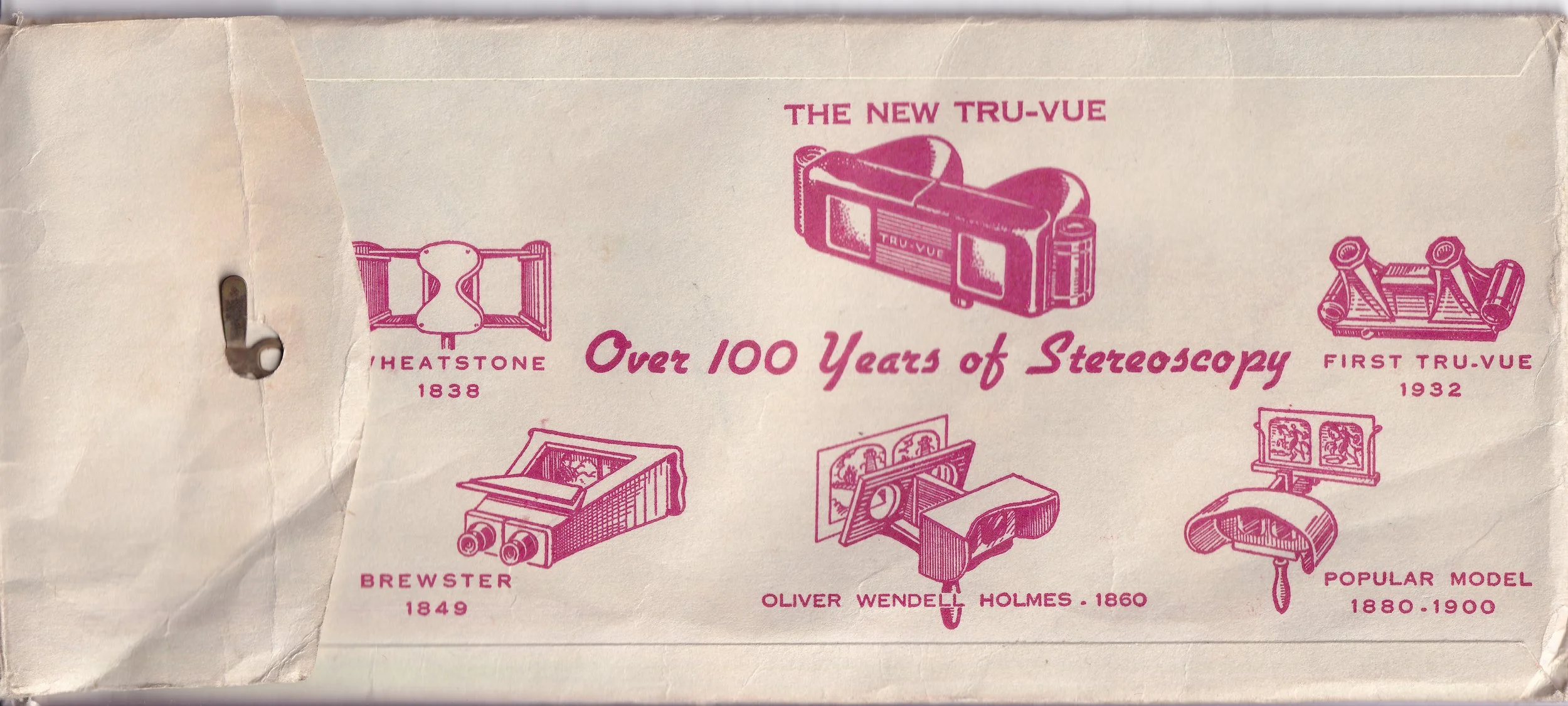
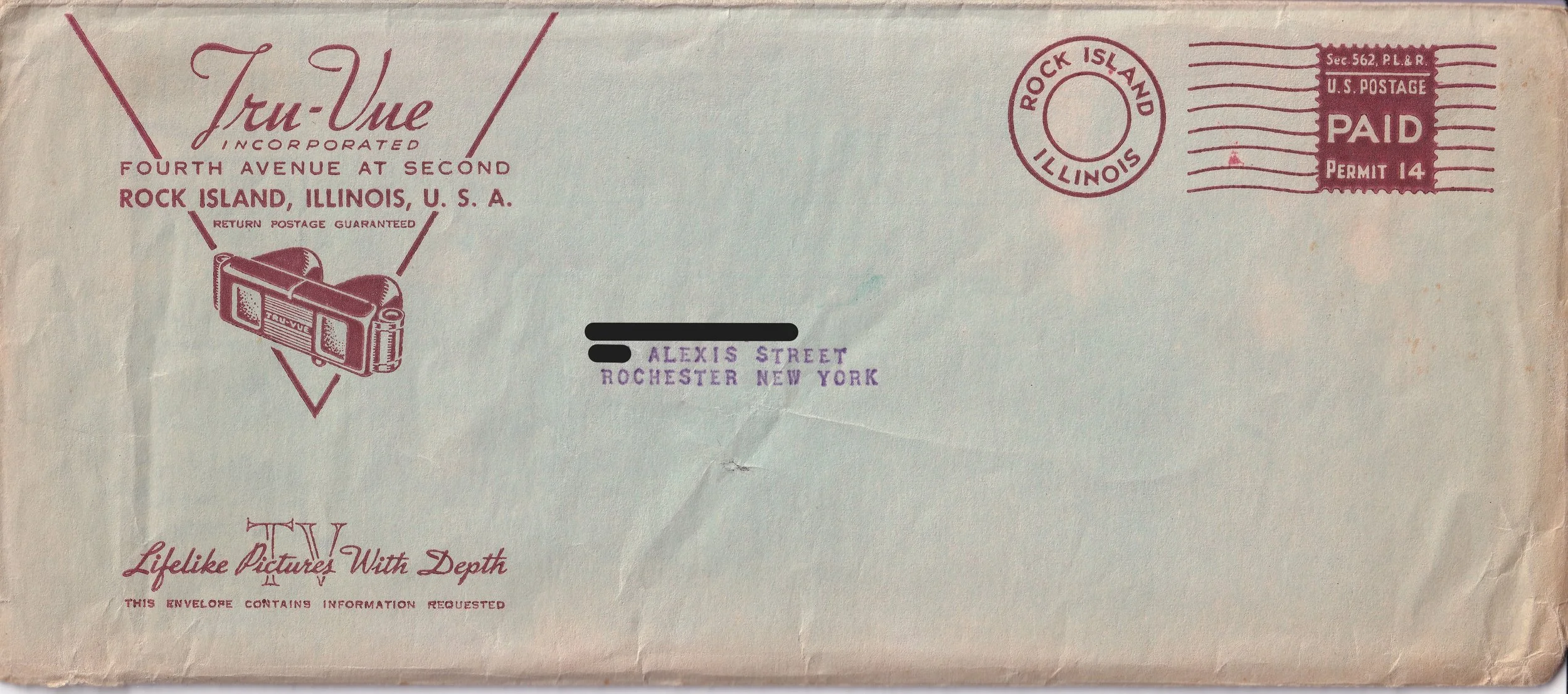
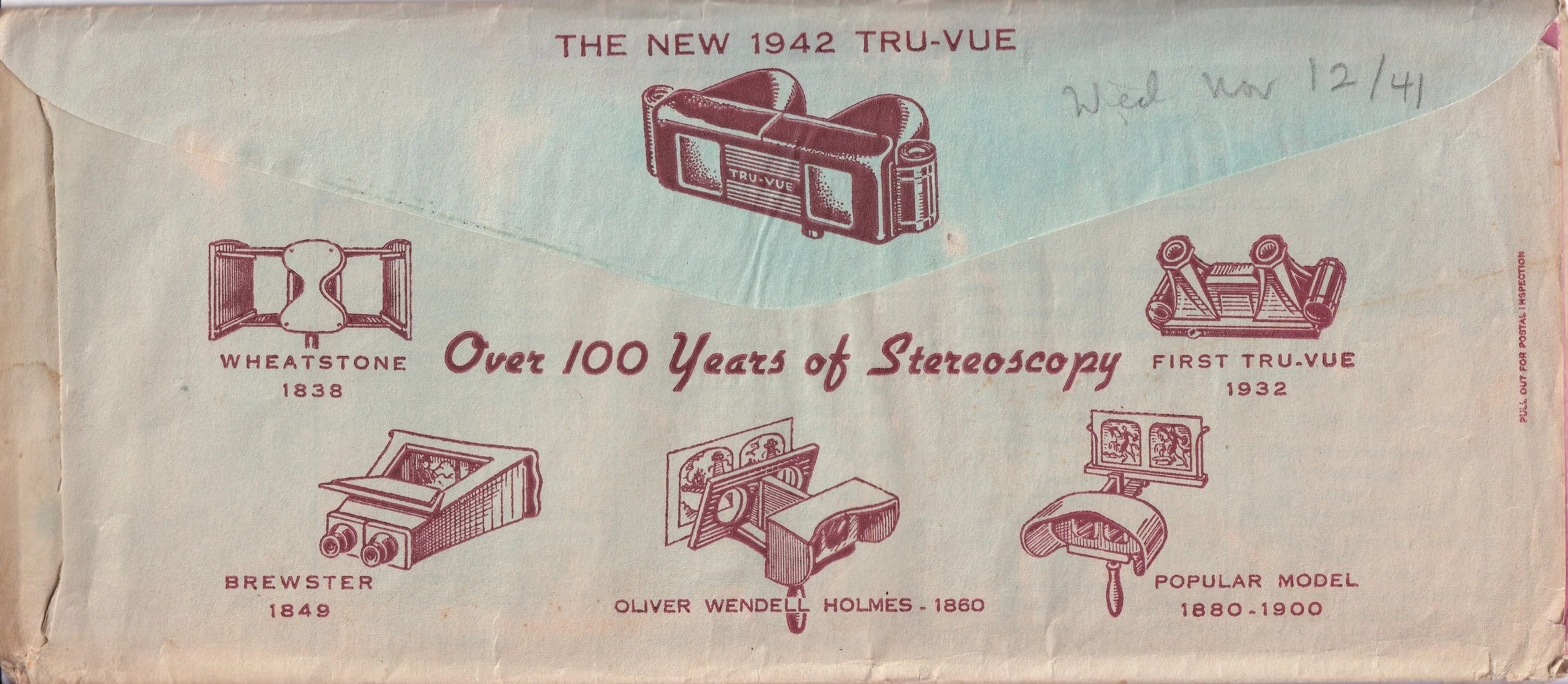
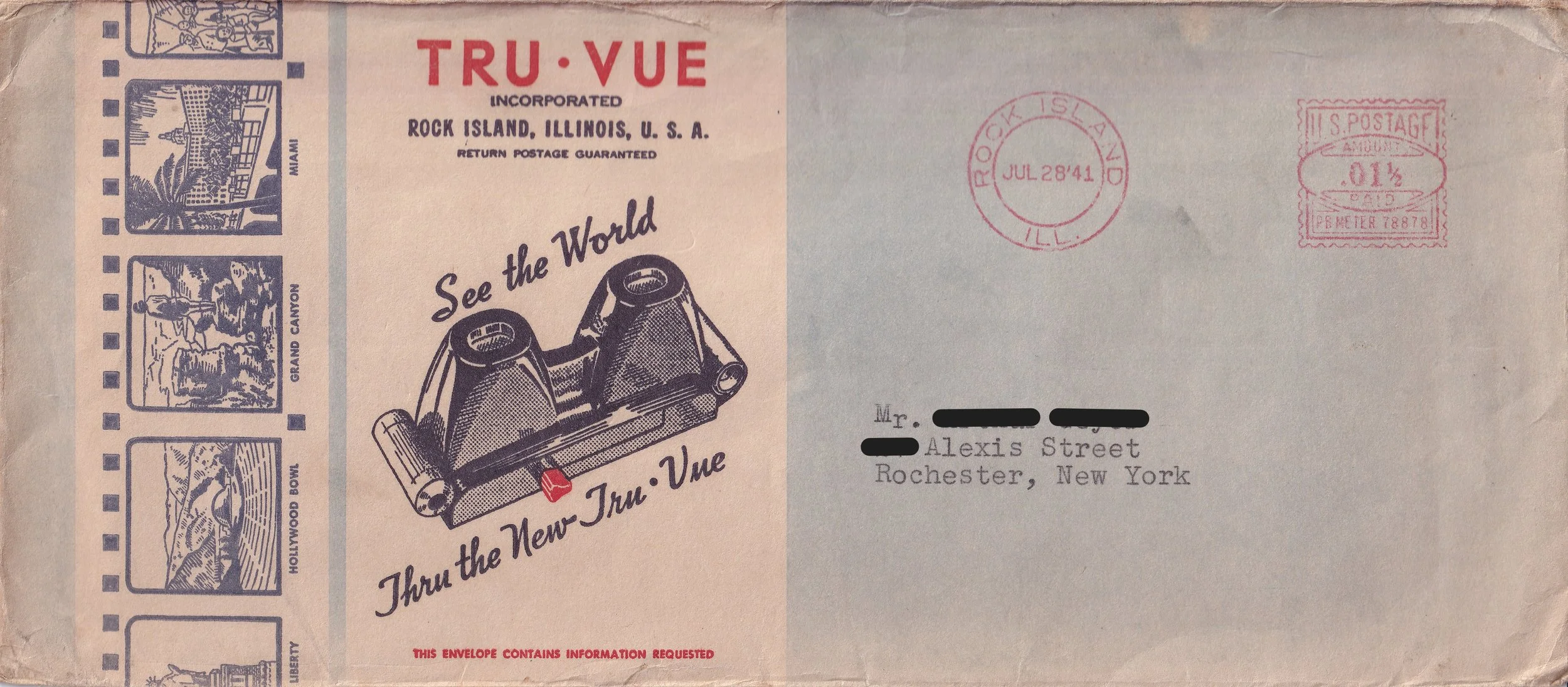
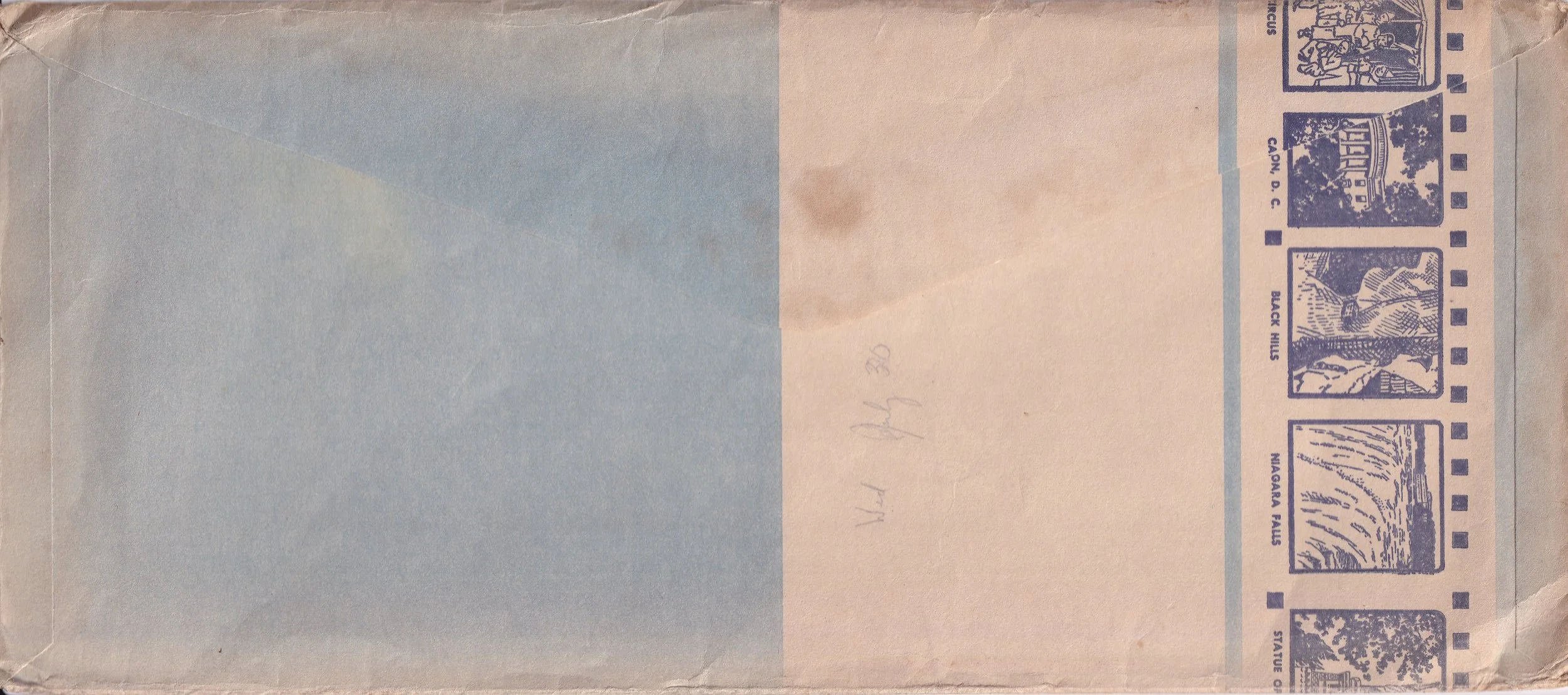
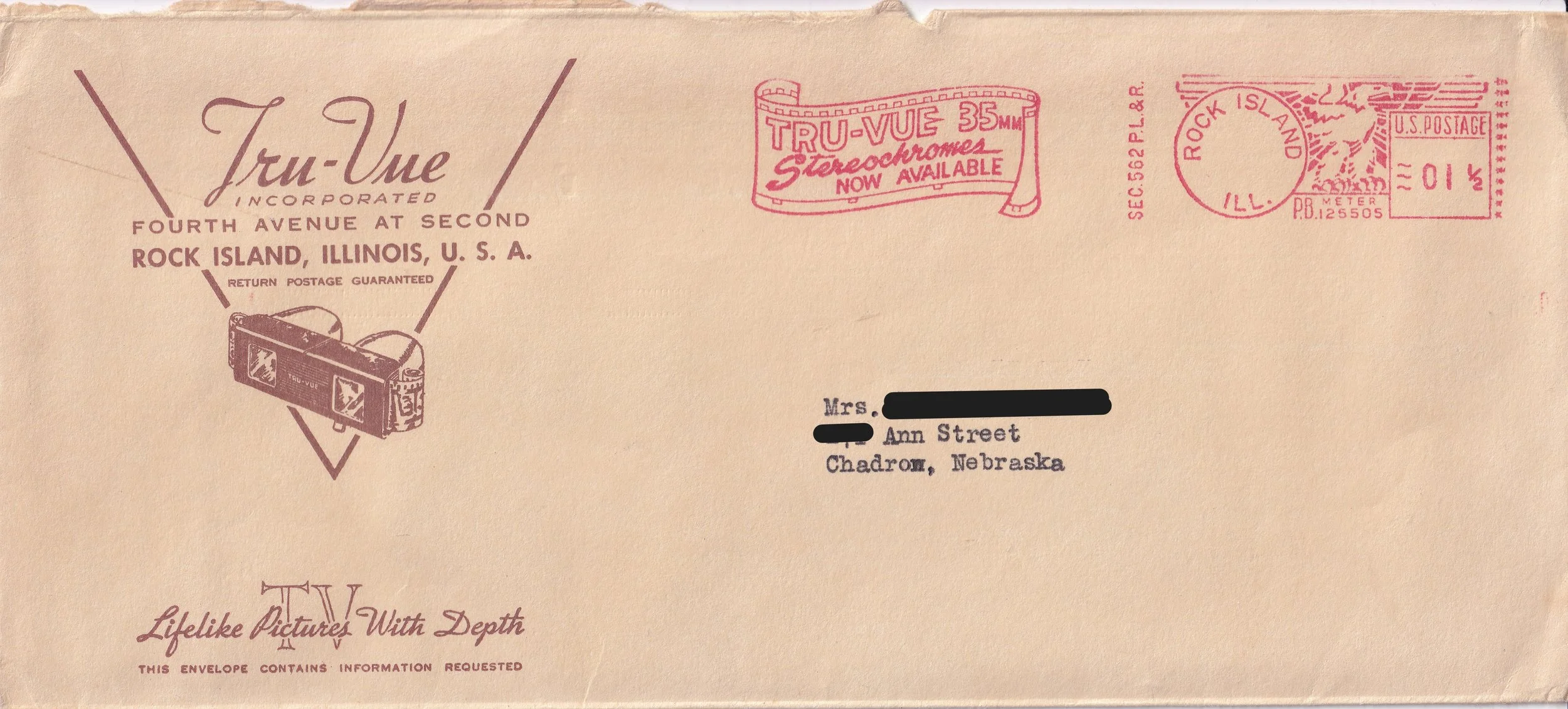
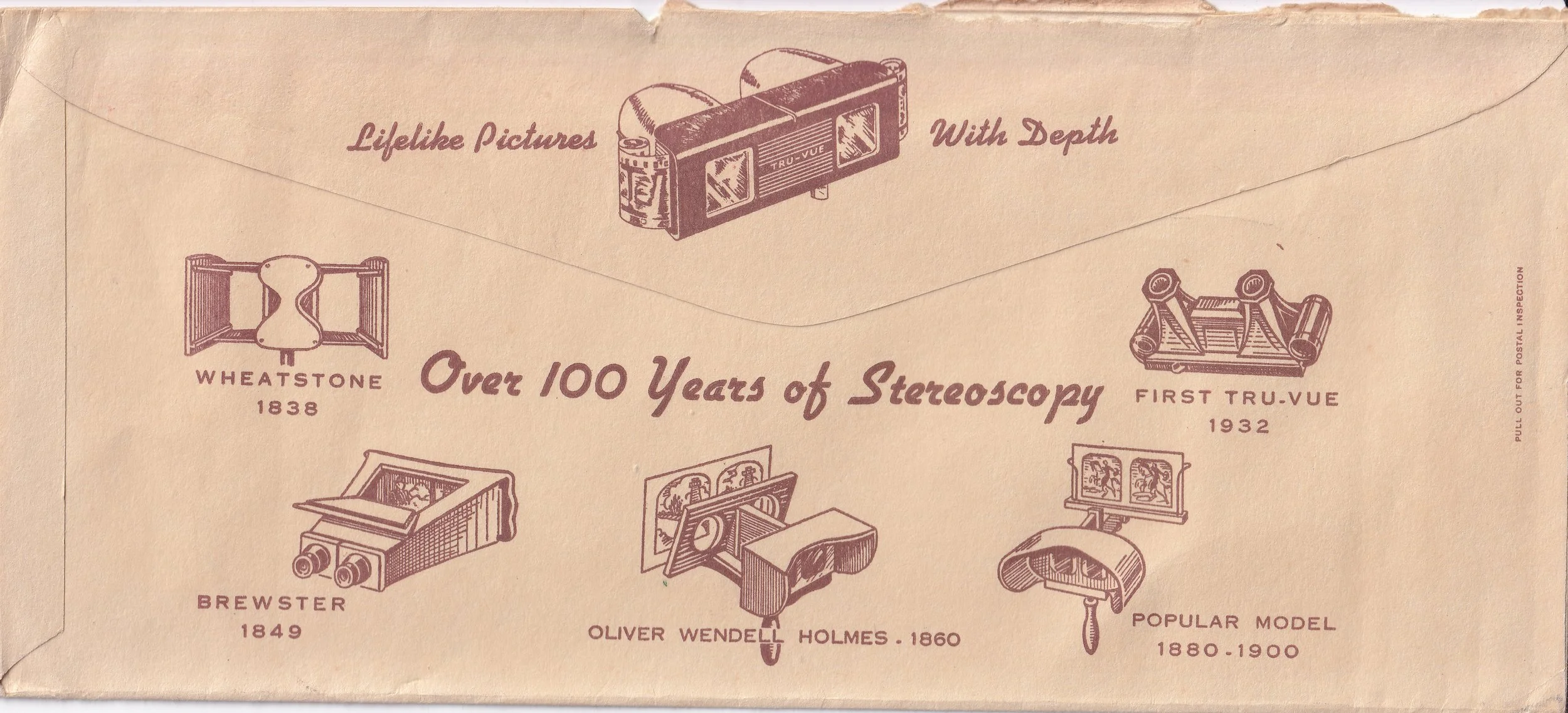
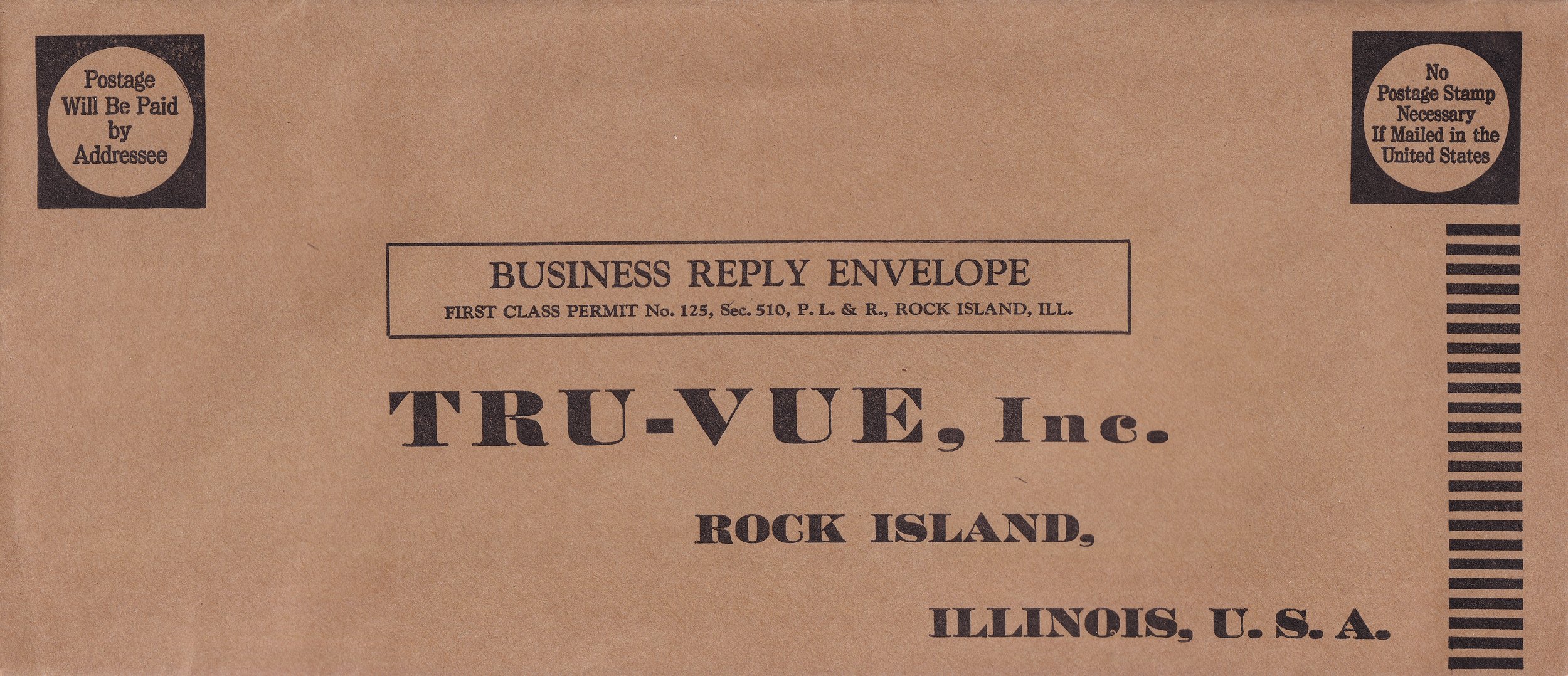
Tru-Vue Mailing Envelopes - Reply, Postage Paid
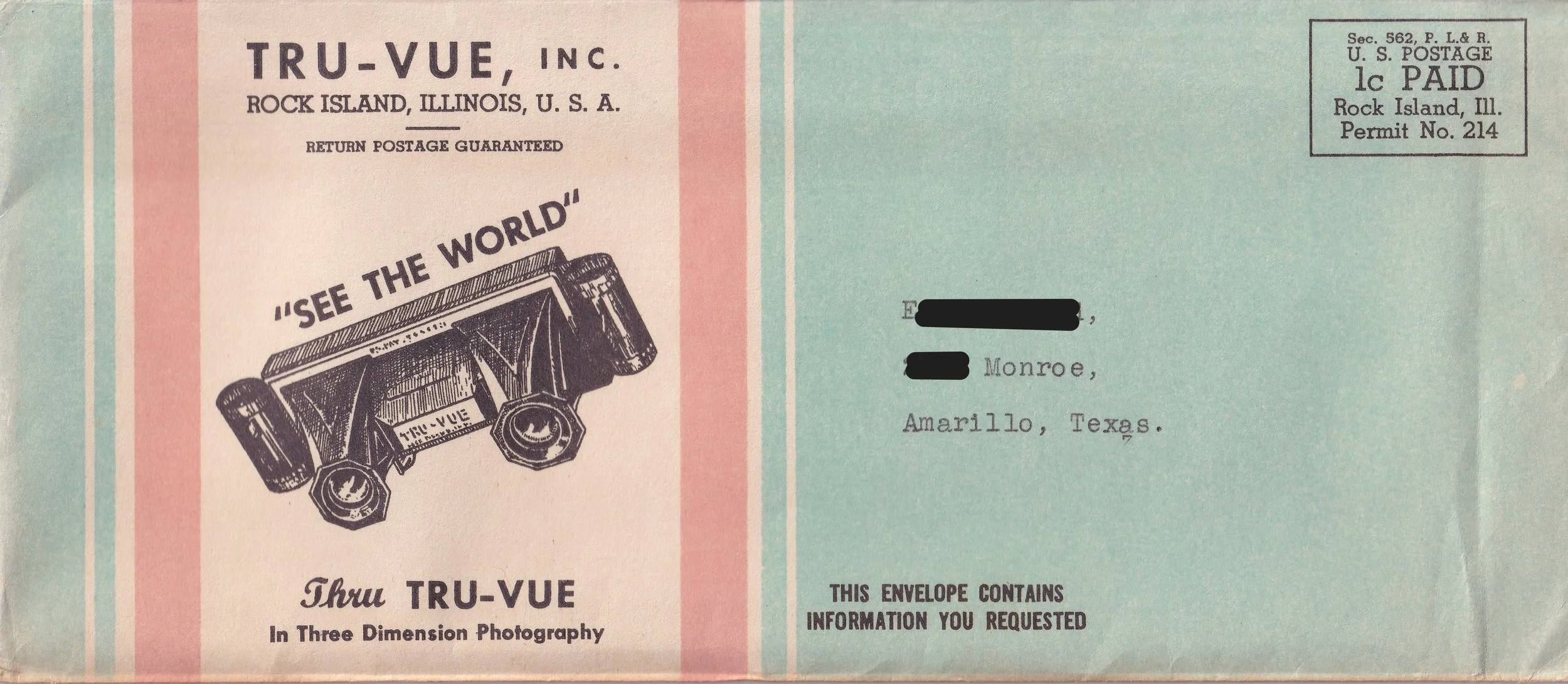
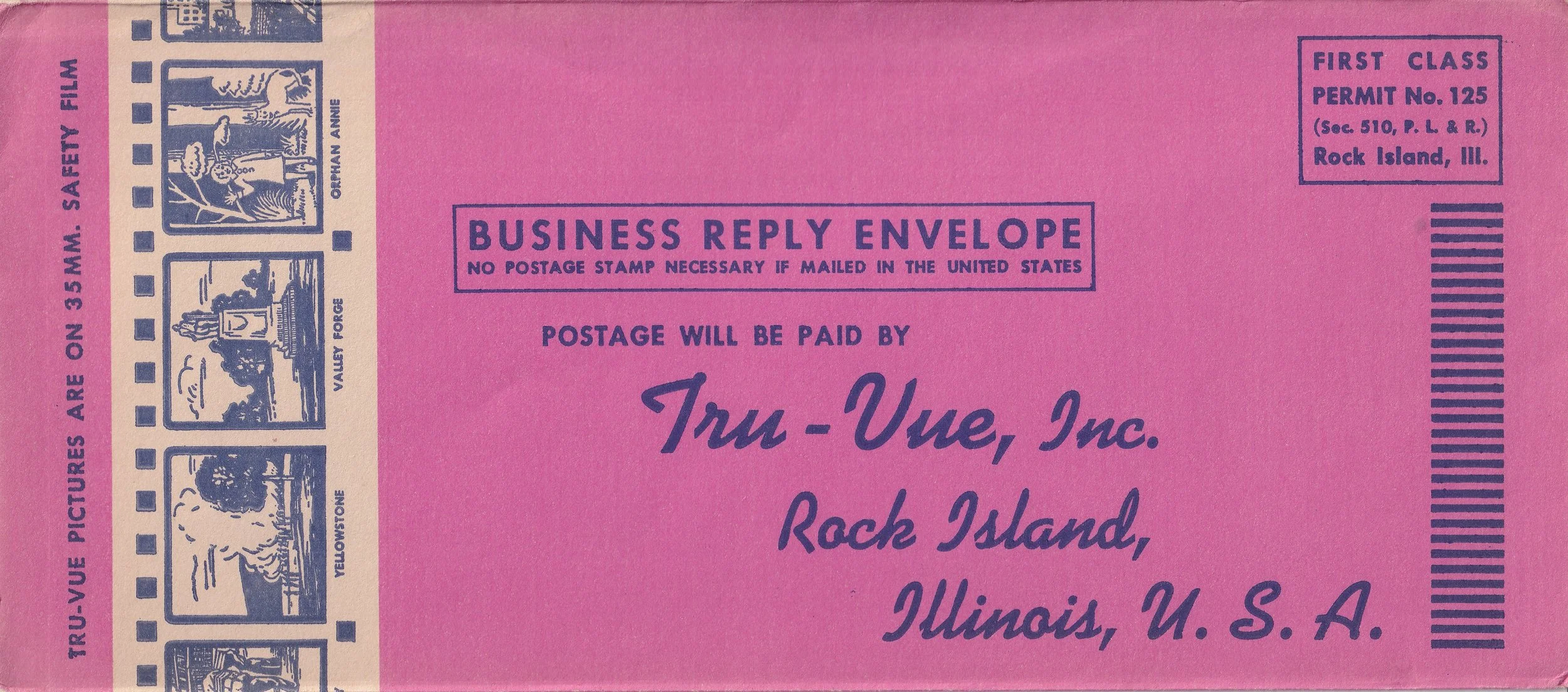
Even their postage-paid reply envelopes promoted their products.
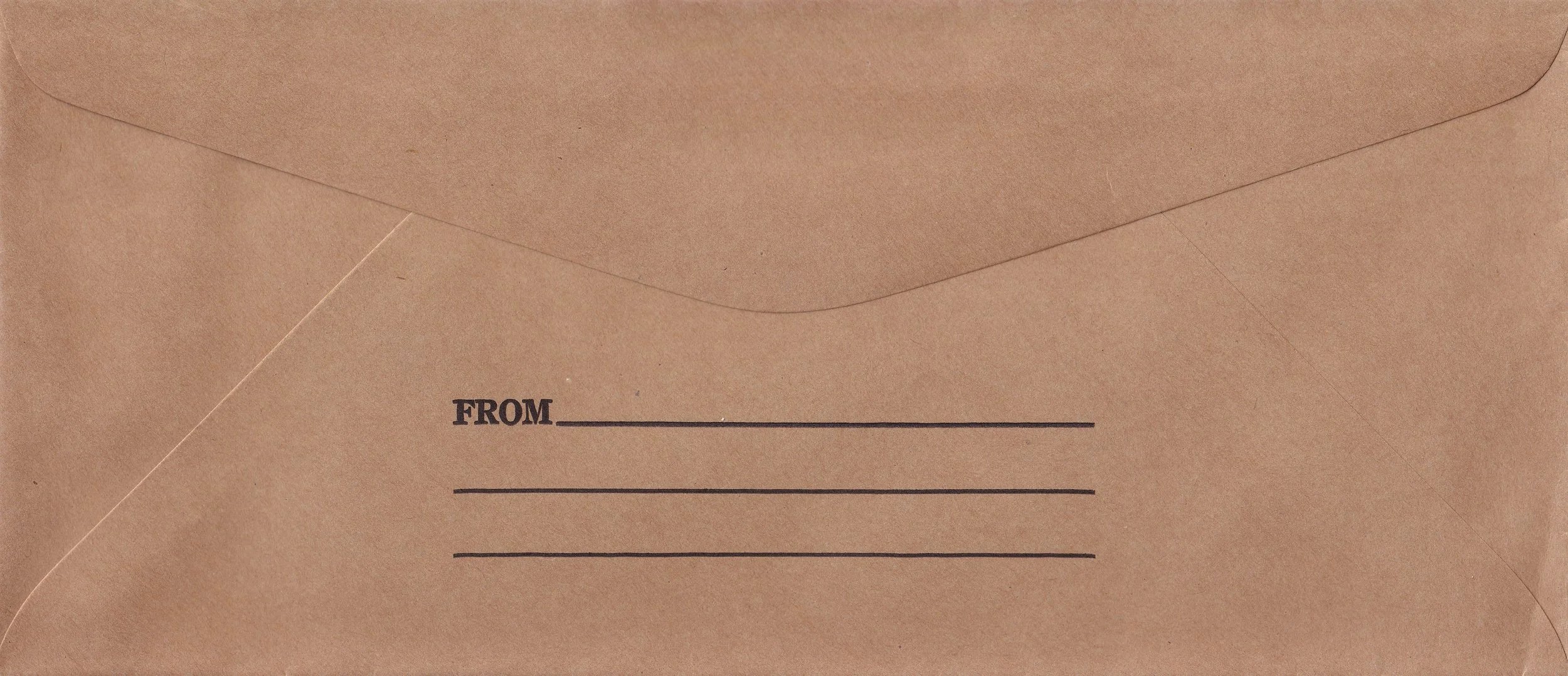
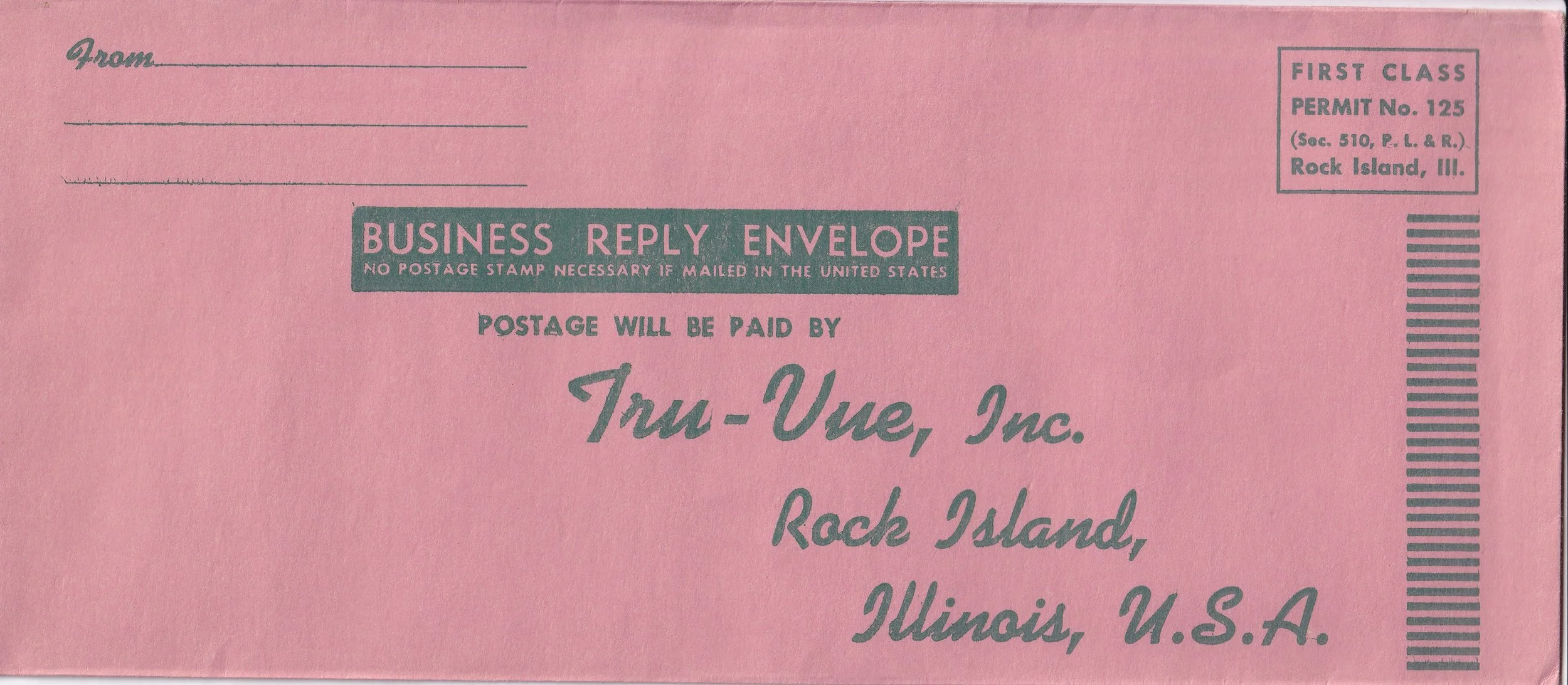
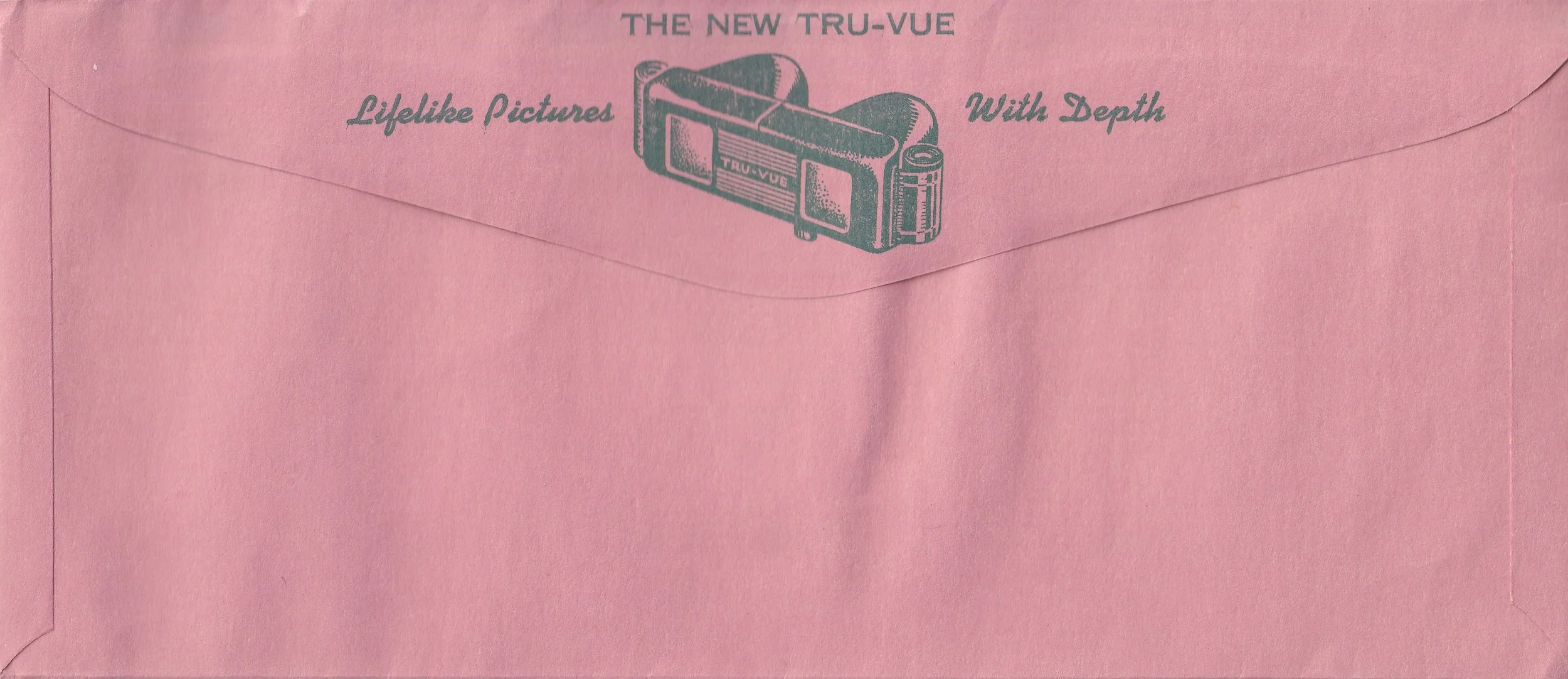
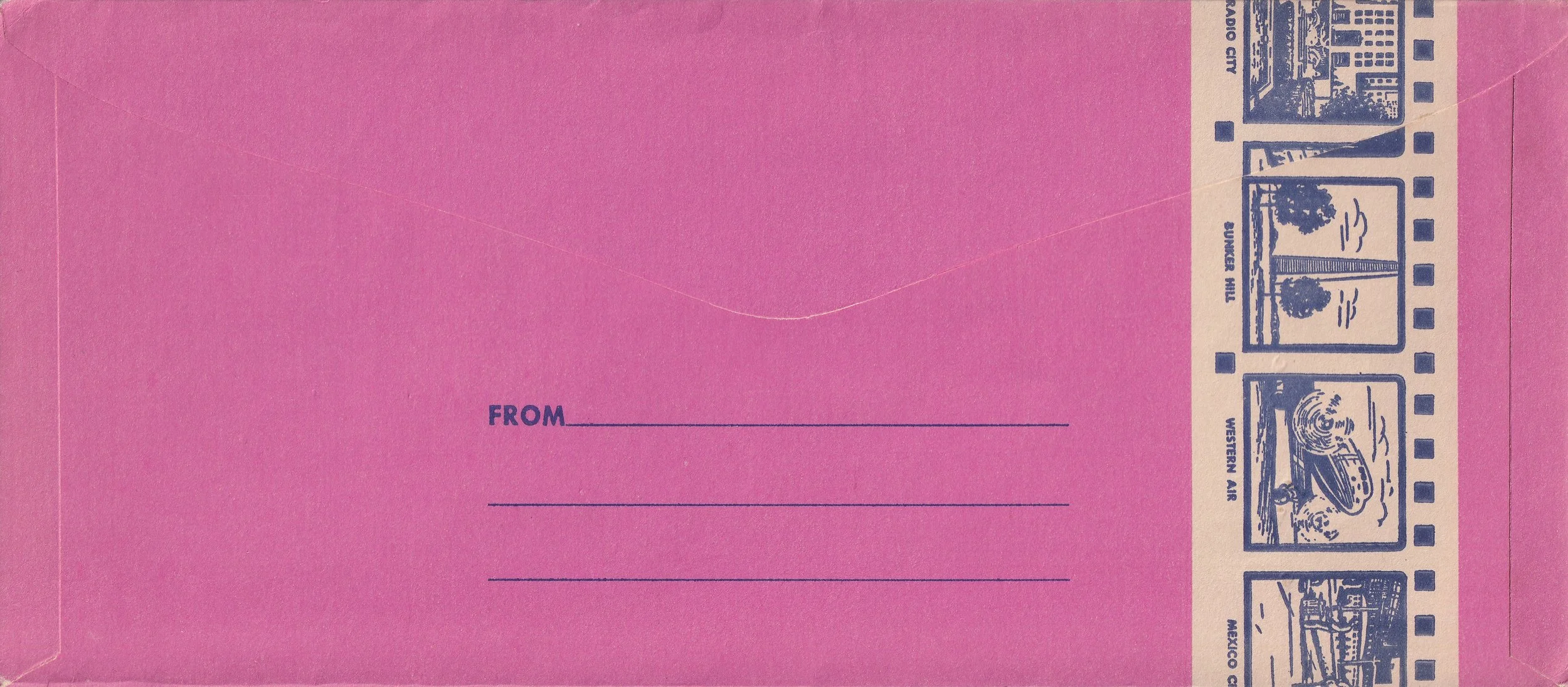
Tru-Vue Community Selling
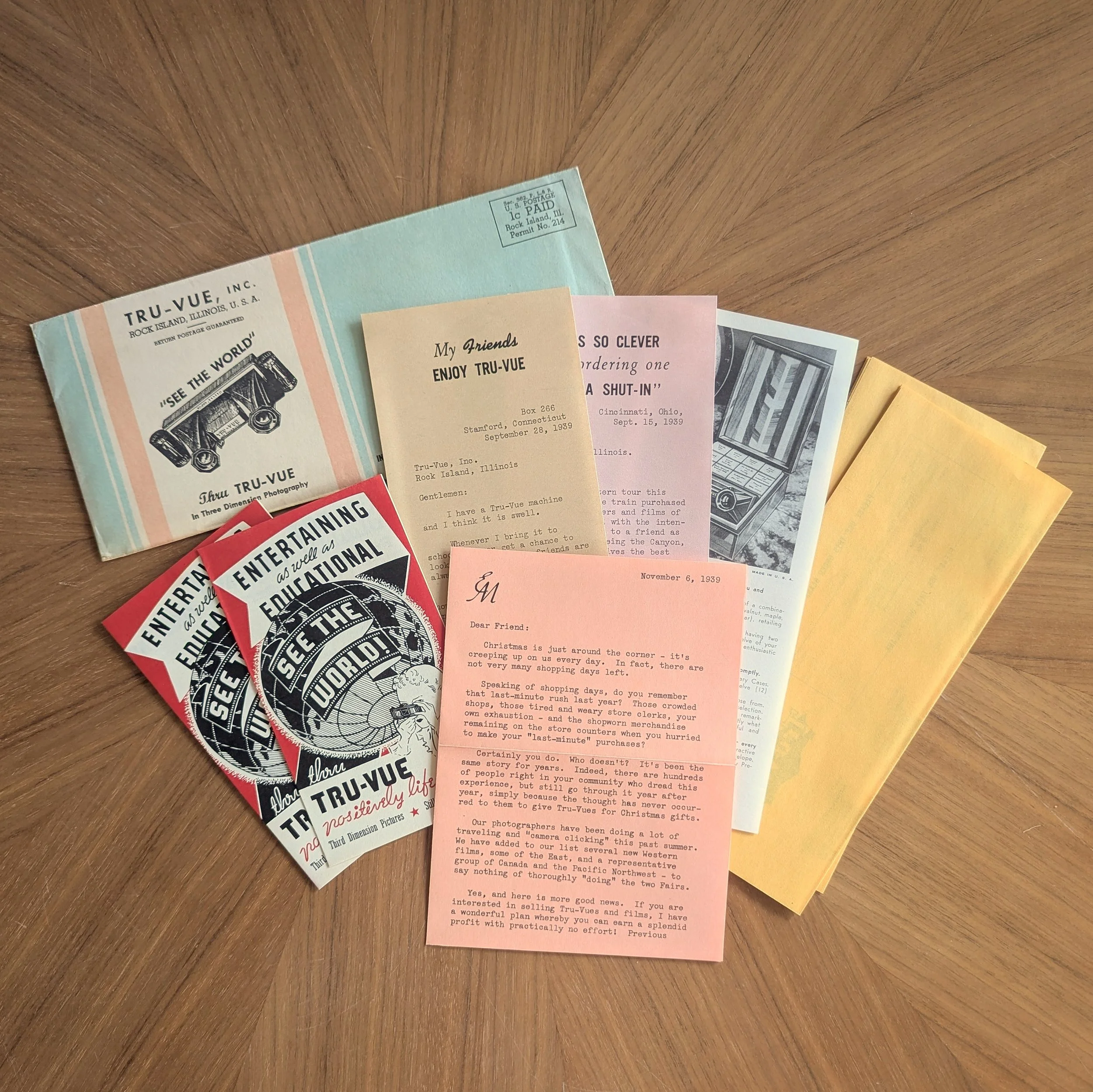
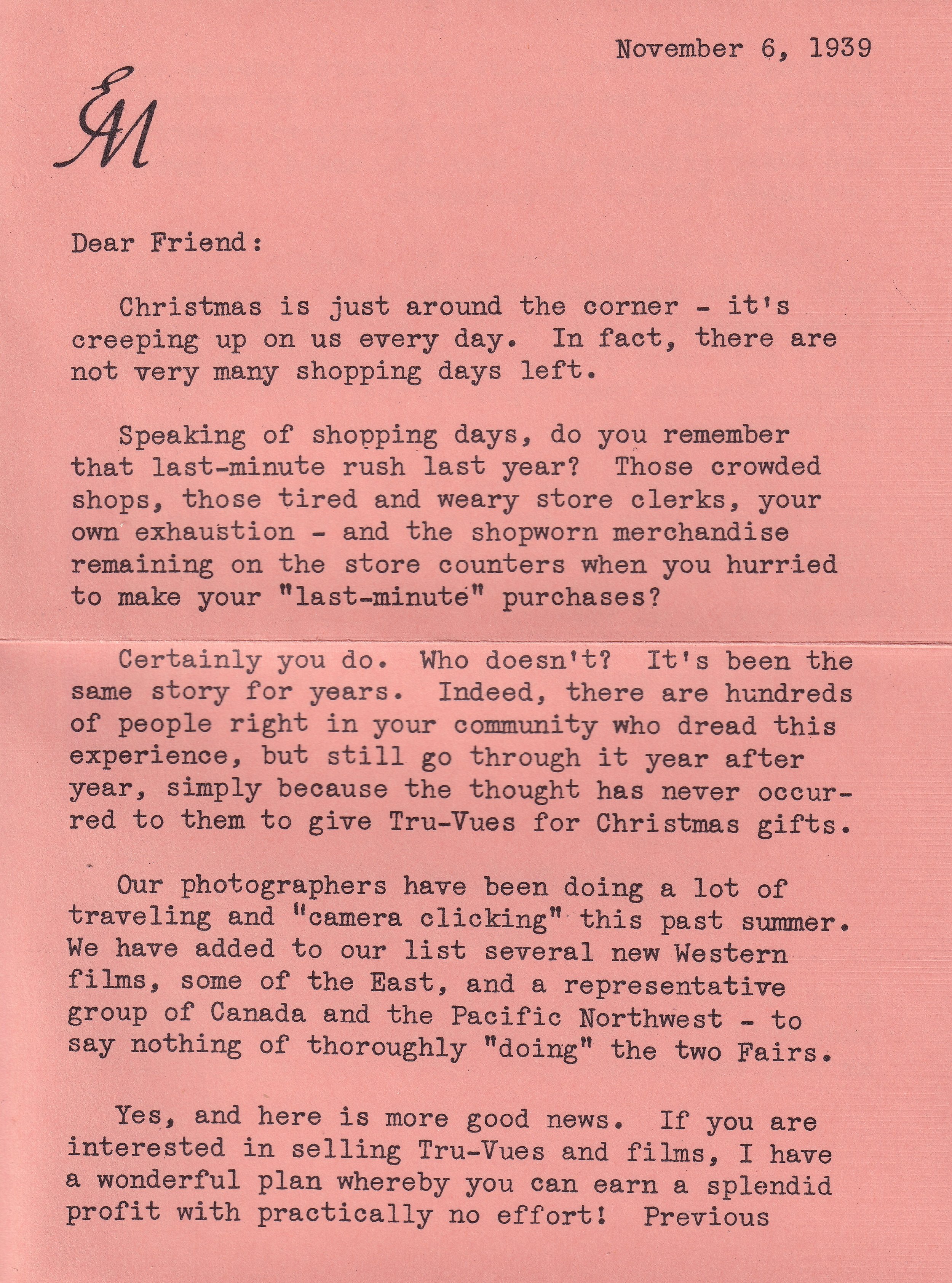
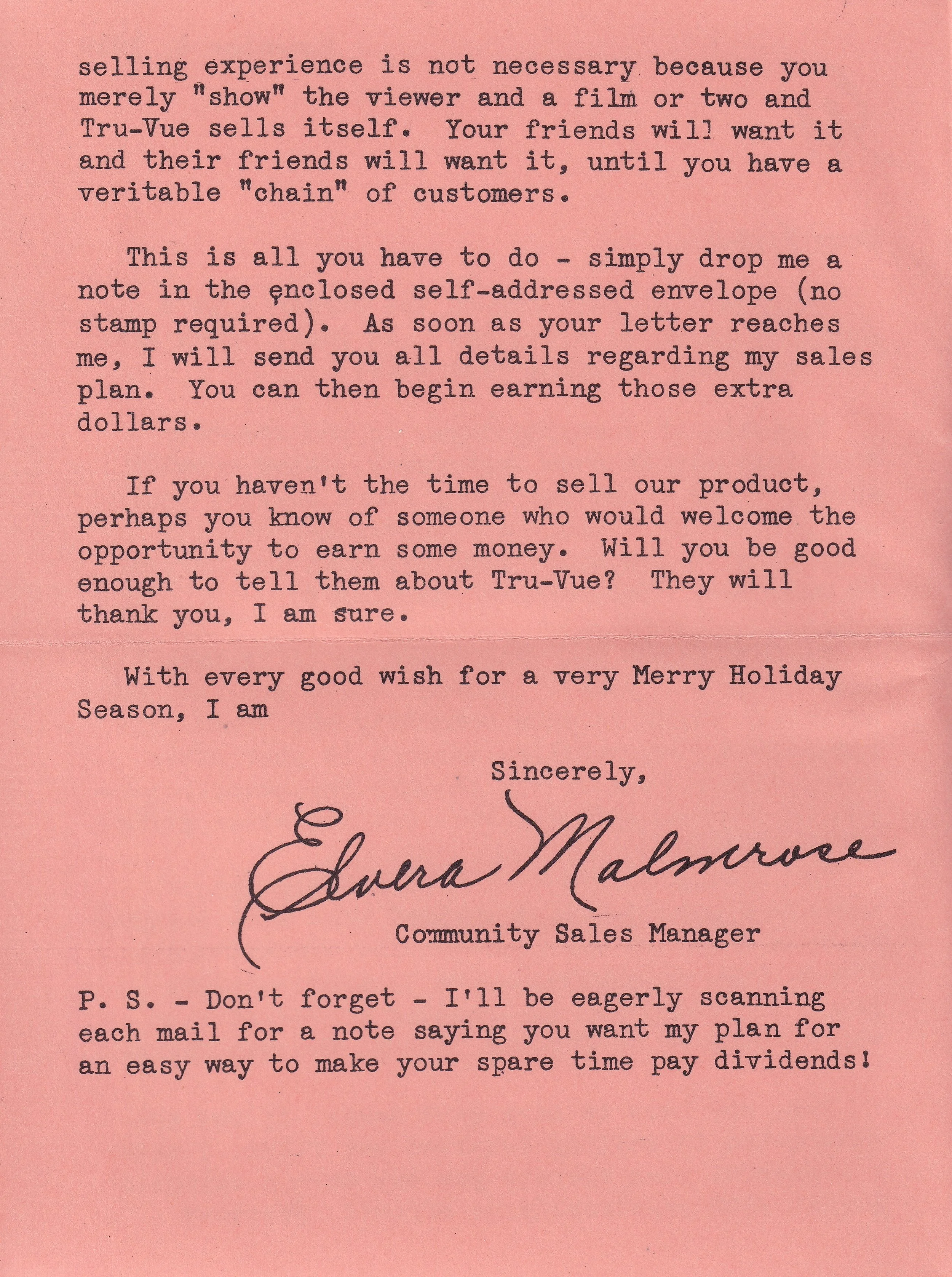
We didn’t know “community selling” was a thing until we saw this set. People were encouraged by Tru-Vue’s Community Sales Manager to earn extra money by selling Tru-Vue to their friends and neighbors.
Tru-Vue Consumer Magazine Advertising
Before the Sale to Sawyer’s
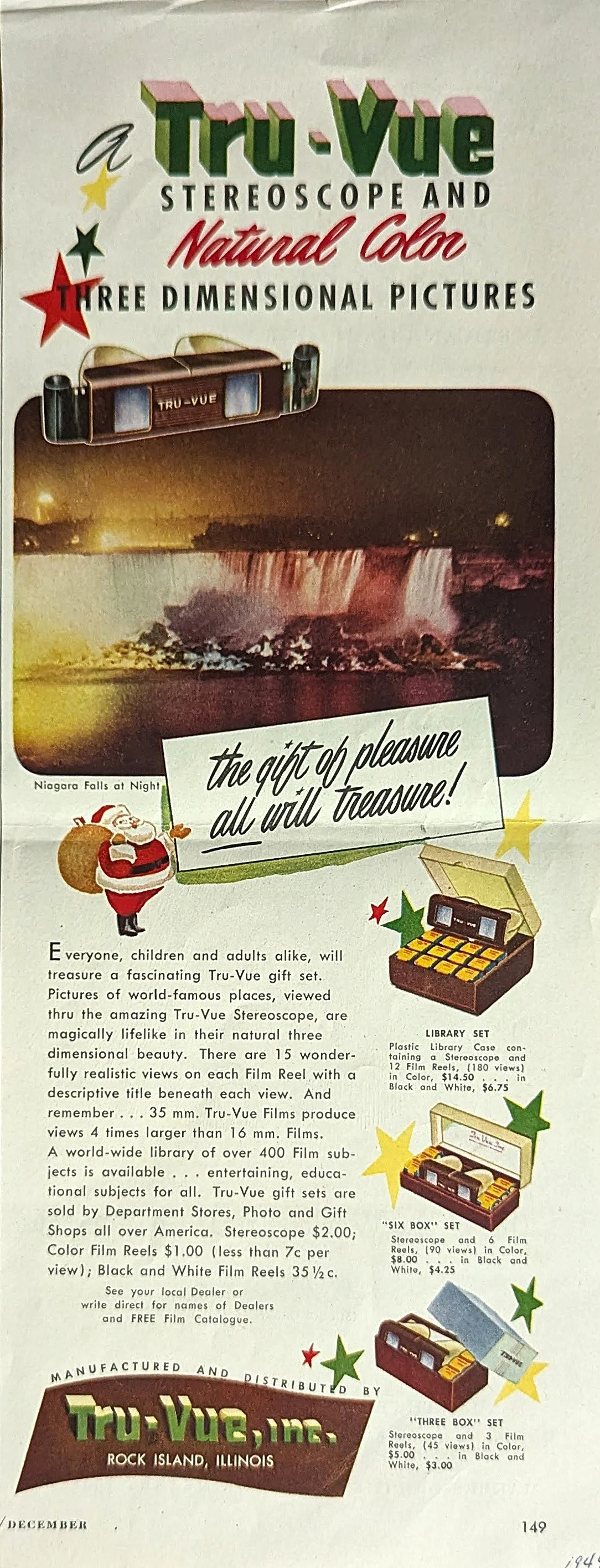
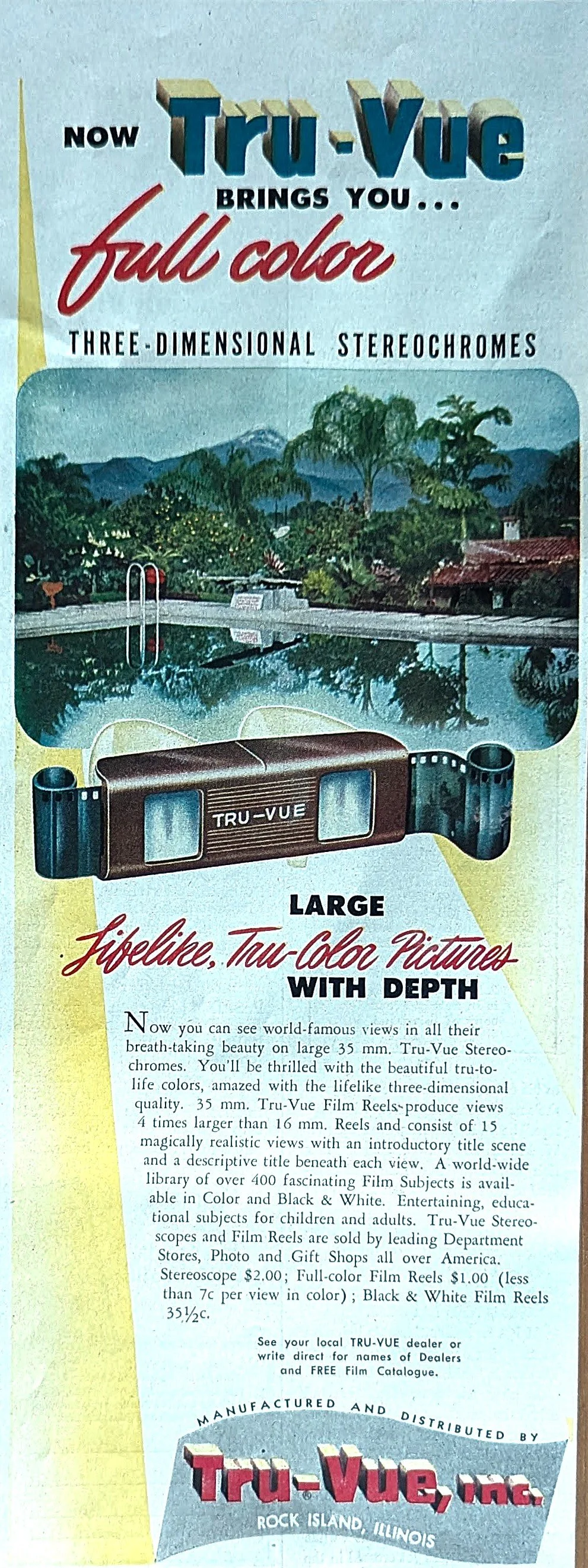
These late 1940s magazine advertisements promote the new availability of color films.
After the Sale to Sawyer’s
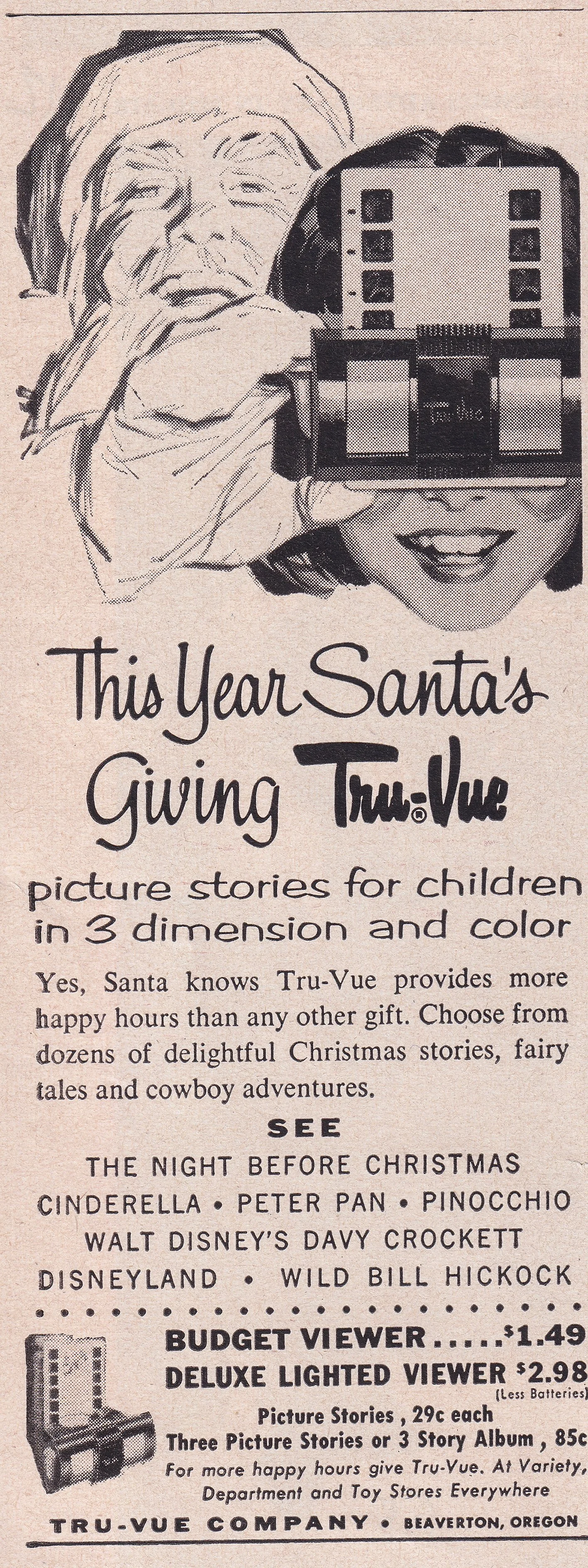
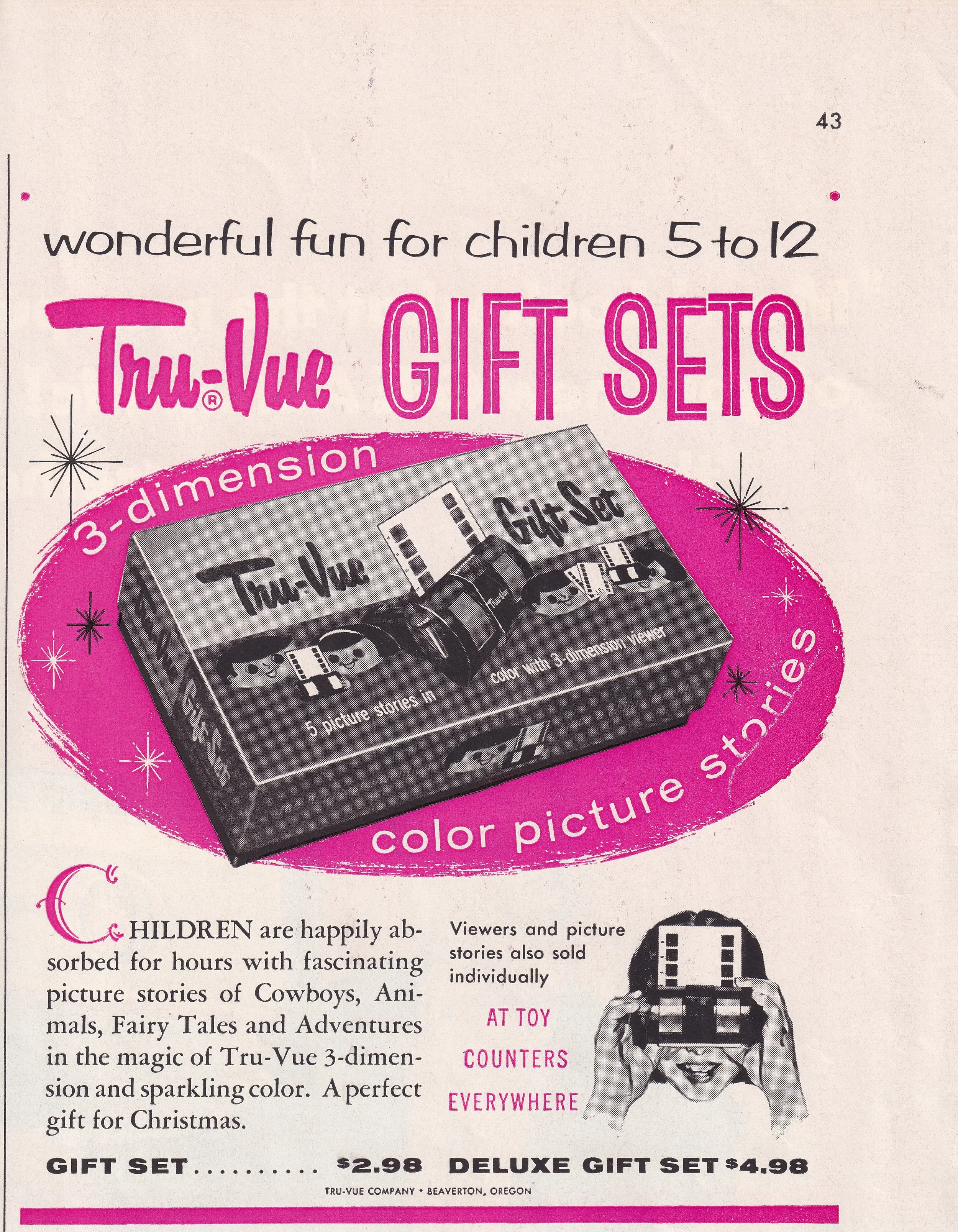
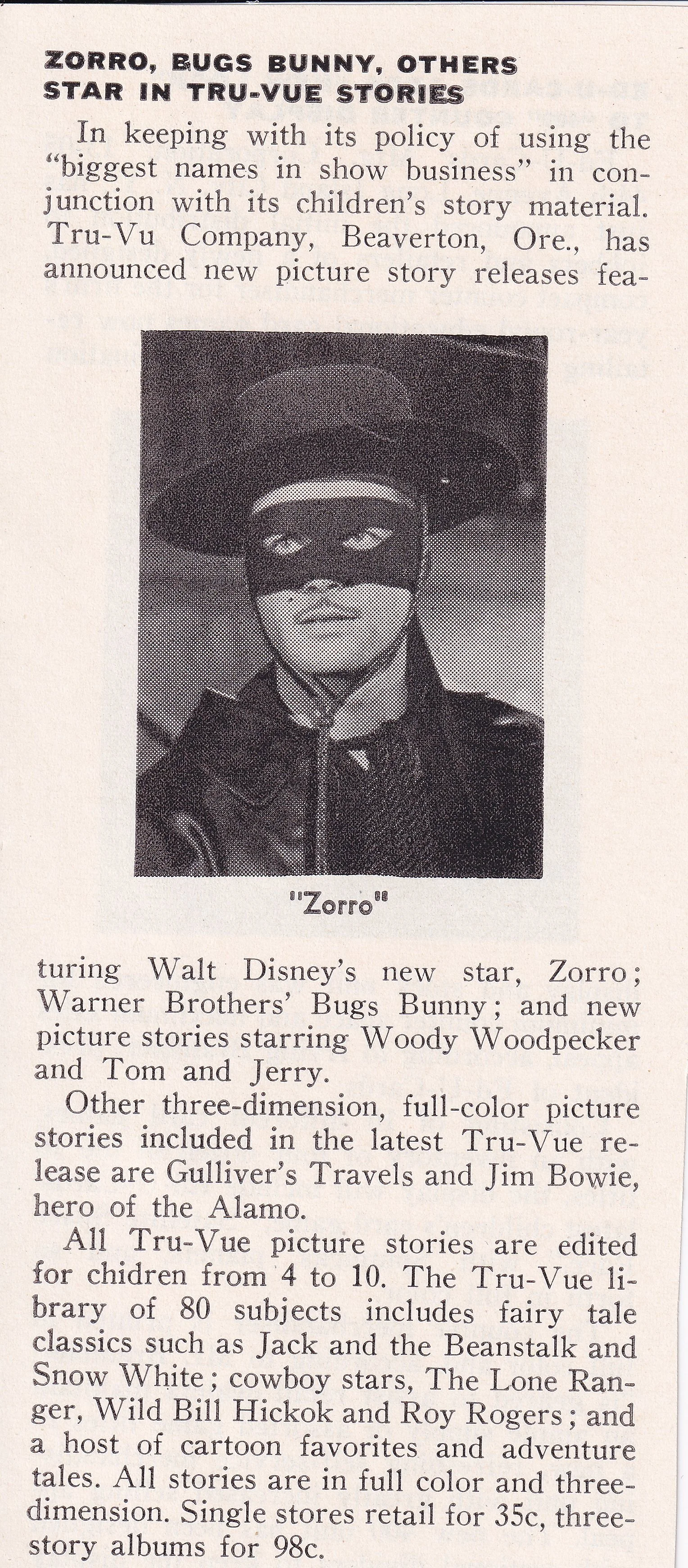
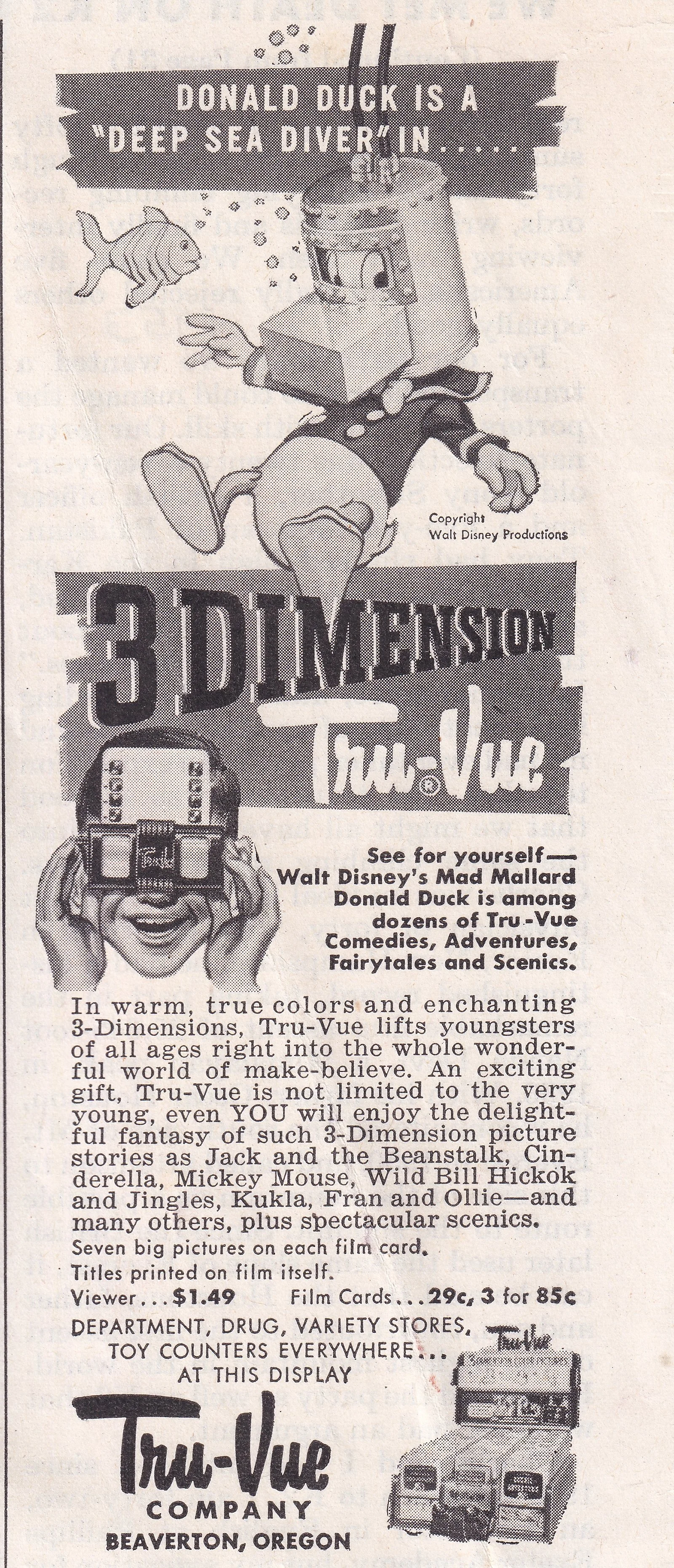
These magazine advertisements promote Tru-Vue’s 3D cards, card viewer, and gift sets. Note the prominent featuring of particular characters like Donald Duck and Zorro in the ads to attract consumers.
Tru-Vue Dealer Advertising
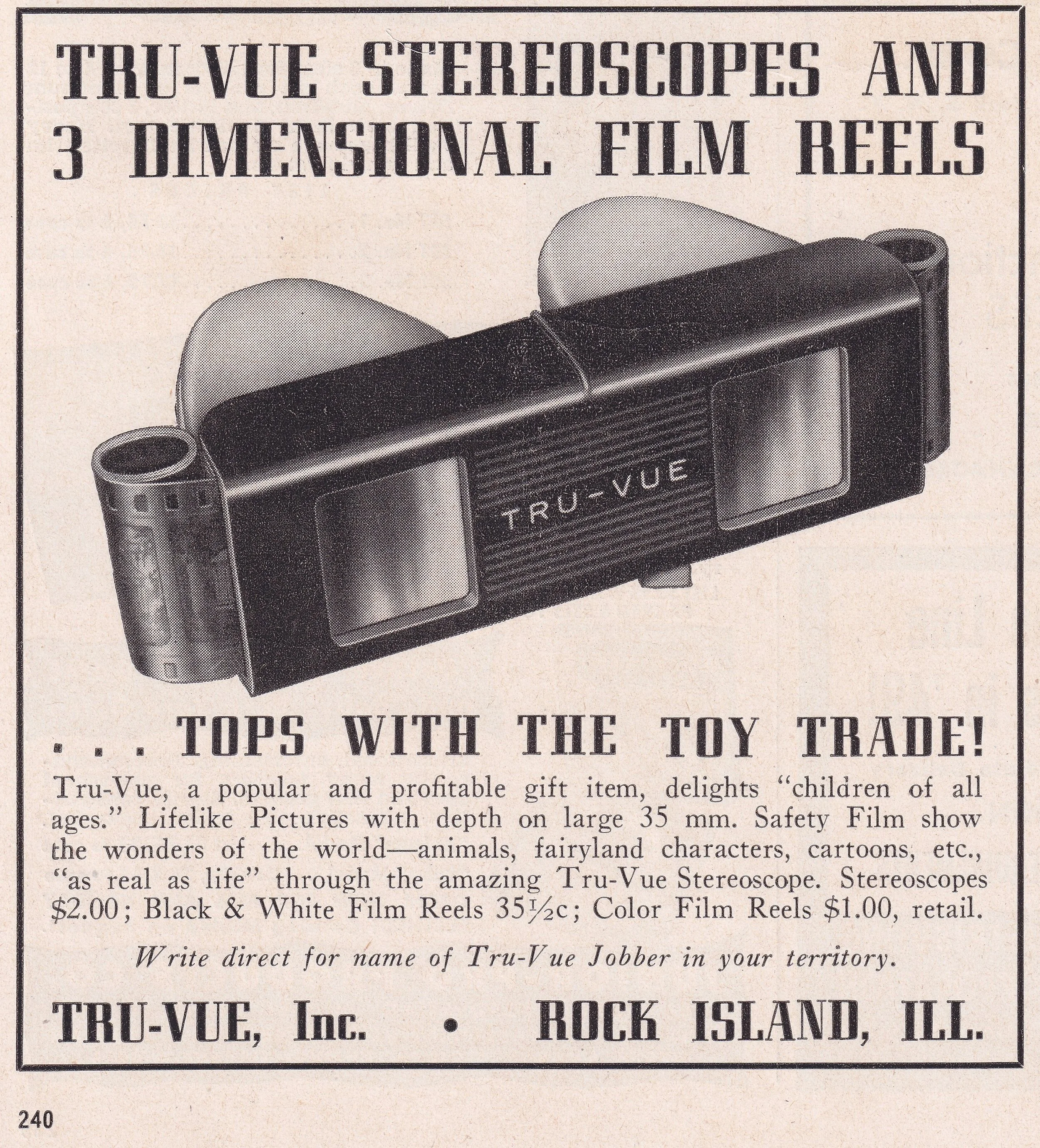
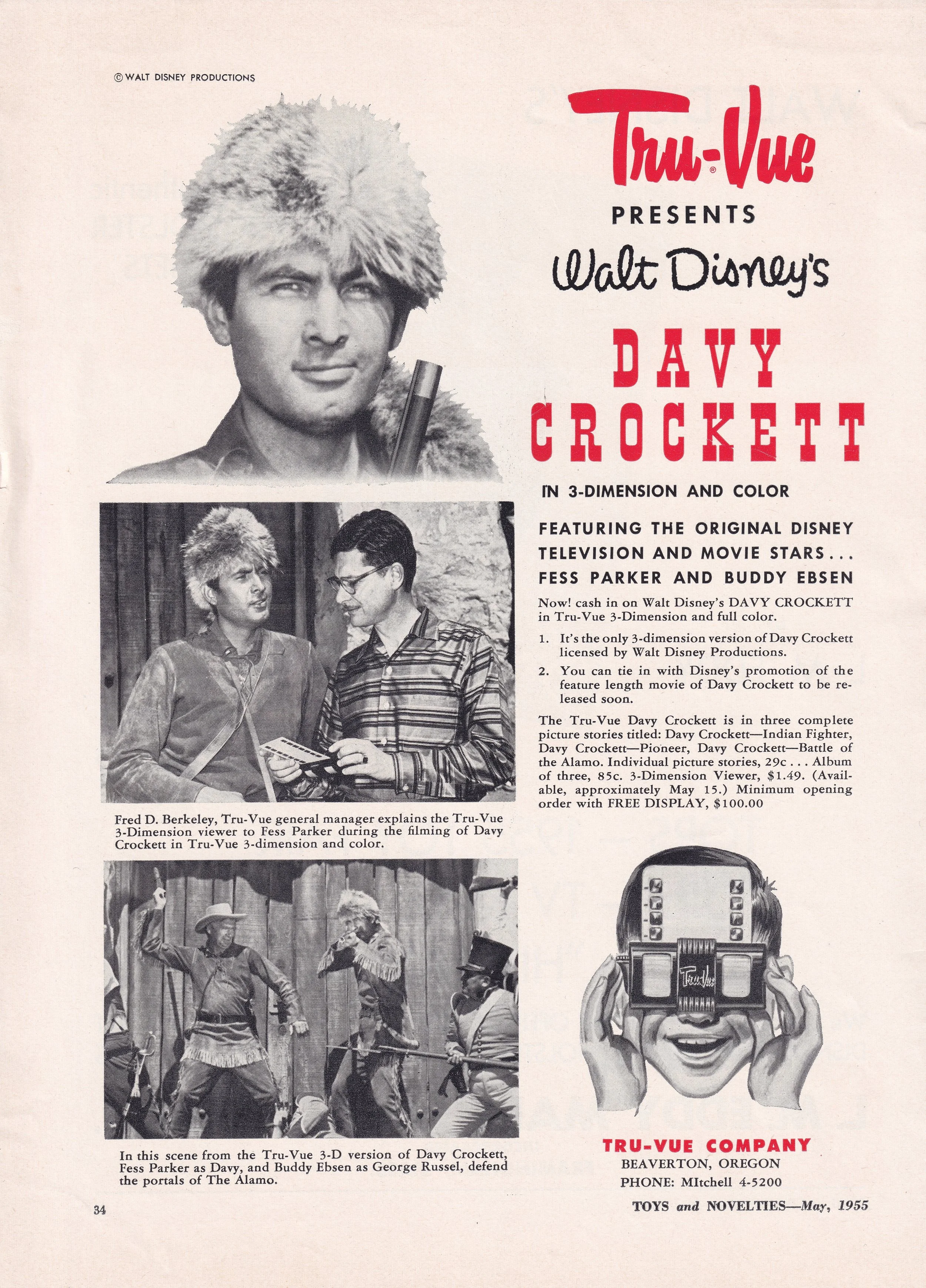
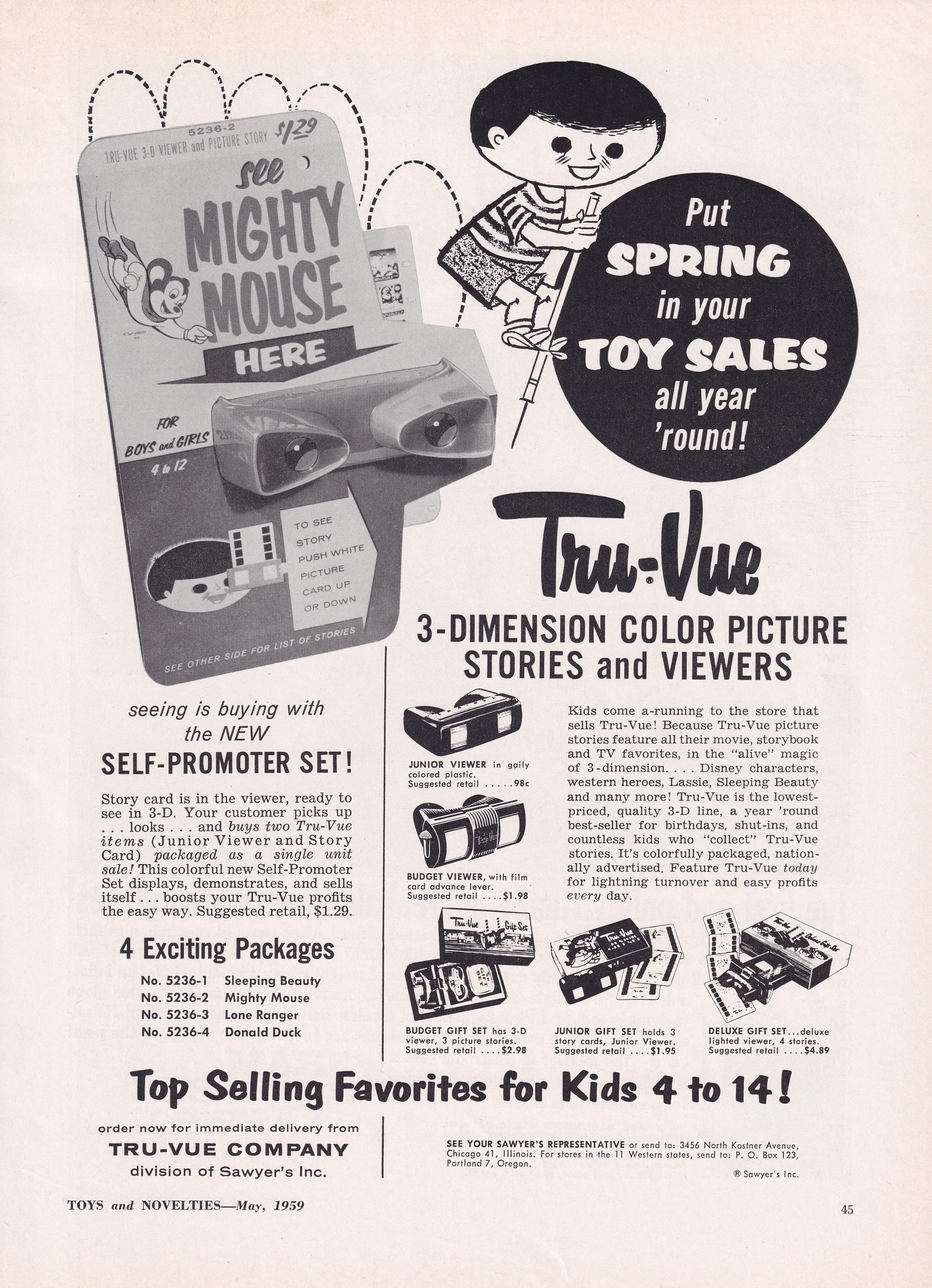
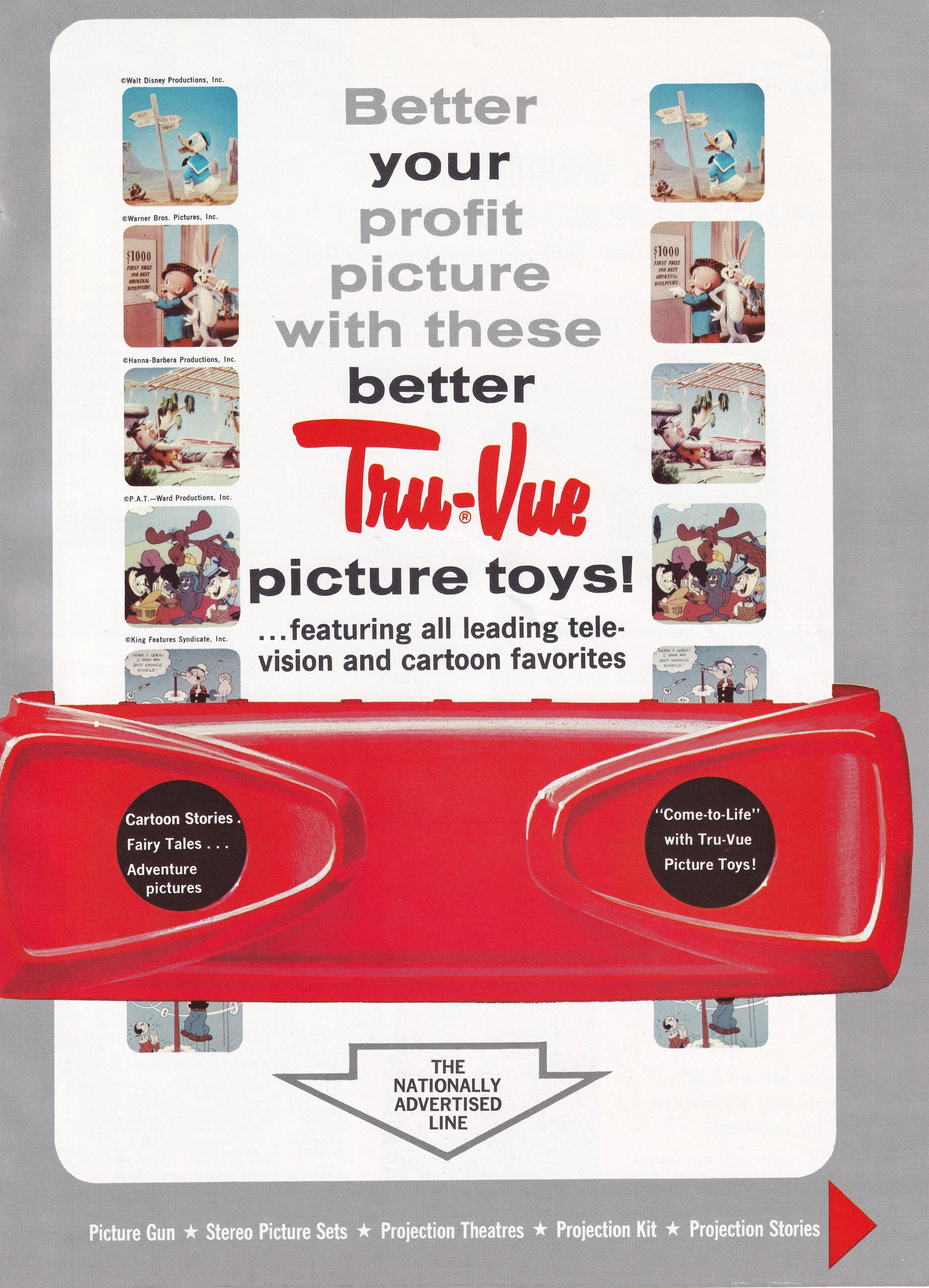
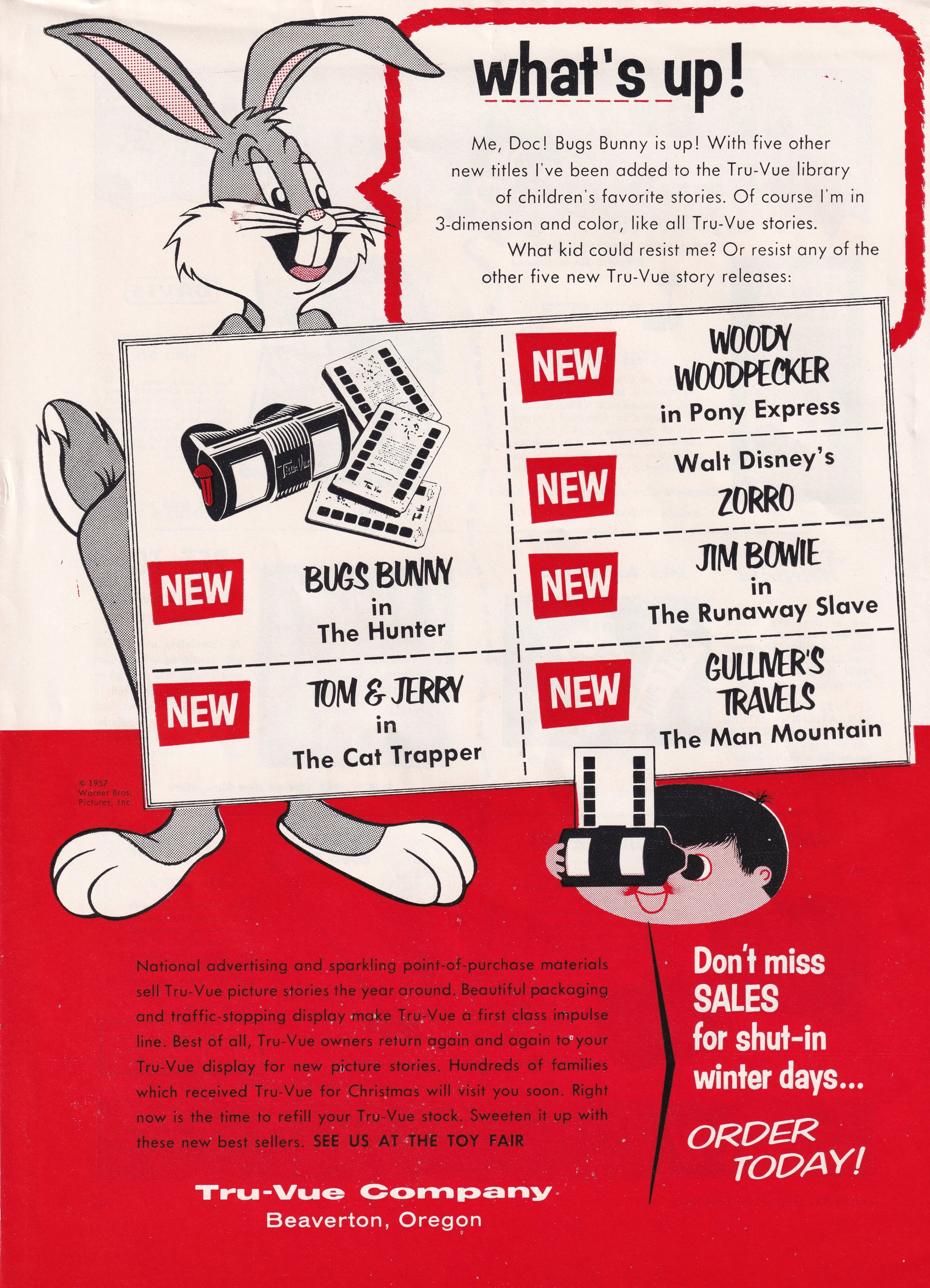
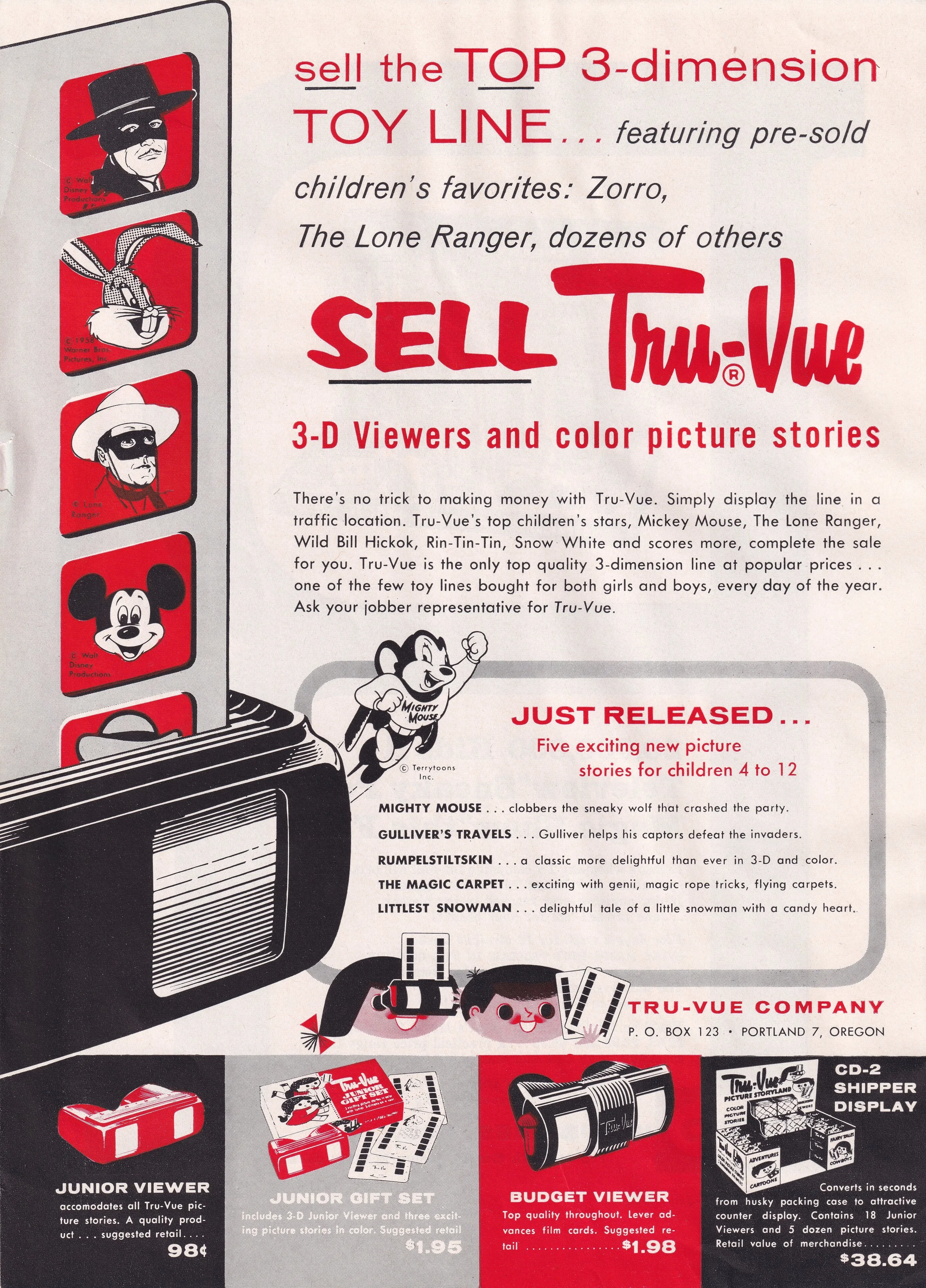
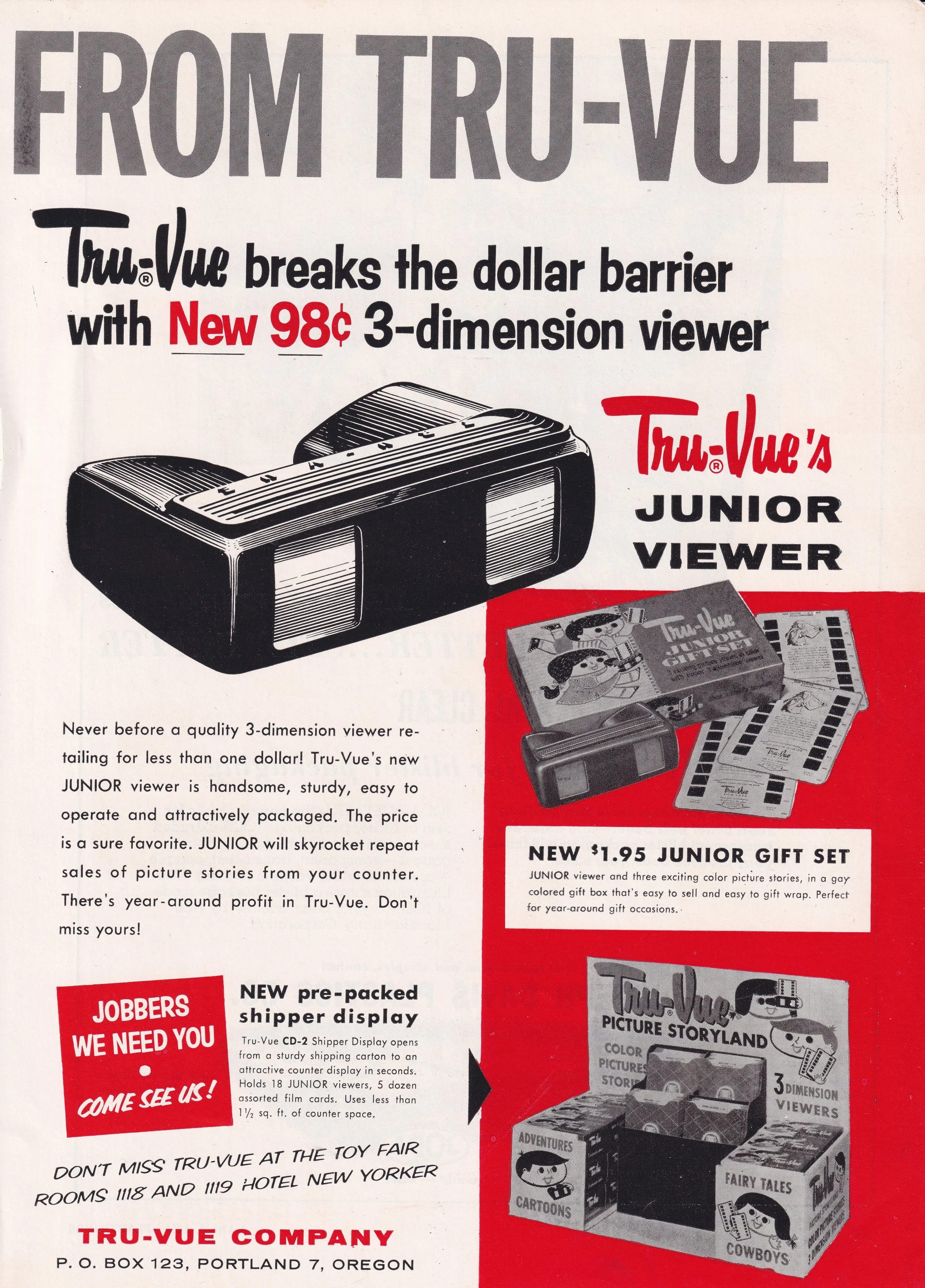
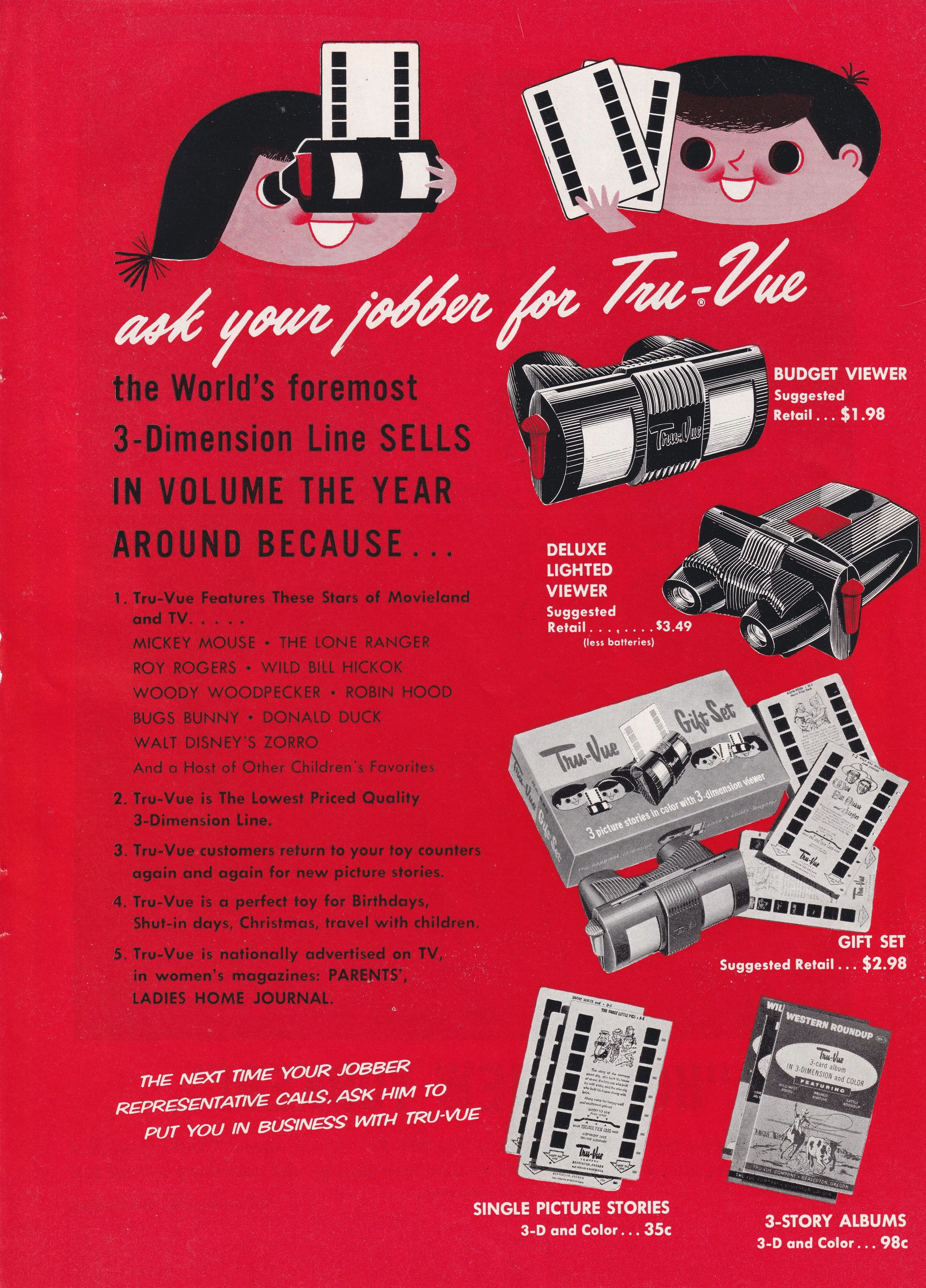
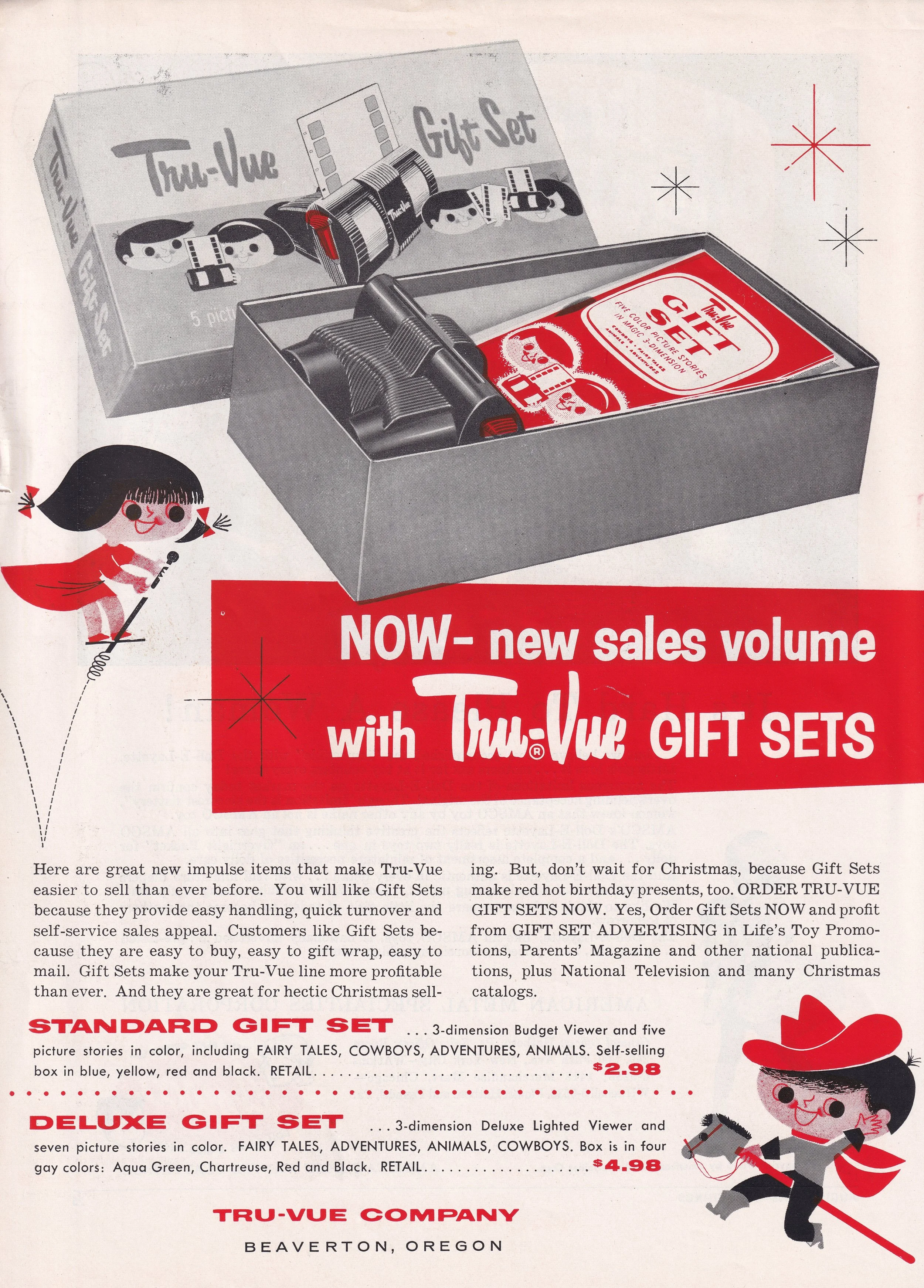
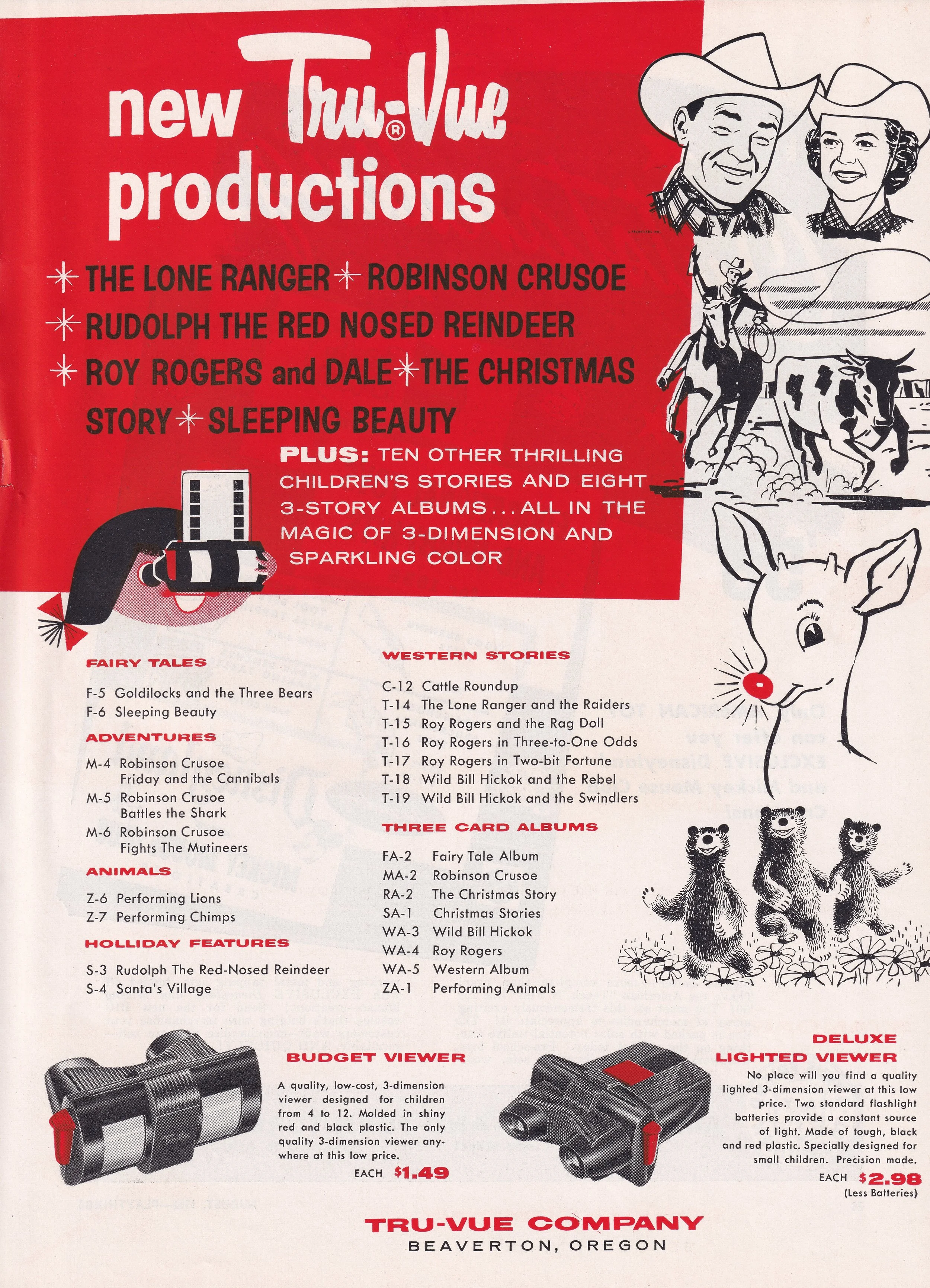
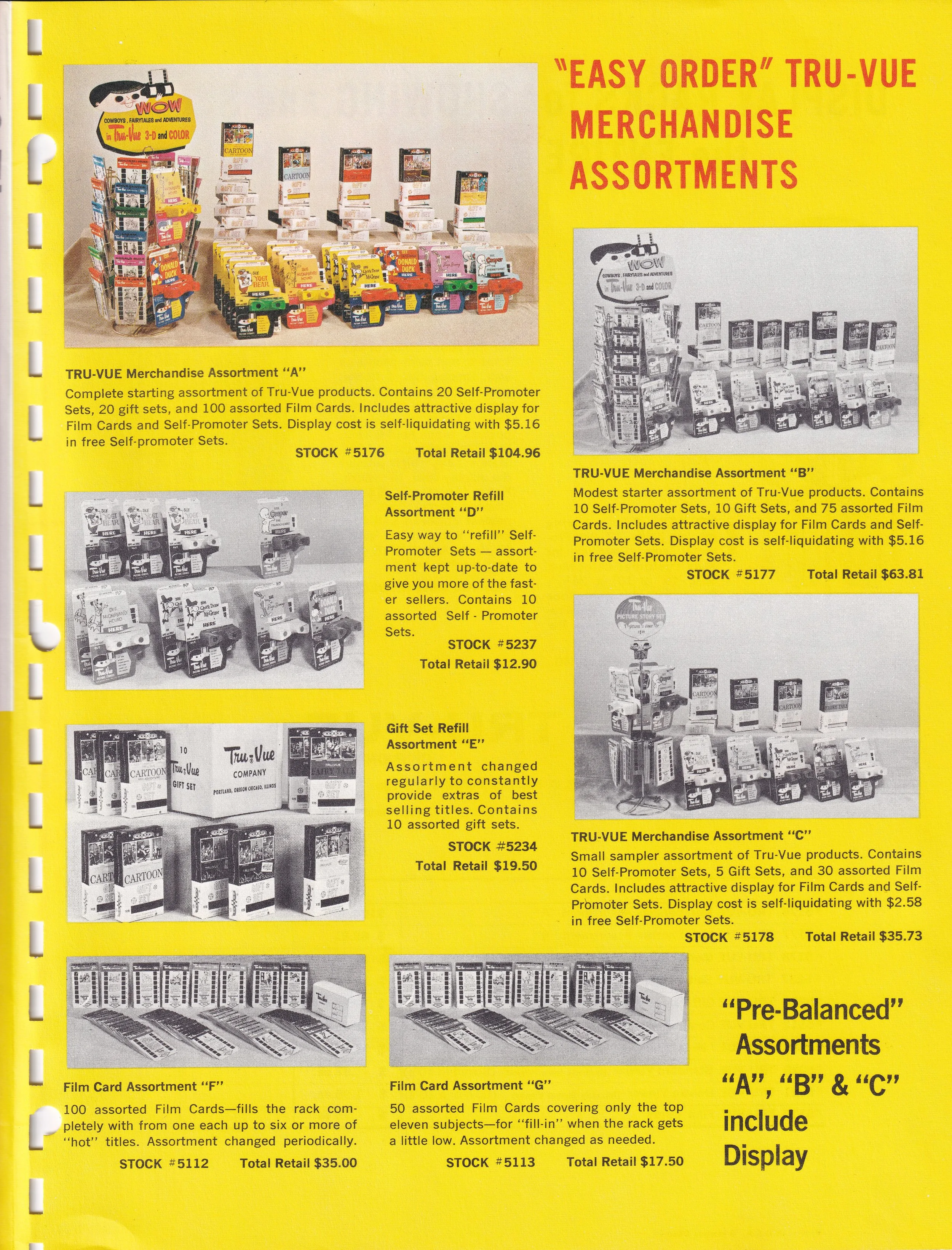
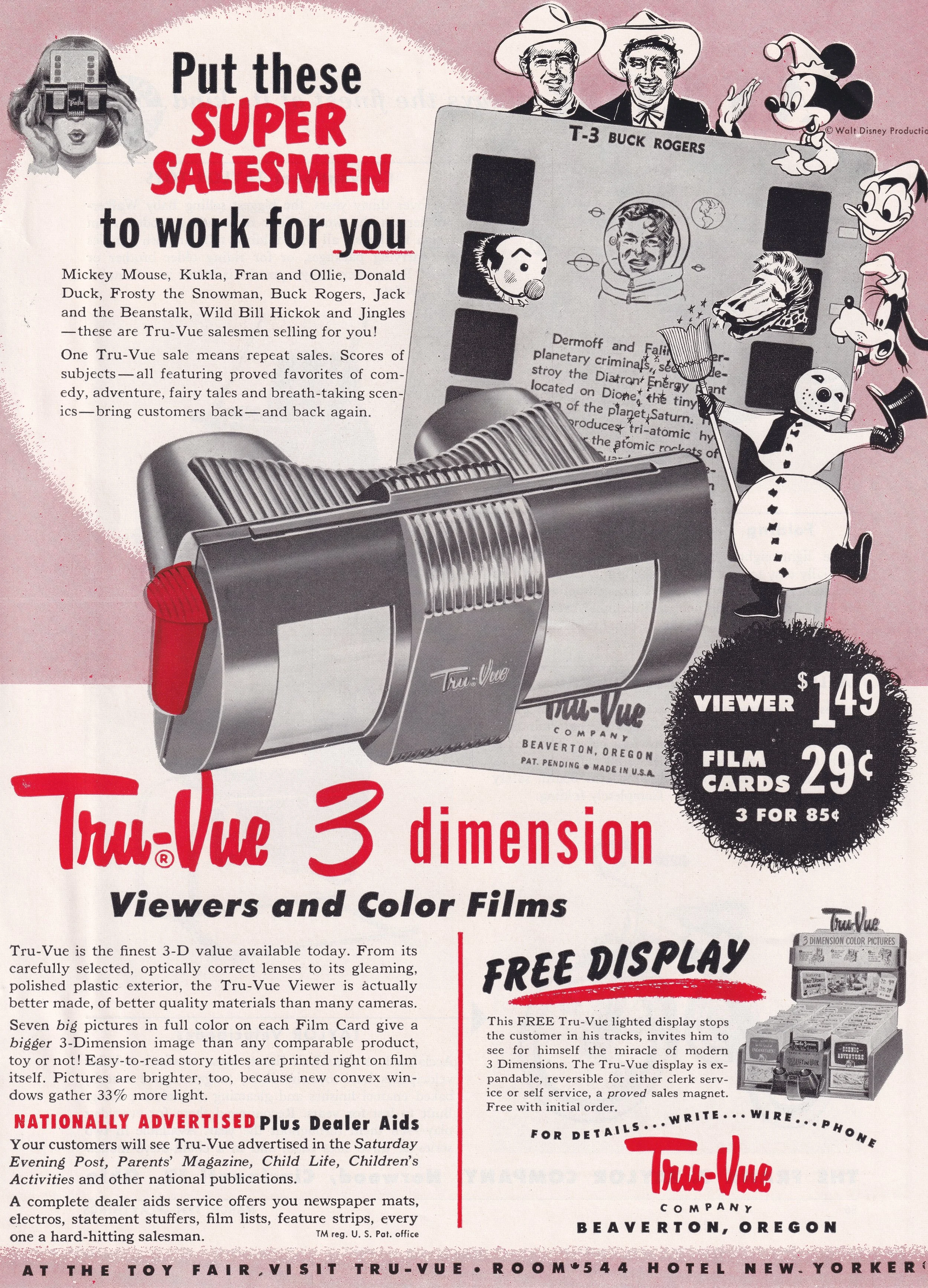
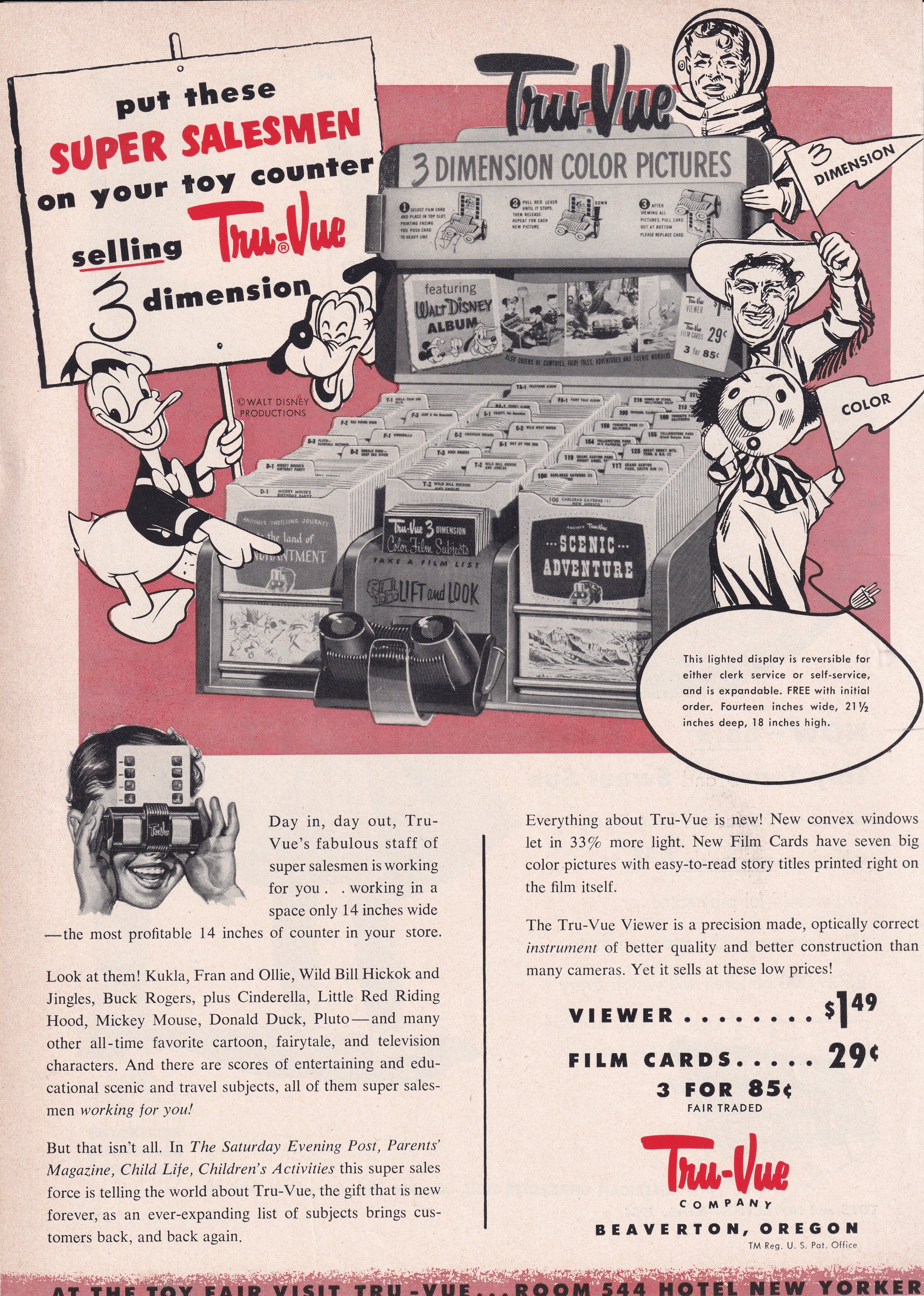
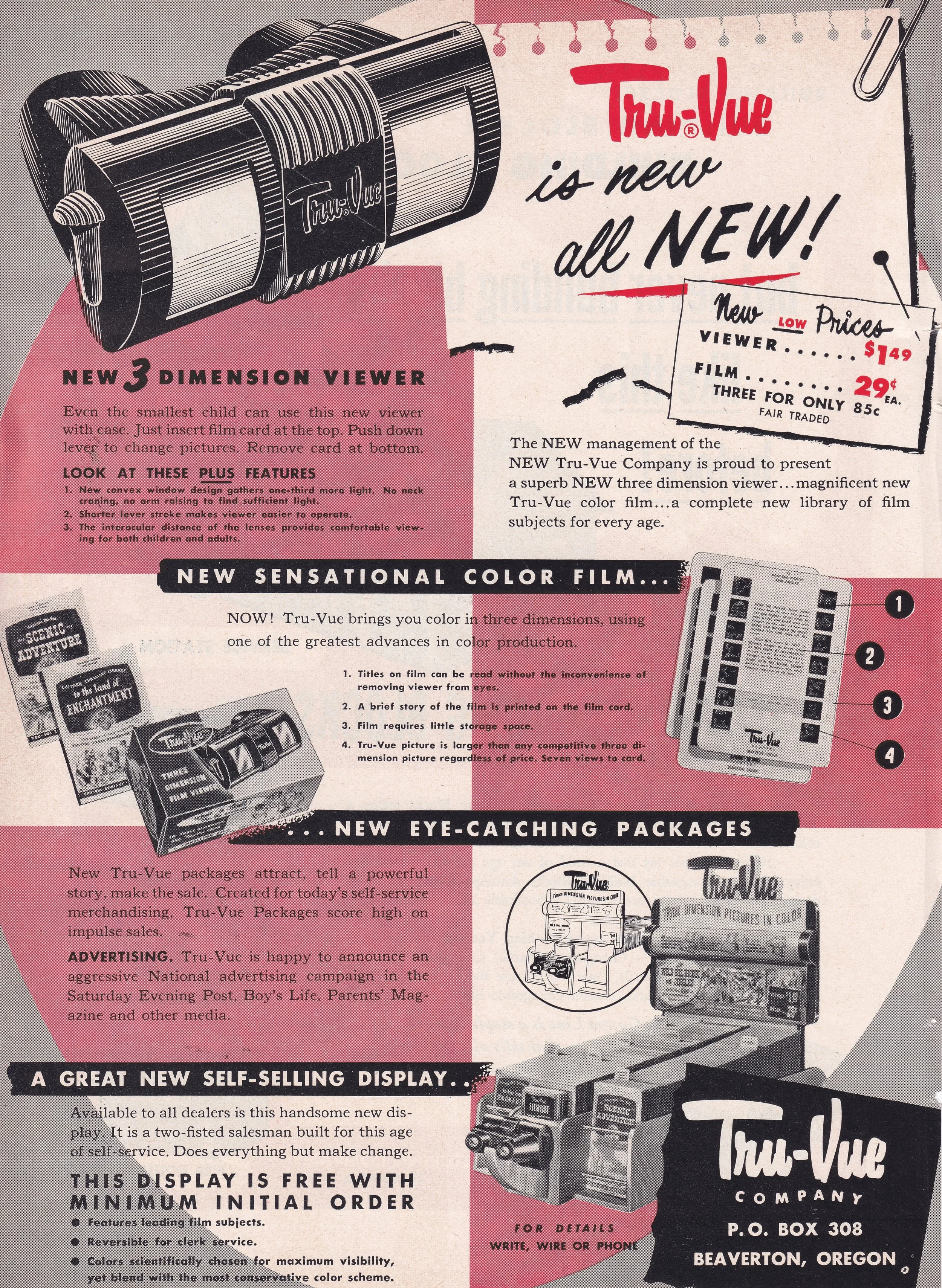
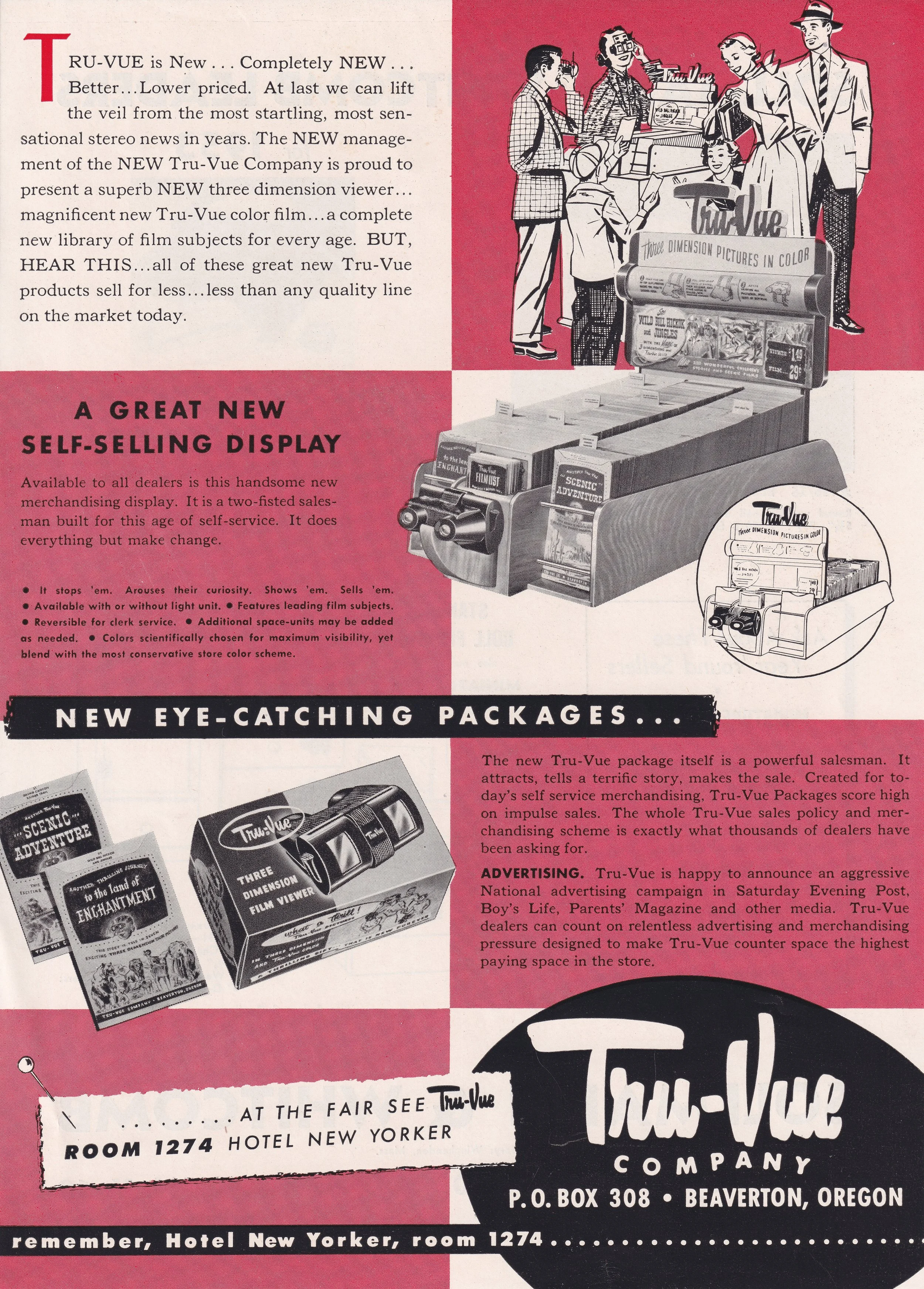
Tru-Vue’s marketing budget wasn’t only for advertising to consumers. They directed quite a bit of advertising to dealers, convincing them to place Tru-Vue in their stores.
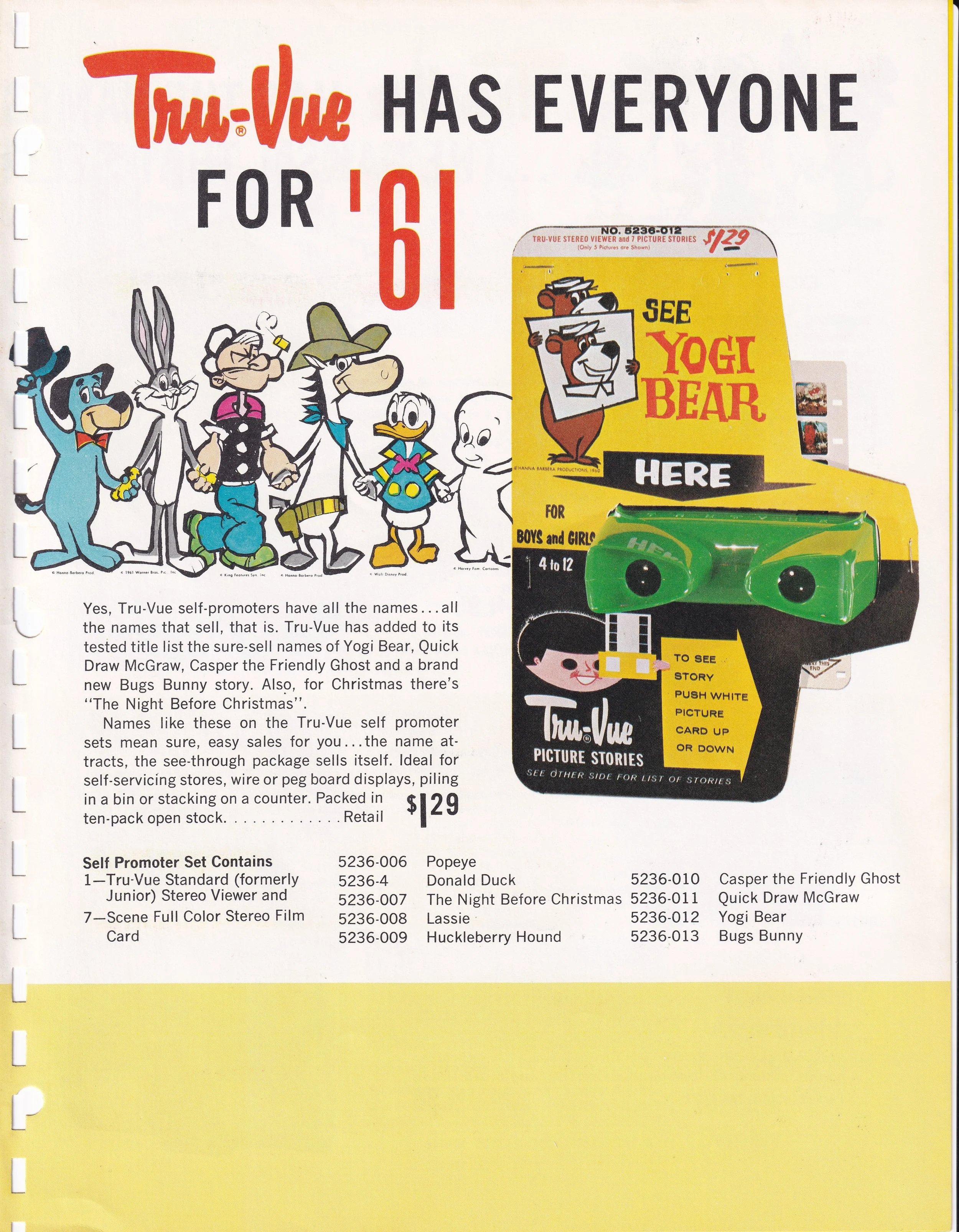
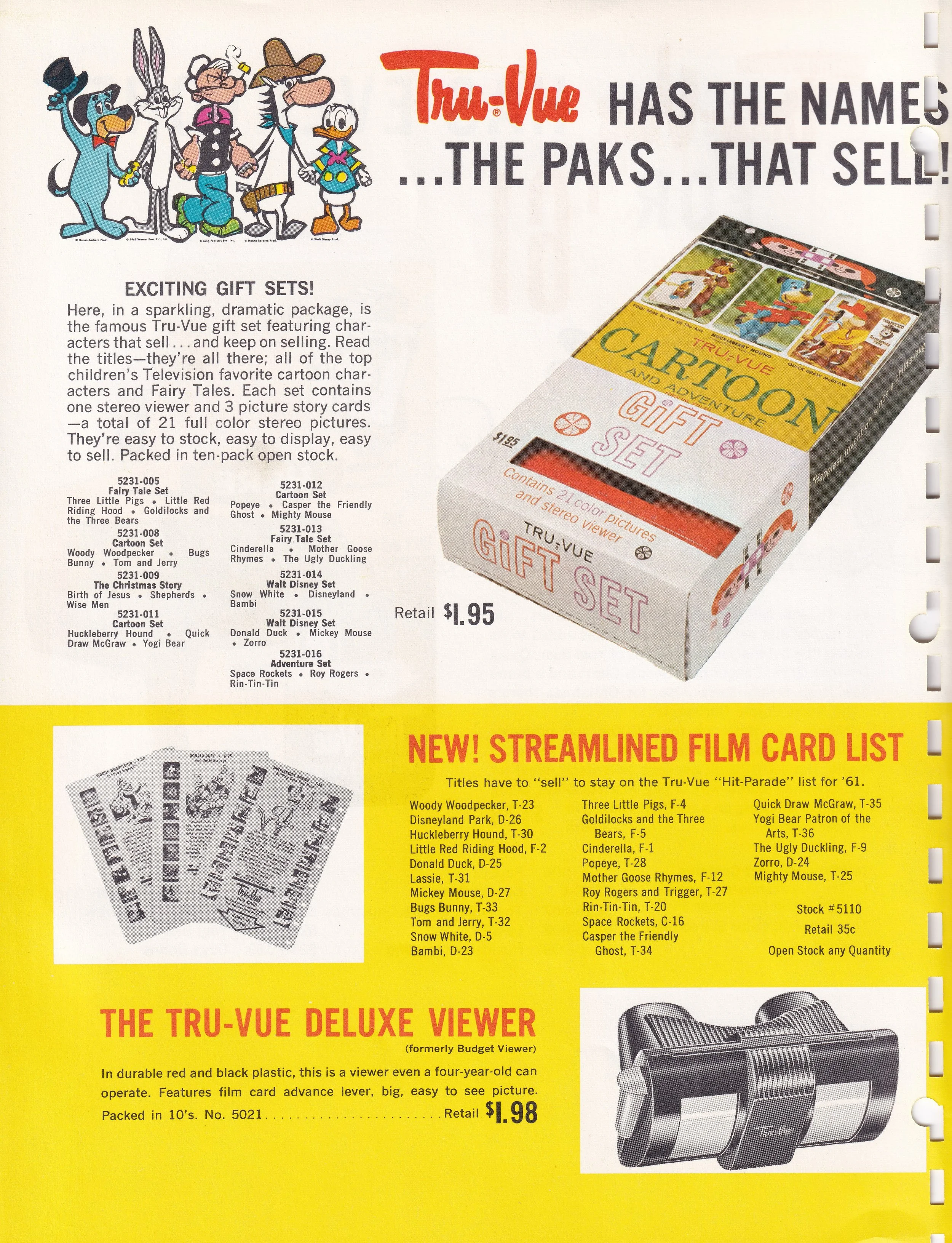
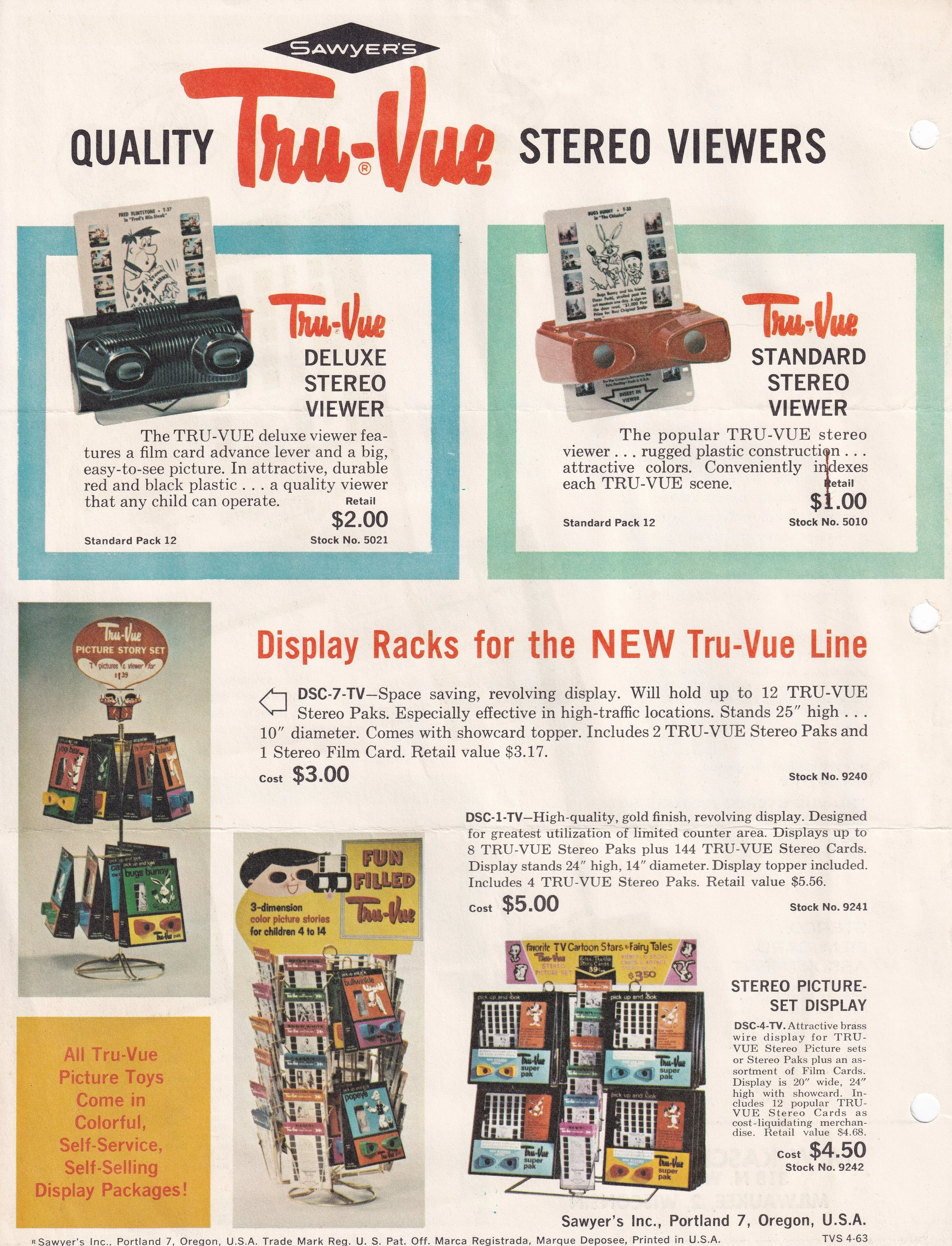
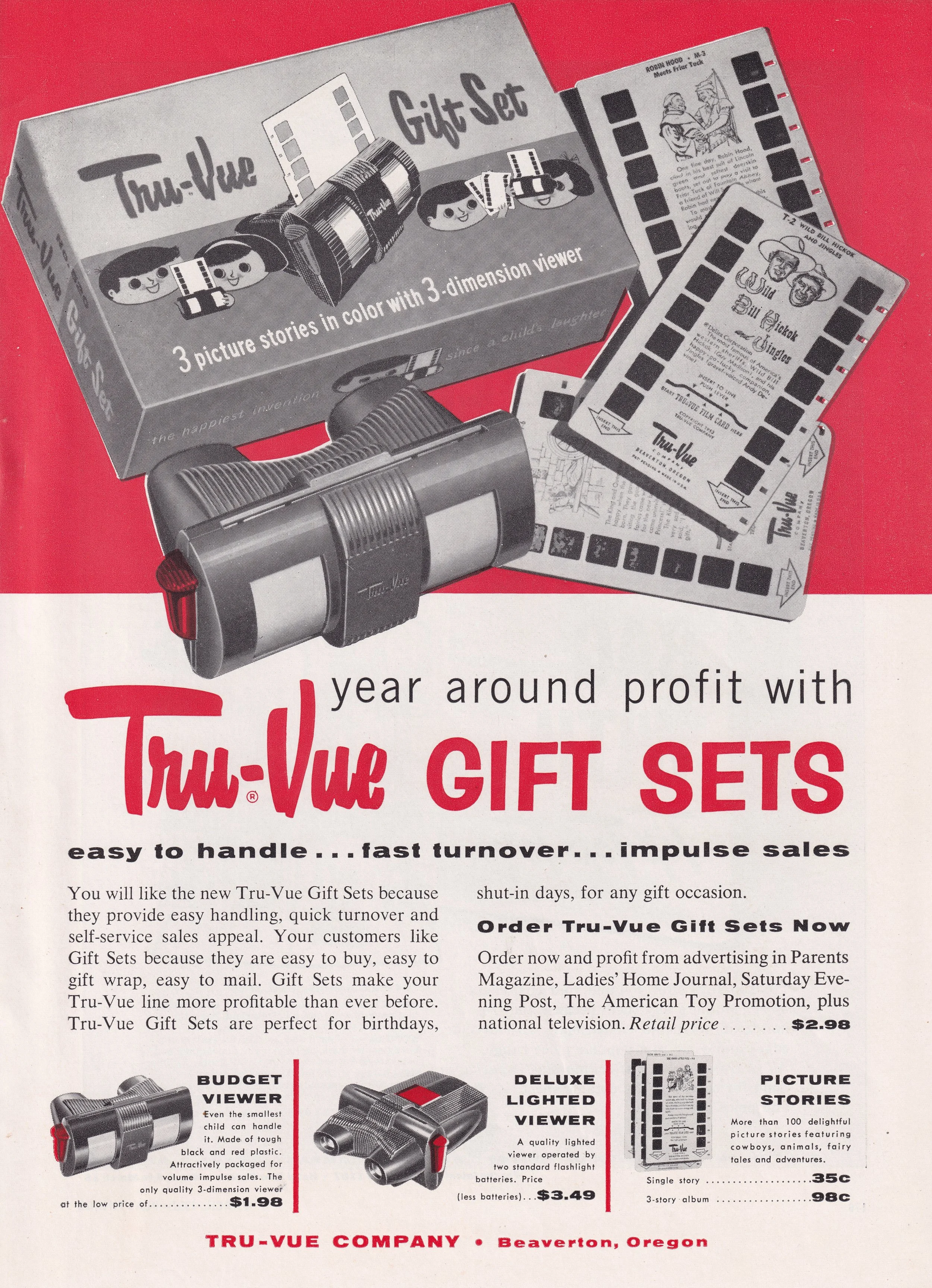
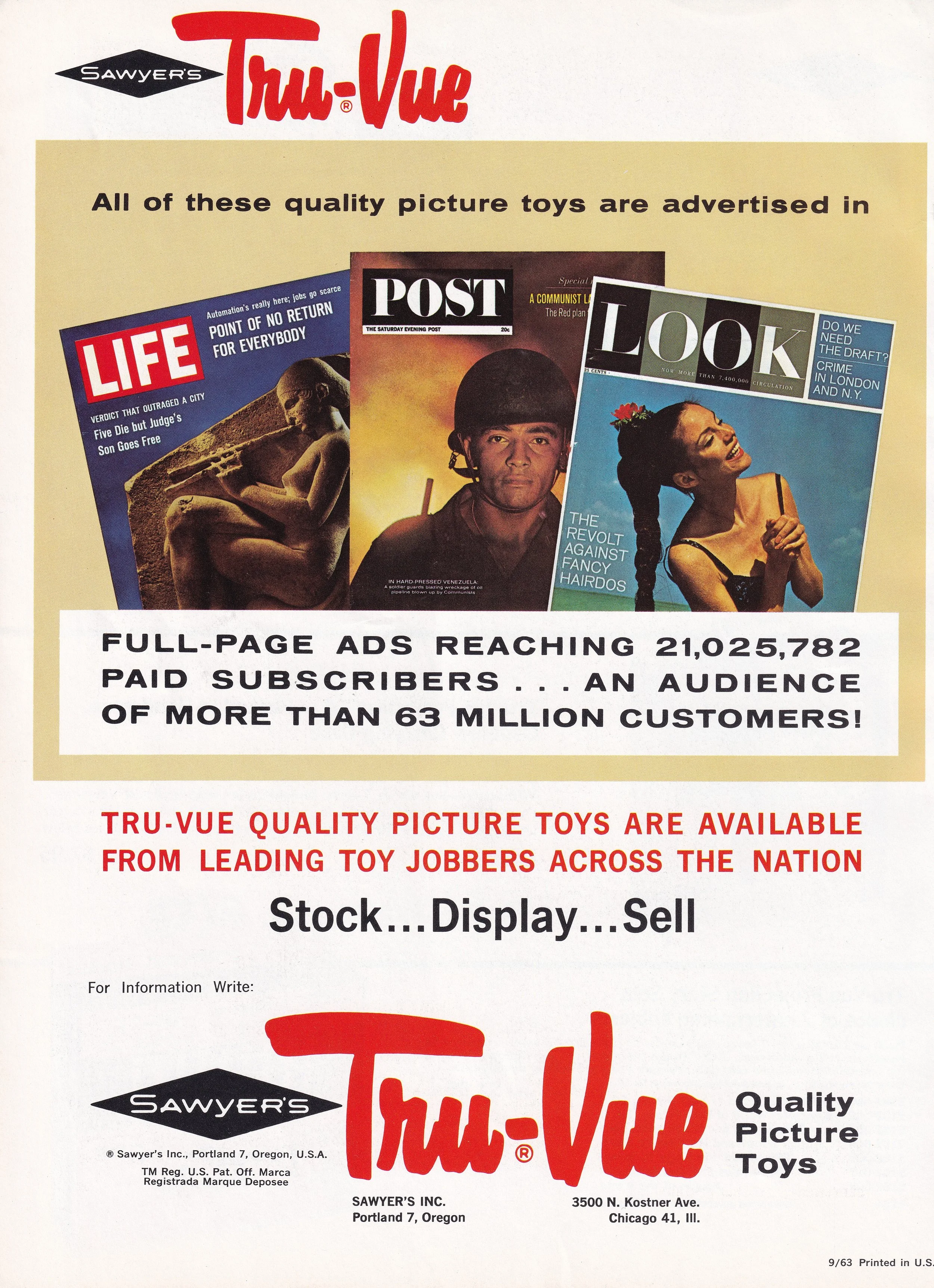
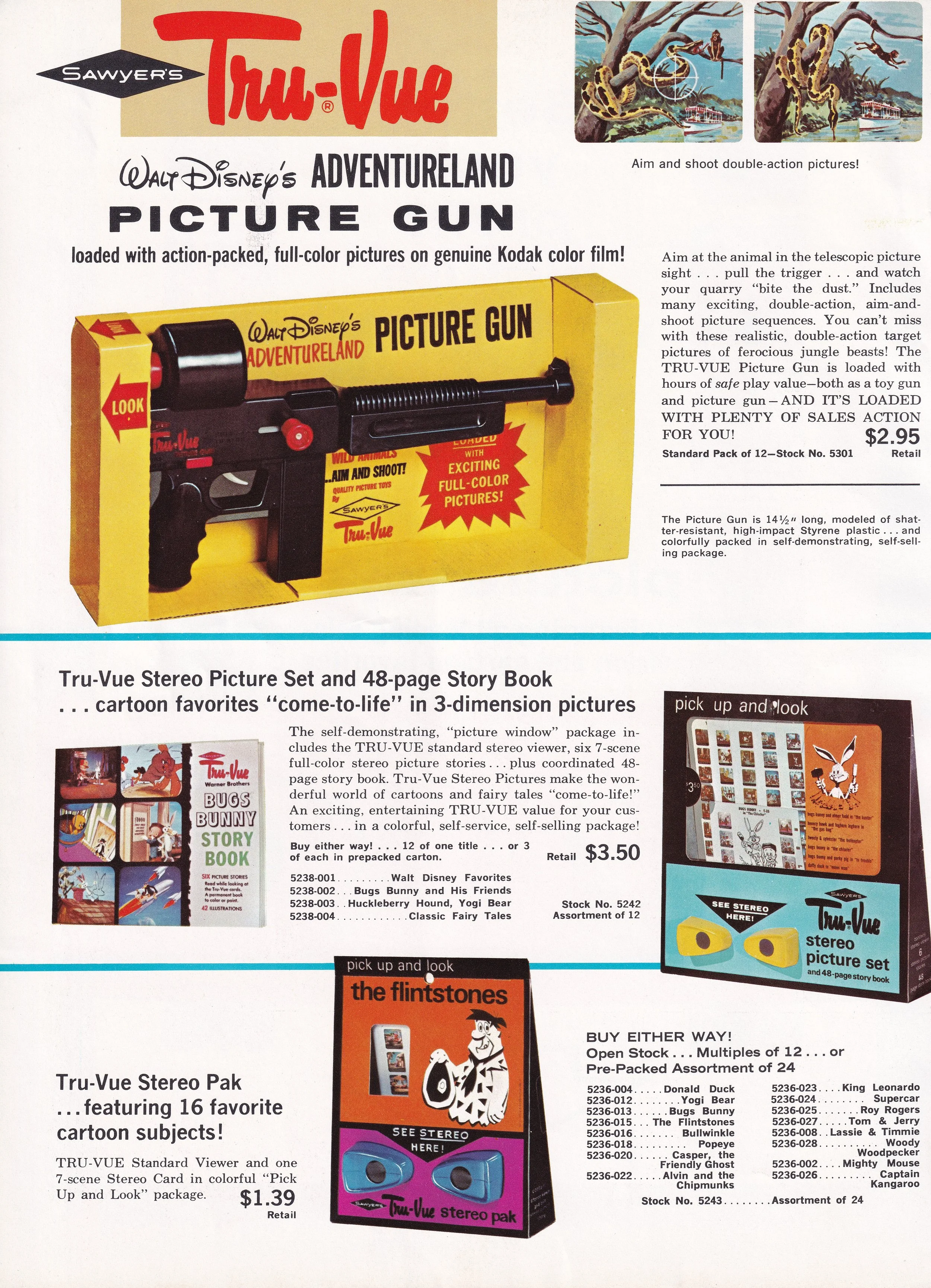
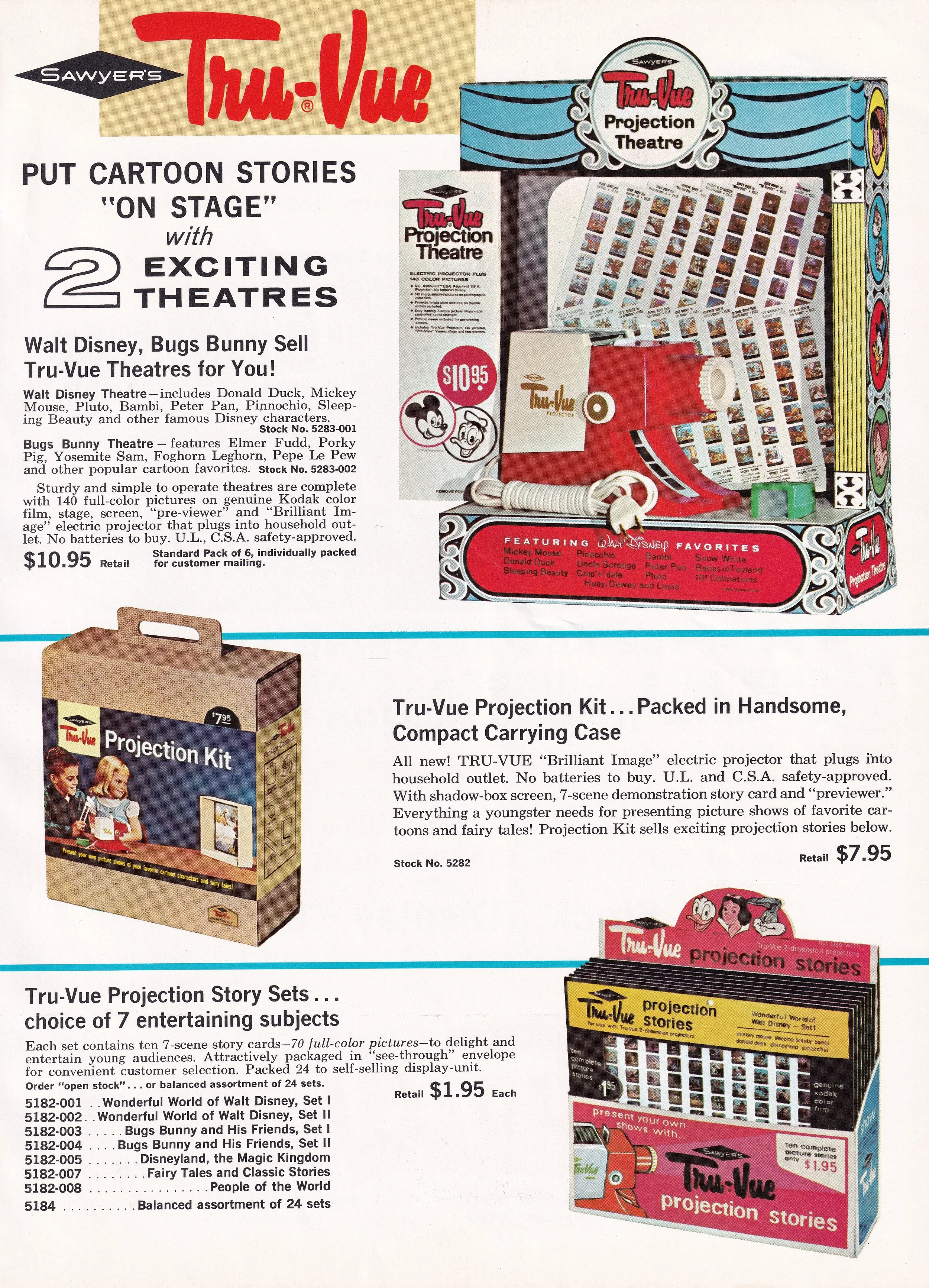
The ads were mailed to dealers, placed in magazines like Toys & Novelties, or made available at toy fairs and conventions. They promised year-round profit, packaging with sure-sell names like Yogi Bear, Casper, and Bugs Bunny, and assured national advertising on TV and in women’s magazines like Ladies Home Journal. Gift sets were promoted as easy to buy, easy to gift wrap, and easy to mail. By 1963, they were promising a reach of more than 63 million customers with full-page color ads in LIFE, Post, and Look.
Dealers had a wide variety of creative point-of-sale displays to choose from — a few are shown above, but there were many more, and they’re fun to collect.
Below are actual dealer correspondence & advertisements — not reproductions — in our collection.
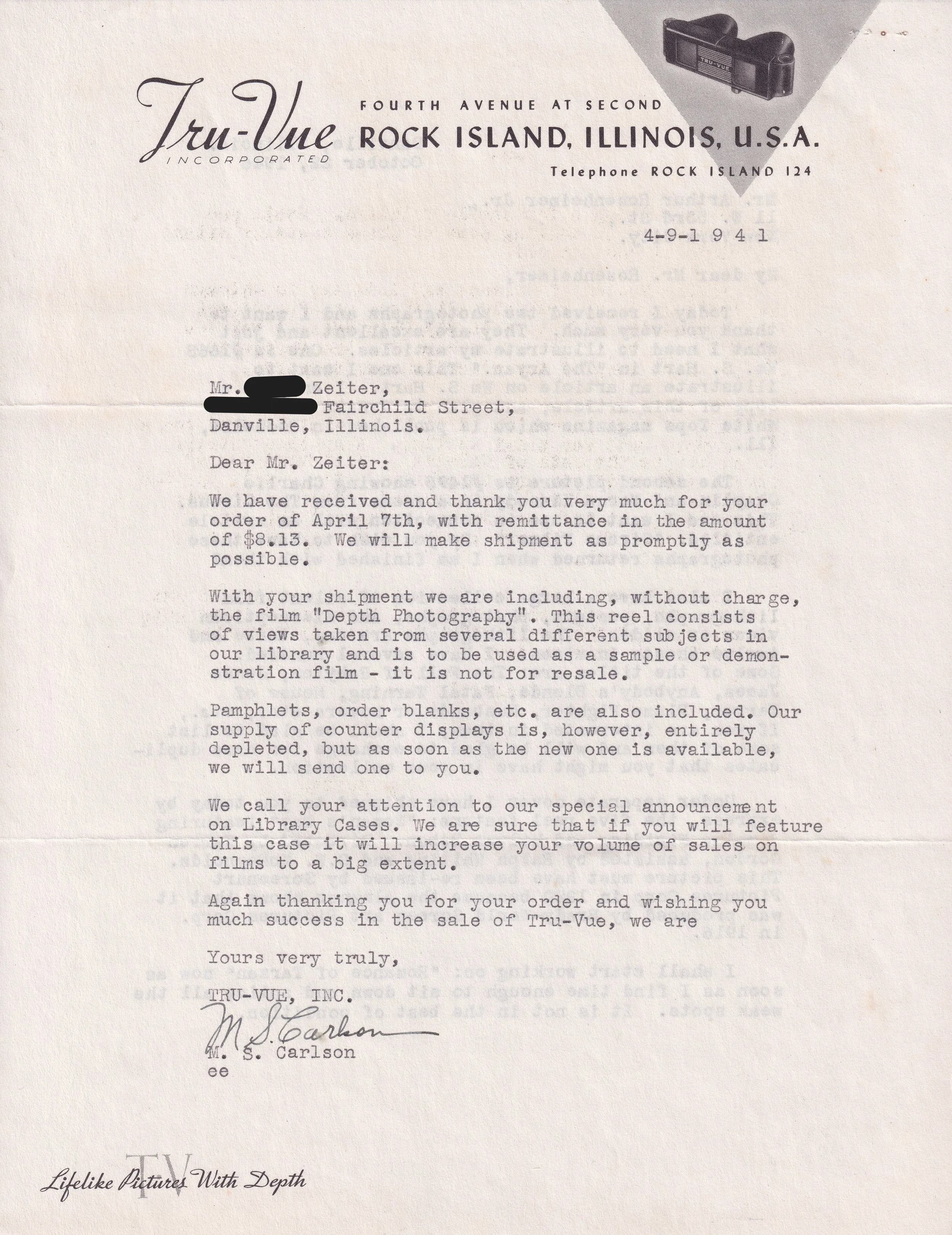
1941 Correspondence to Dealer
This typewritten letter is signed by Maurice Carlson, one of the founders of Tru-Vue and an executive at Rock Island Bridge & Iron Works.
Dealer Advertisement - Before Sale to Sawyer’s
Dealer Advertisements - After Sale to Sawyer’s
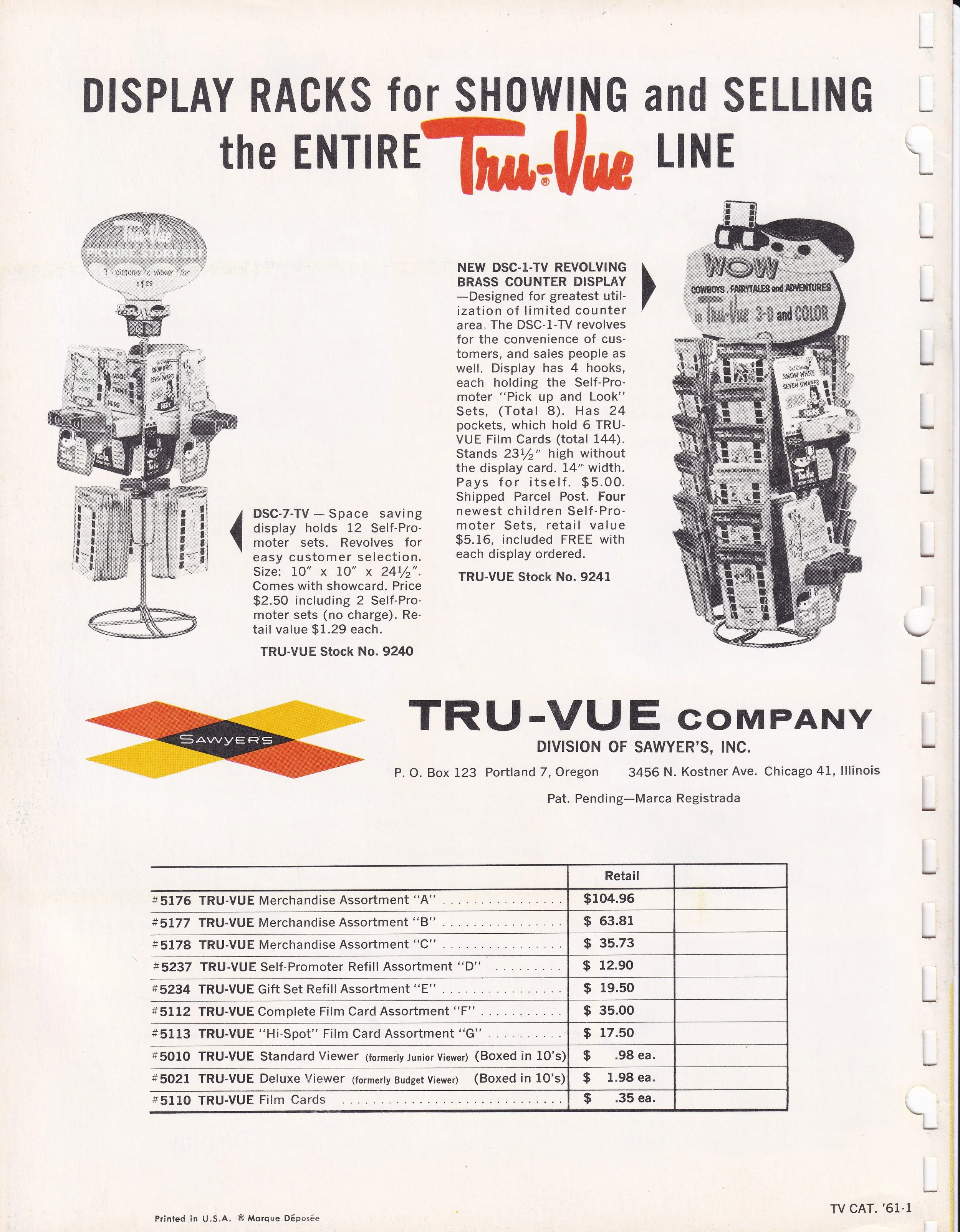
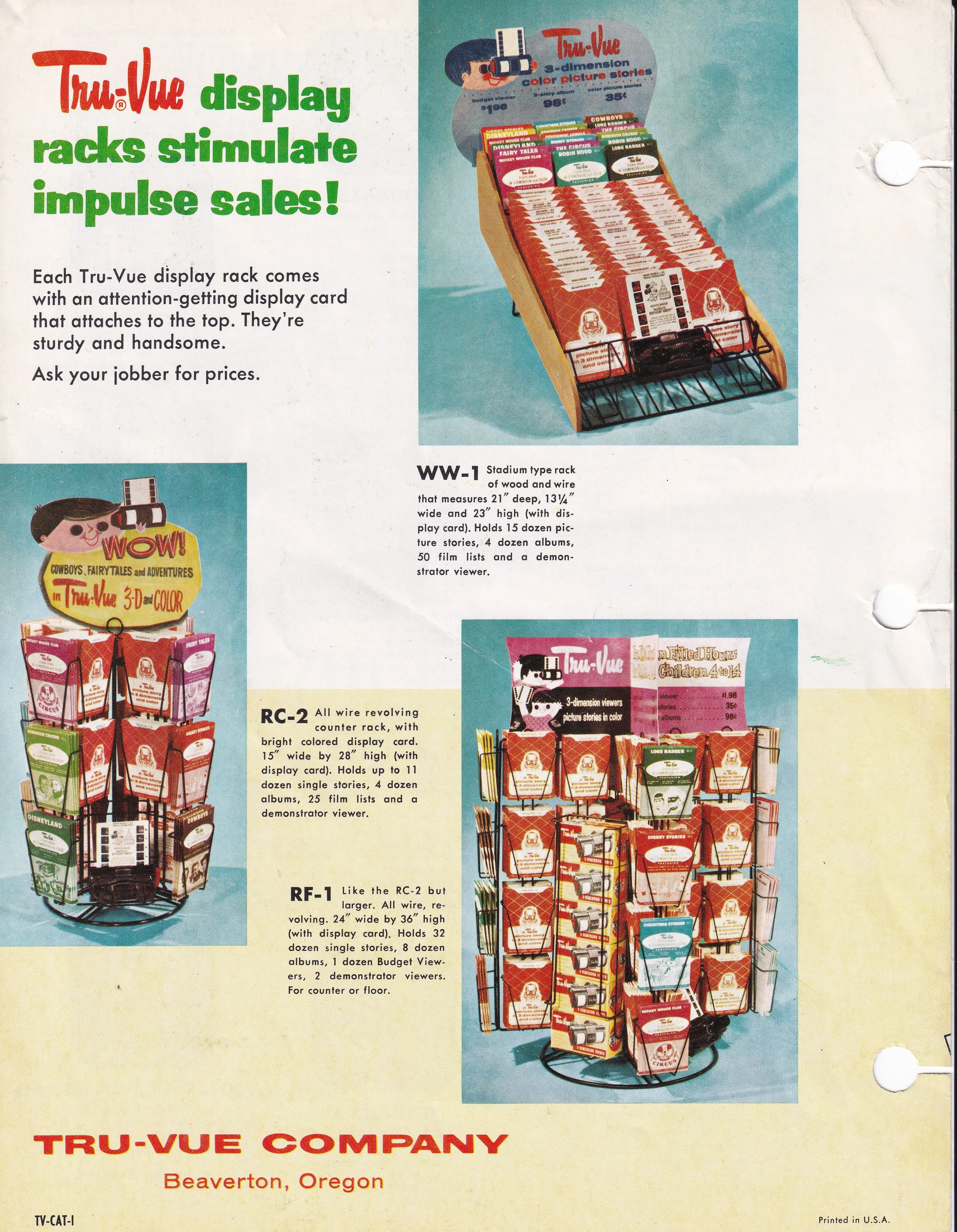
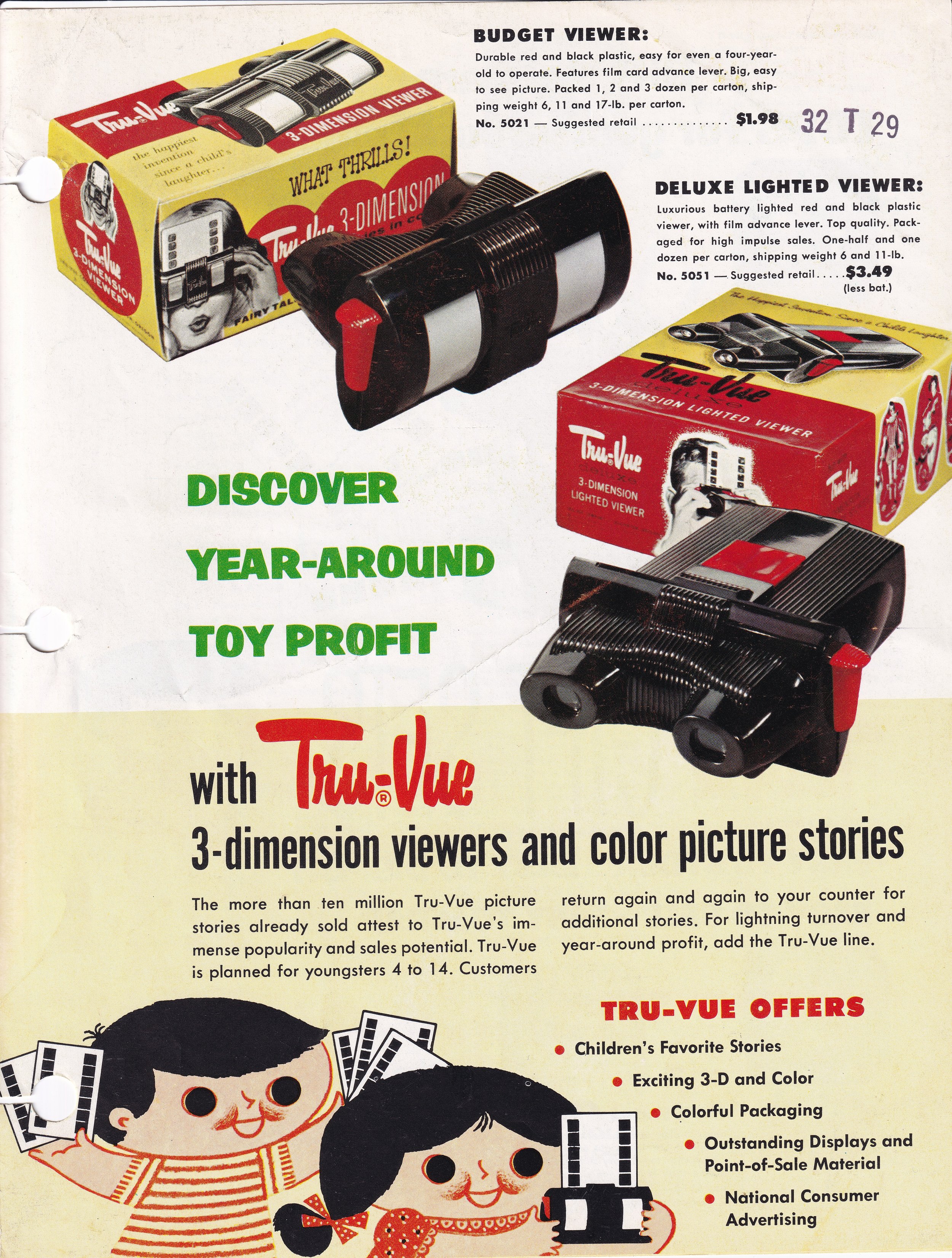
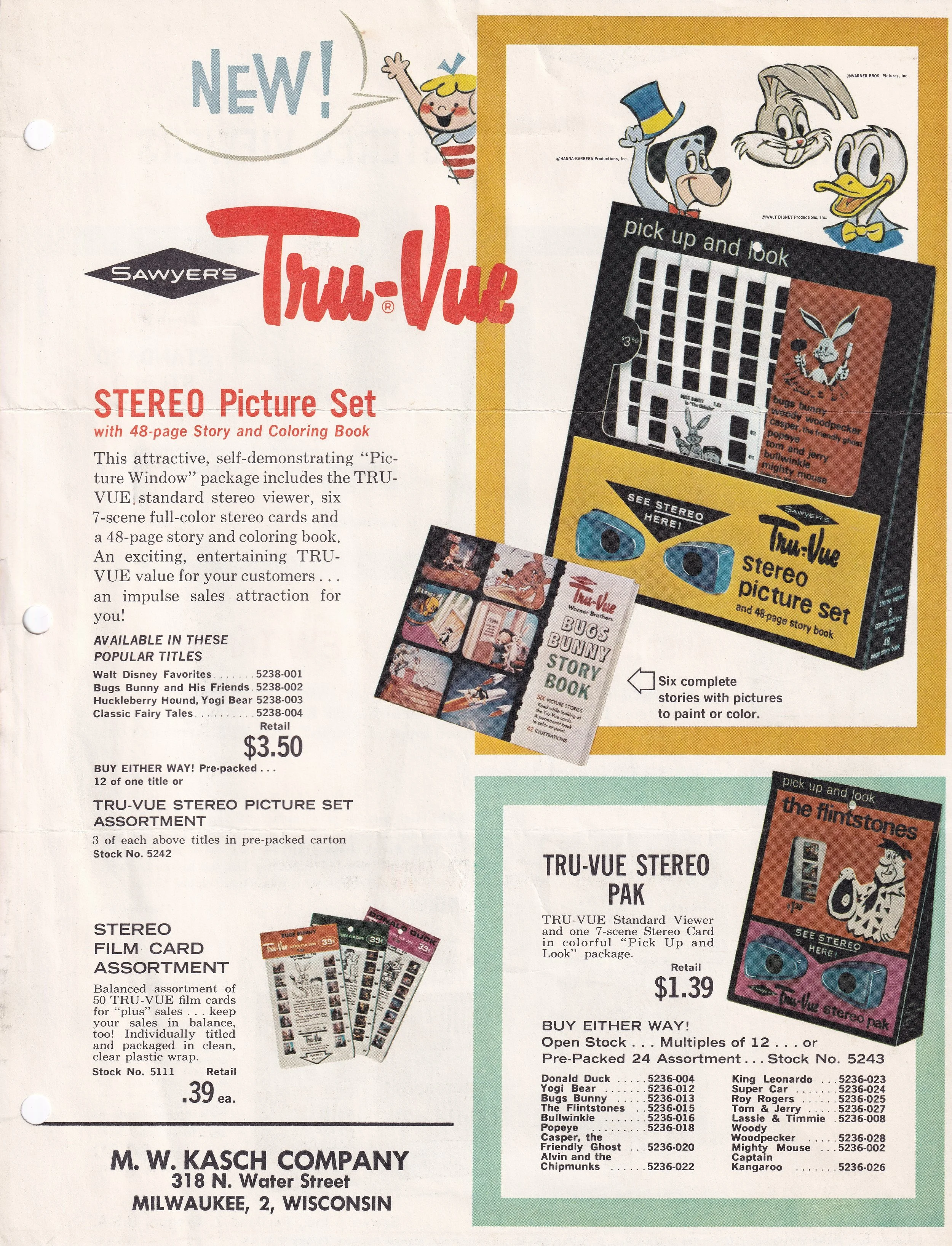
Tru-Vue Retail Point-of-Sale Displays
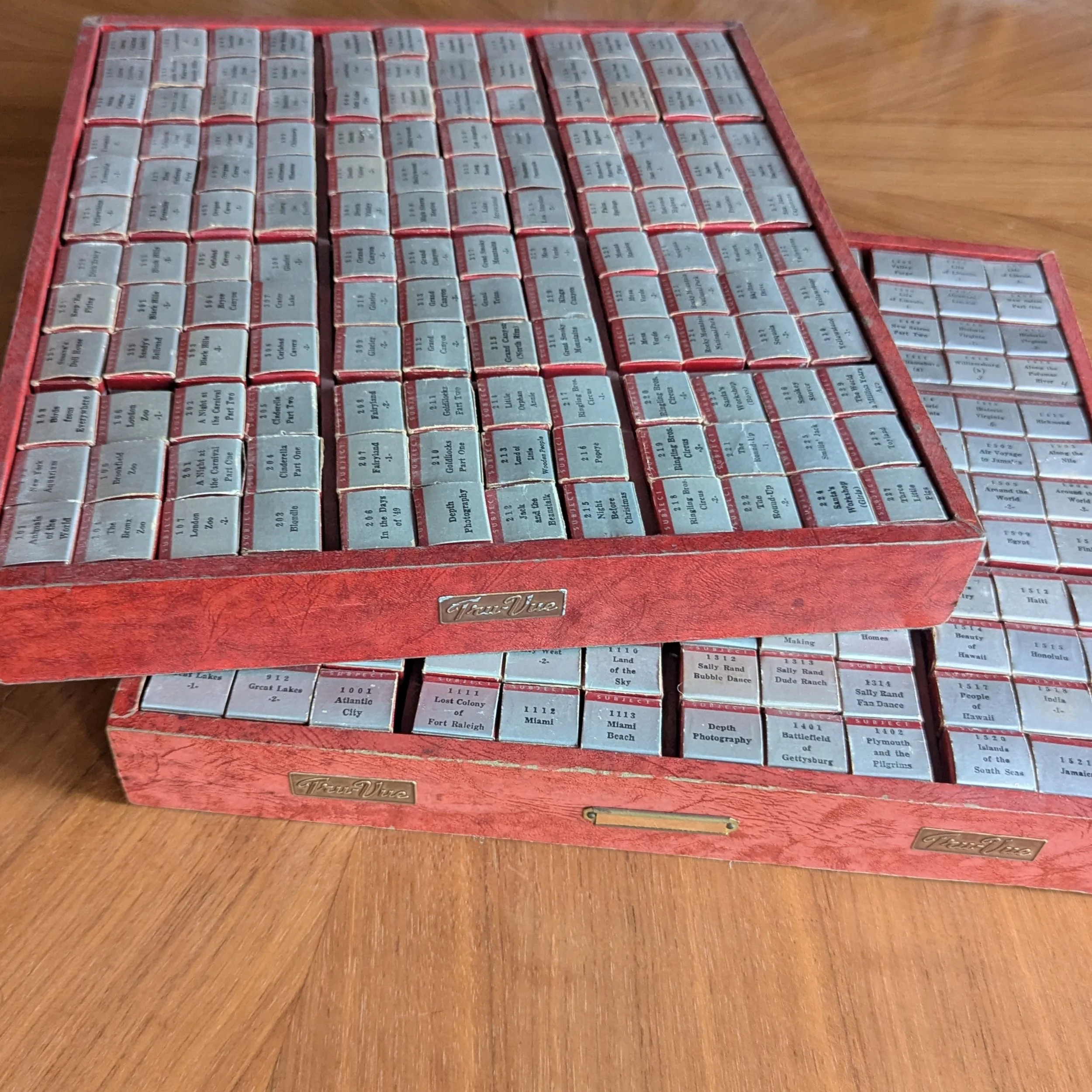
Film Display Tray for Counter, Showcase, or Shelf
In Tru-Vue’s promotional materials to dealers, these wooden trays were described as “fashionably finished in Cardinal Red Crackled Leatherette and identified with burnished gold Tru-Vue labels.” Each tray holds 144 film boxes, sectioned into 12 groups of 12. In addition to the gold Tru-Vue labels, the trays had a small gold metal card holder that could be used for indexing.
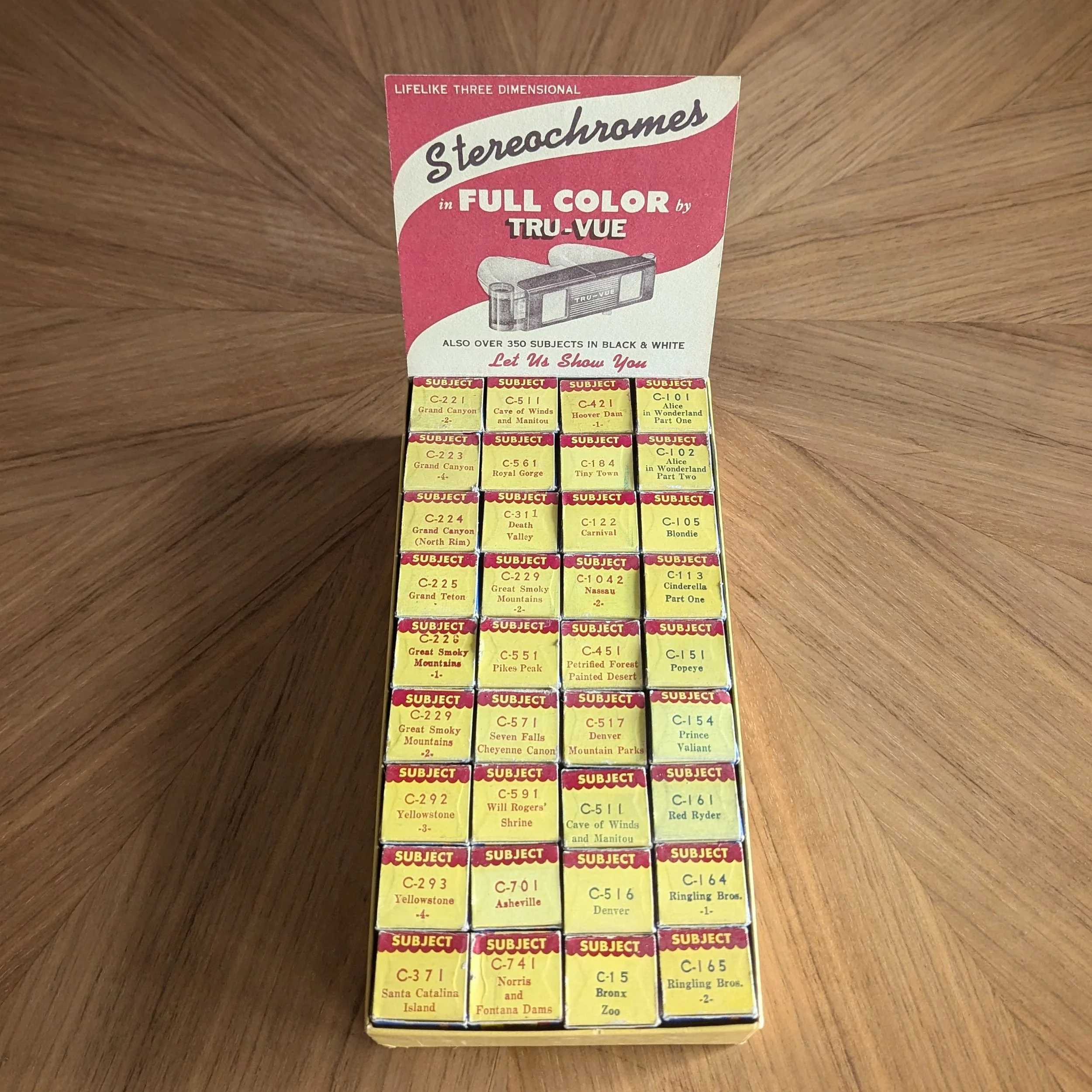
36 Film Display Box
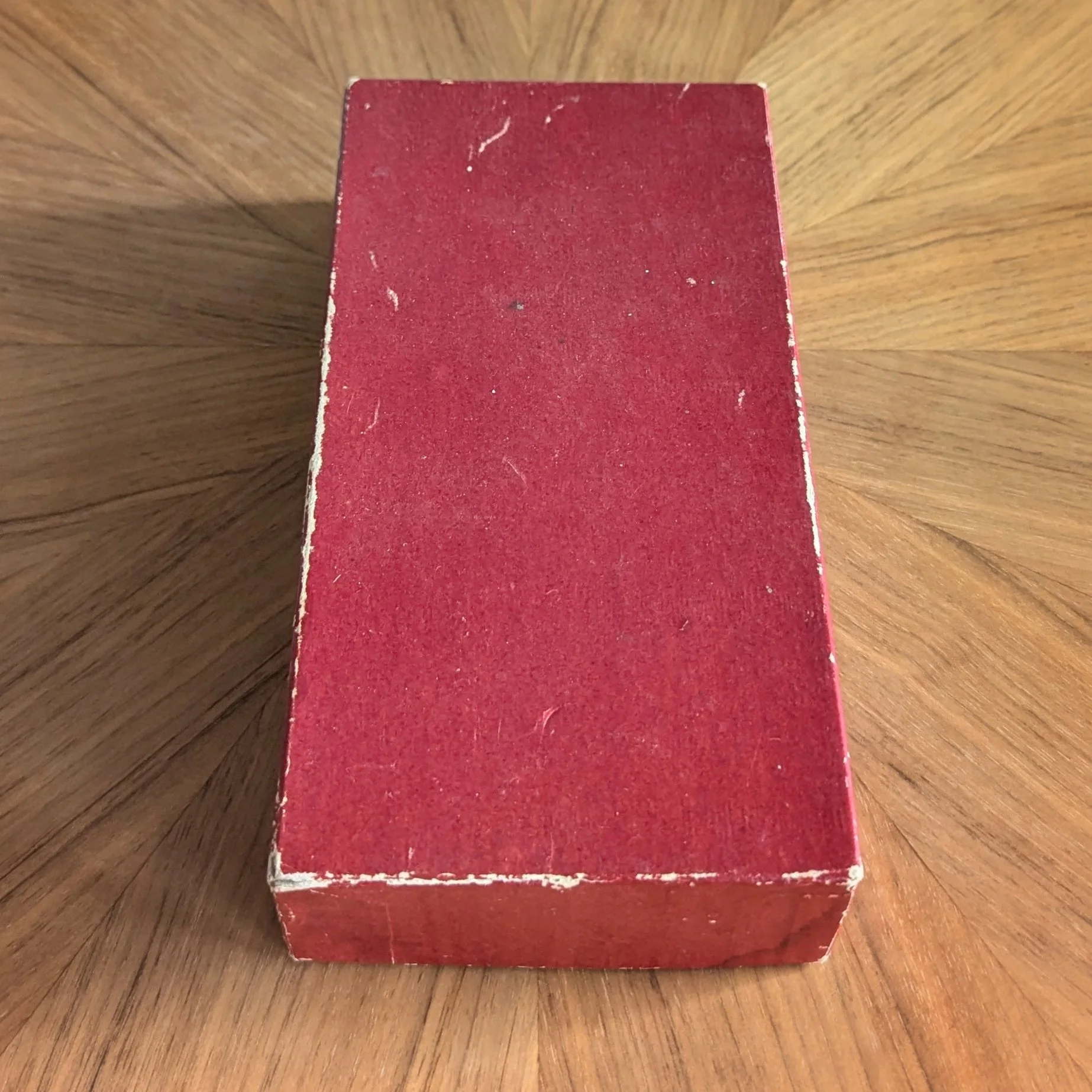
This red cardboard box opens to become a display box for Tru-Vue’s full-color Stereochromes.
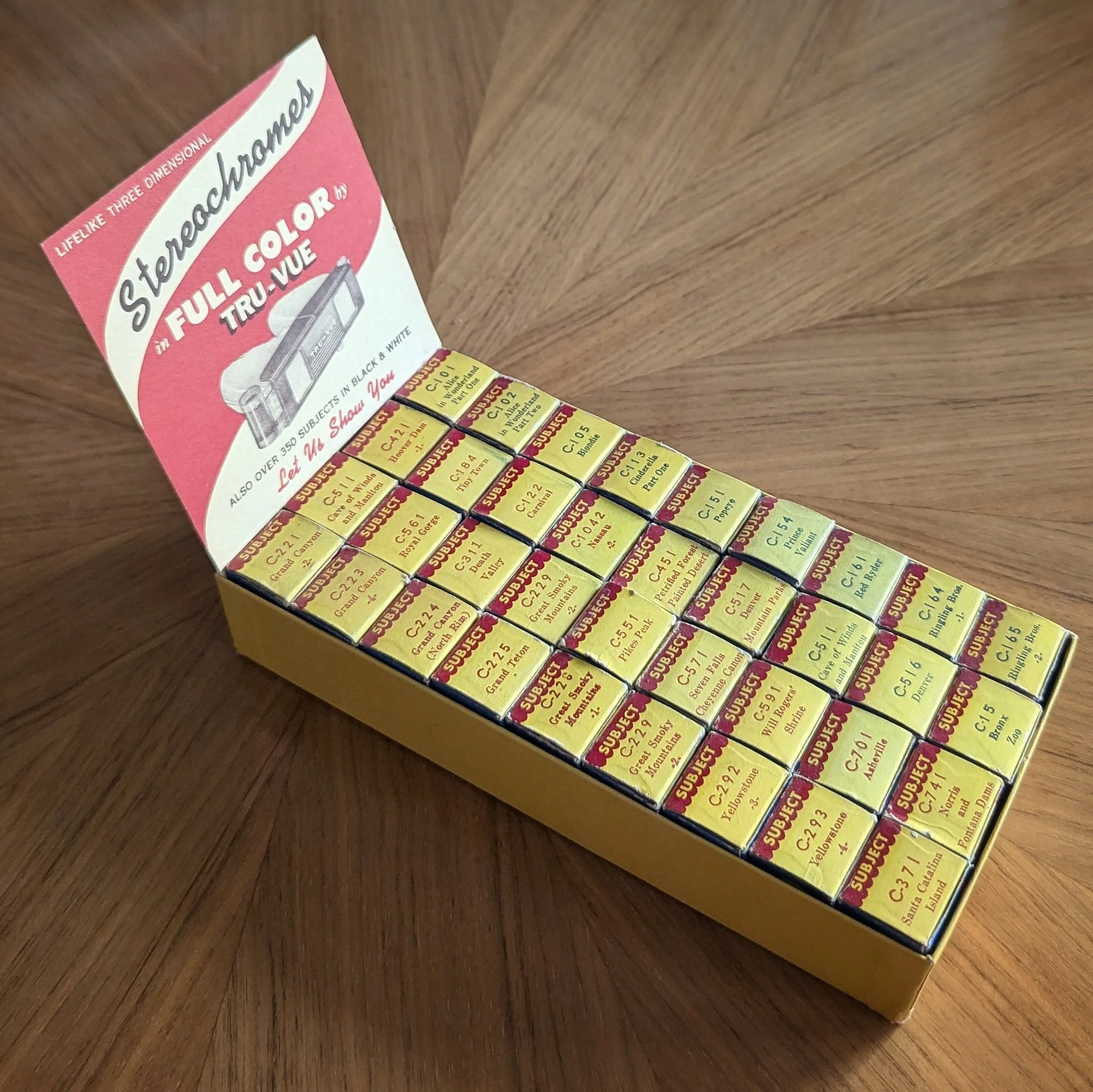
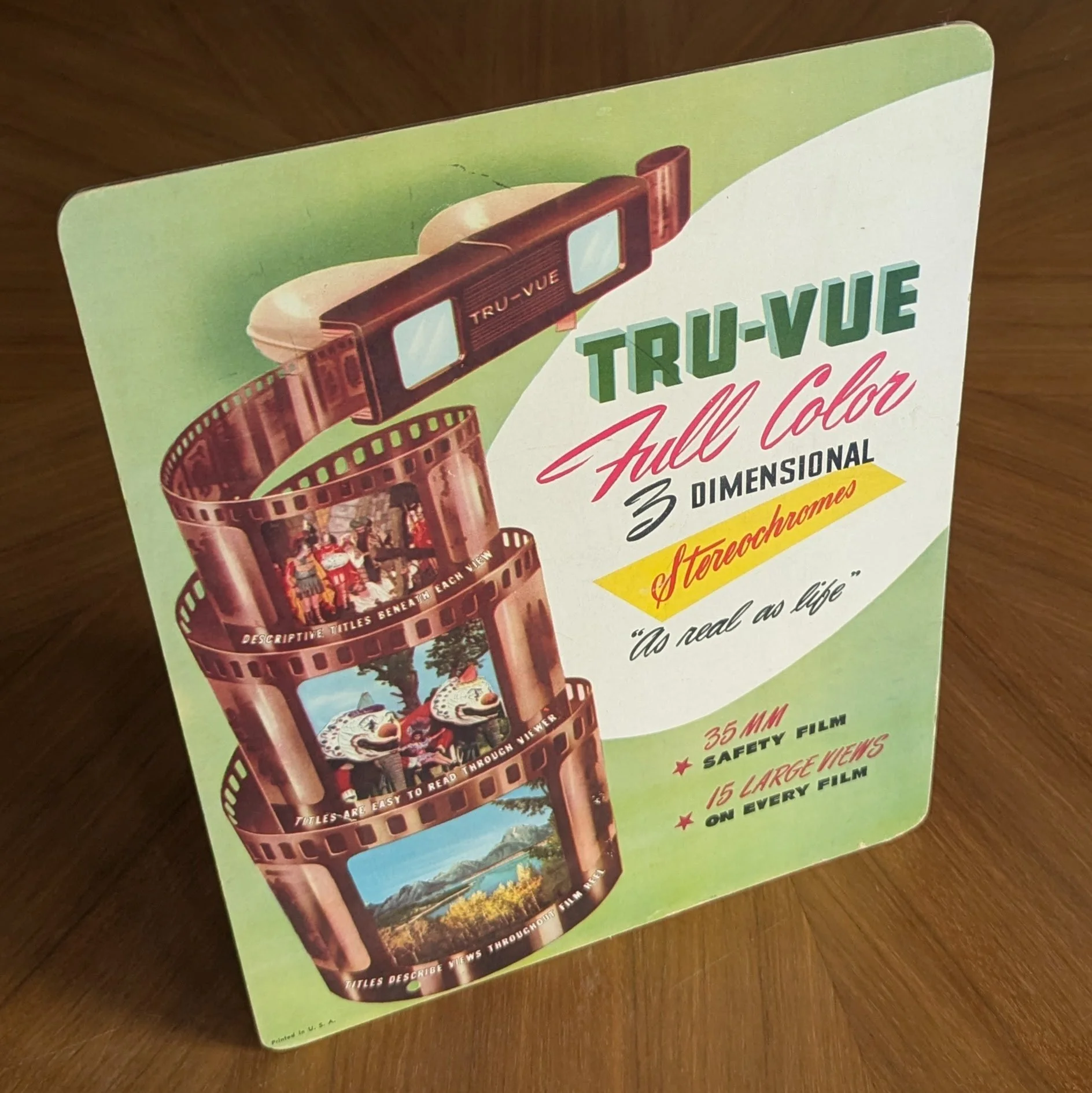
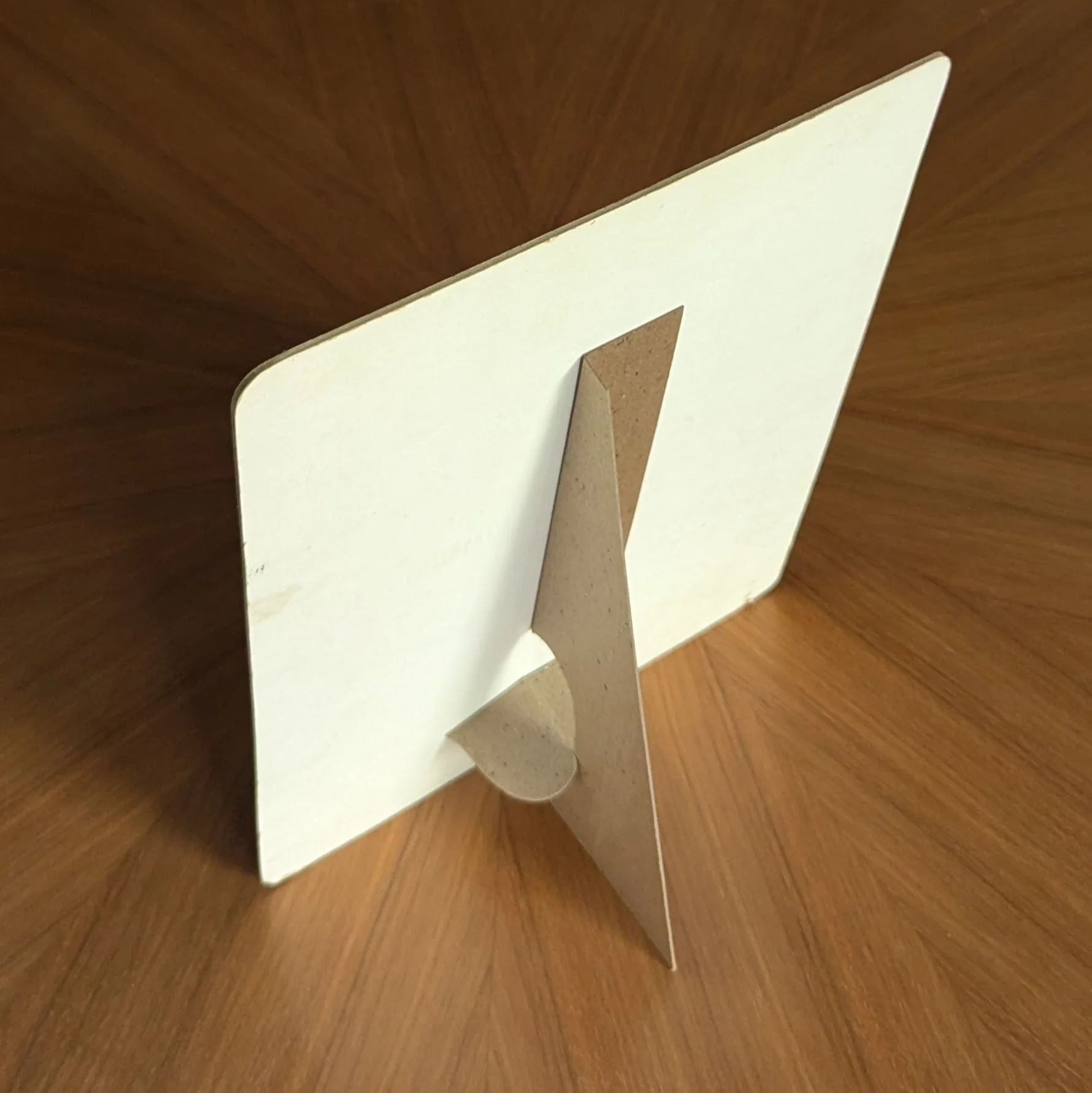
Easel-Backed Counter & Window Display Card
10 ½” x 13 1/2” color promotional display card for Tru-Vue’s color Stereochrome films.
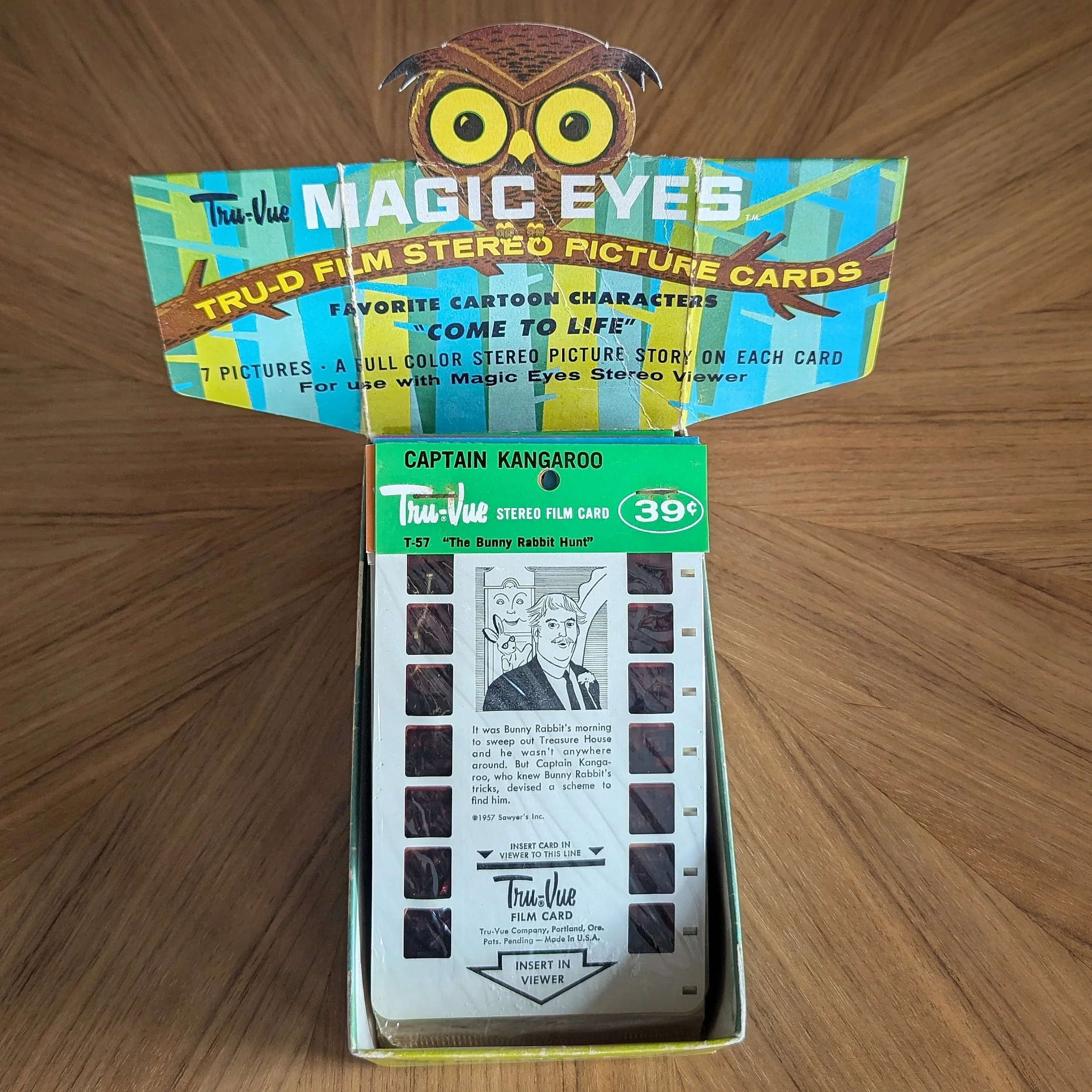
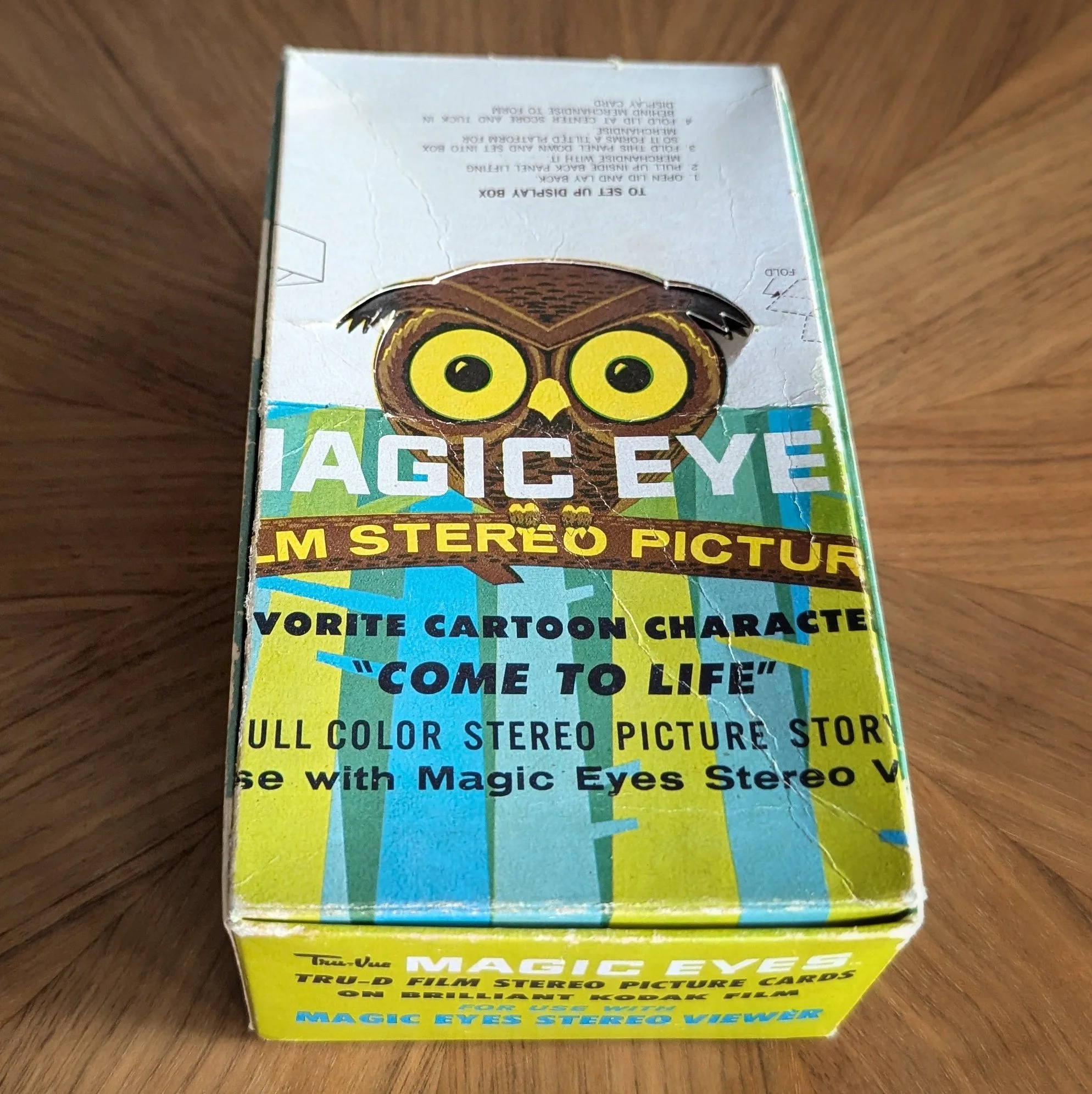
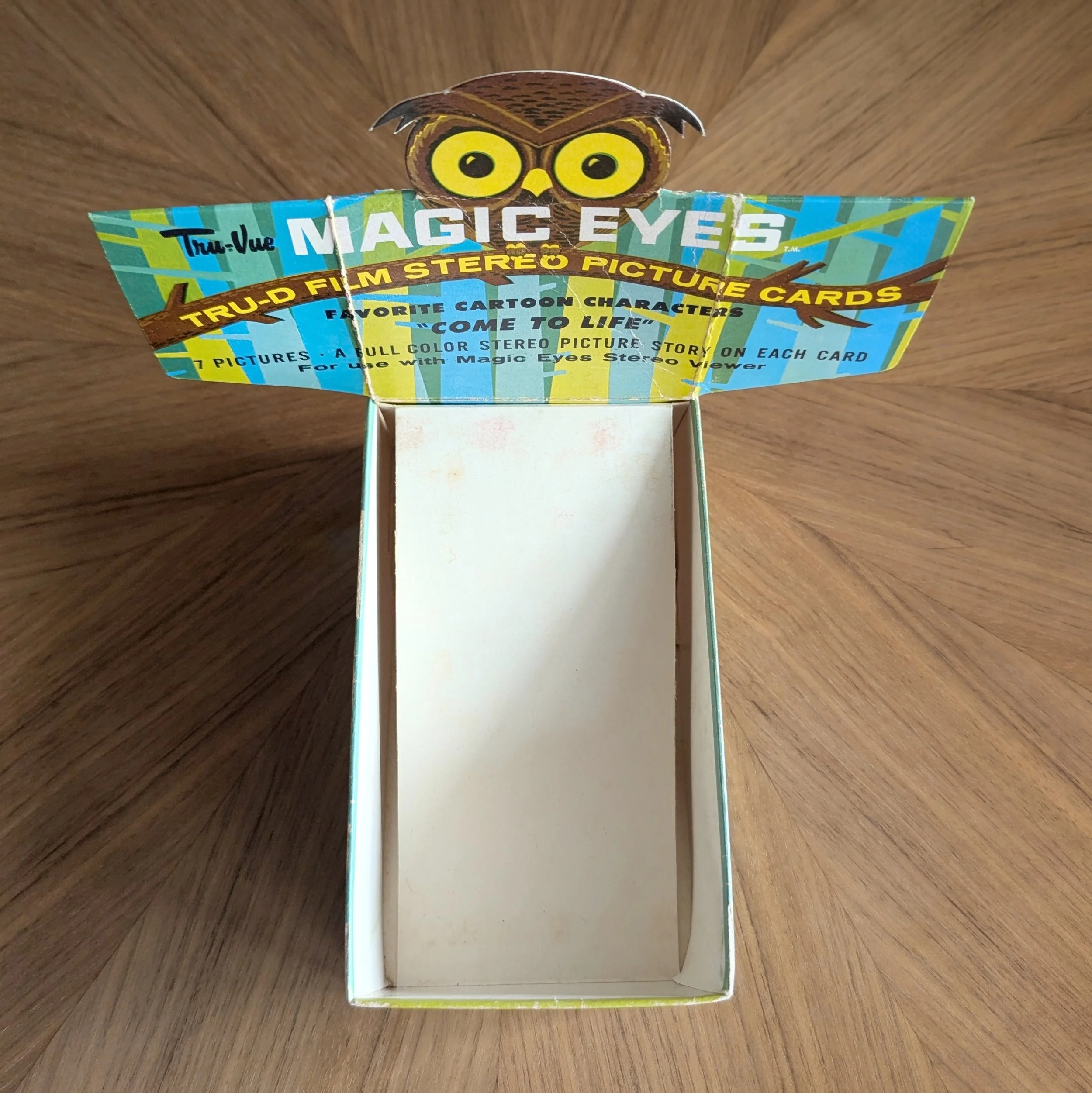
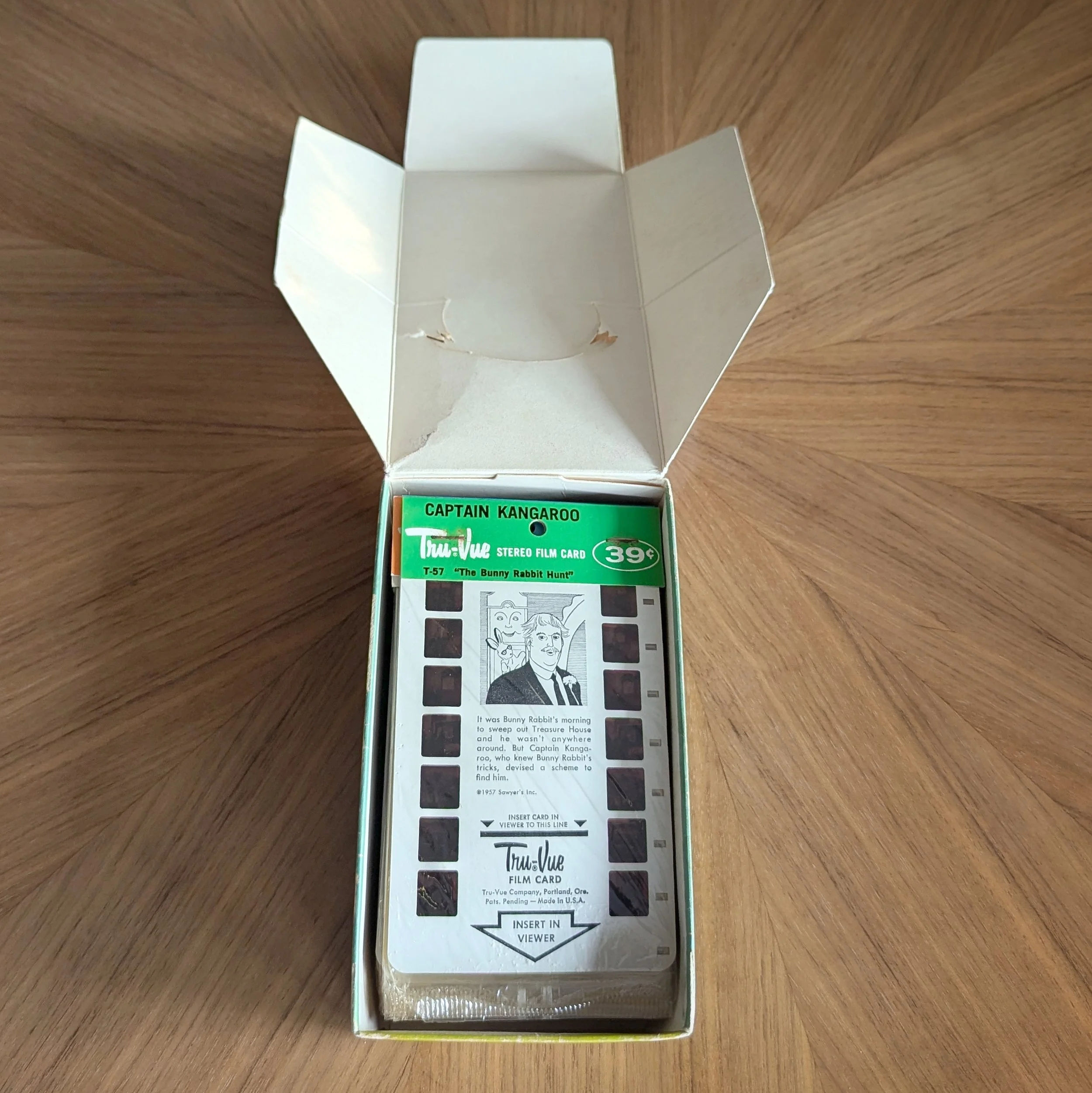
Magic Eyes Card Display Box
The Magic Eyes owl folds up and out to help dealers promote Tru-Vue cards.
Tru-Vue Special Sets as Marketing
Even though these sets and more are covered in our Special Sets section, we’d be remiss if we didn’t also include a few of them here to demonstrate Tru-Vue’s marketing strategy. Tru-Vue would photograph special events and locations, then create custom sets to sell at those locations, such as tourist spots and hotels. They did extensive commercial photography as well and would occasionally build entire marketing campaigns around them.
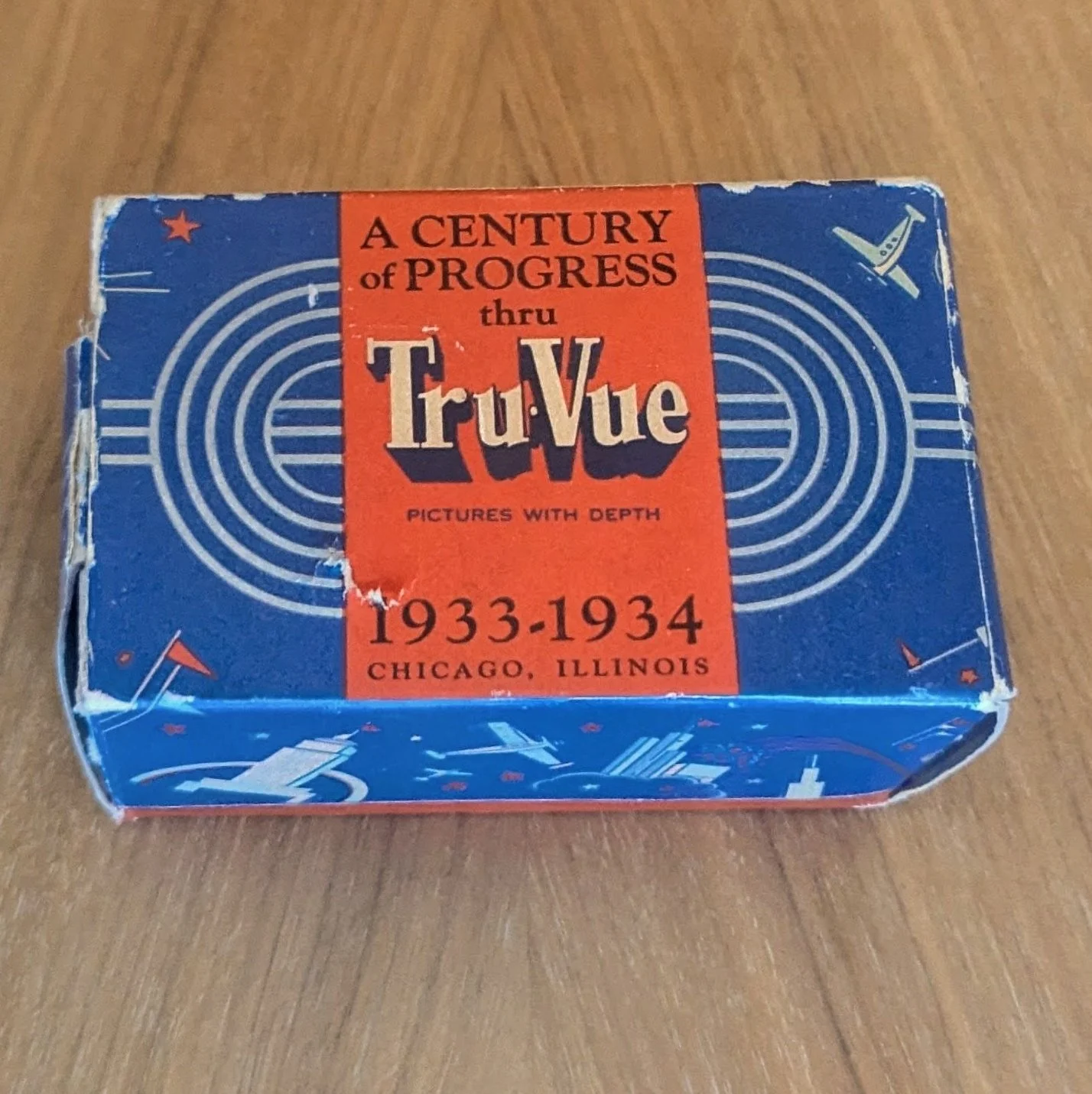
1933-34 Century of Progress World's Fair
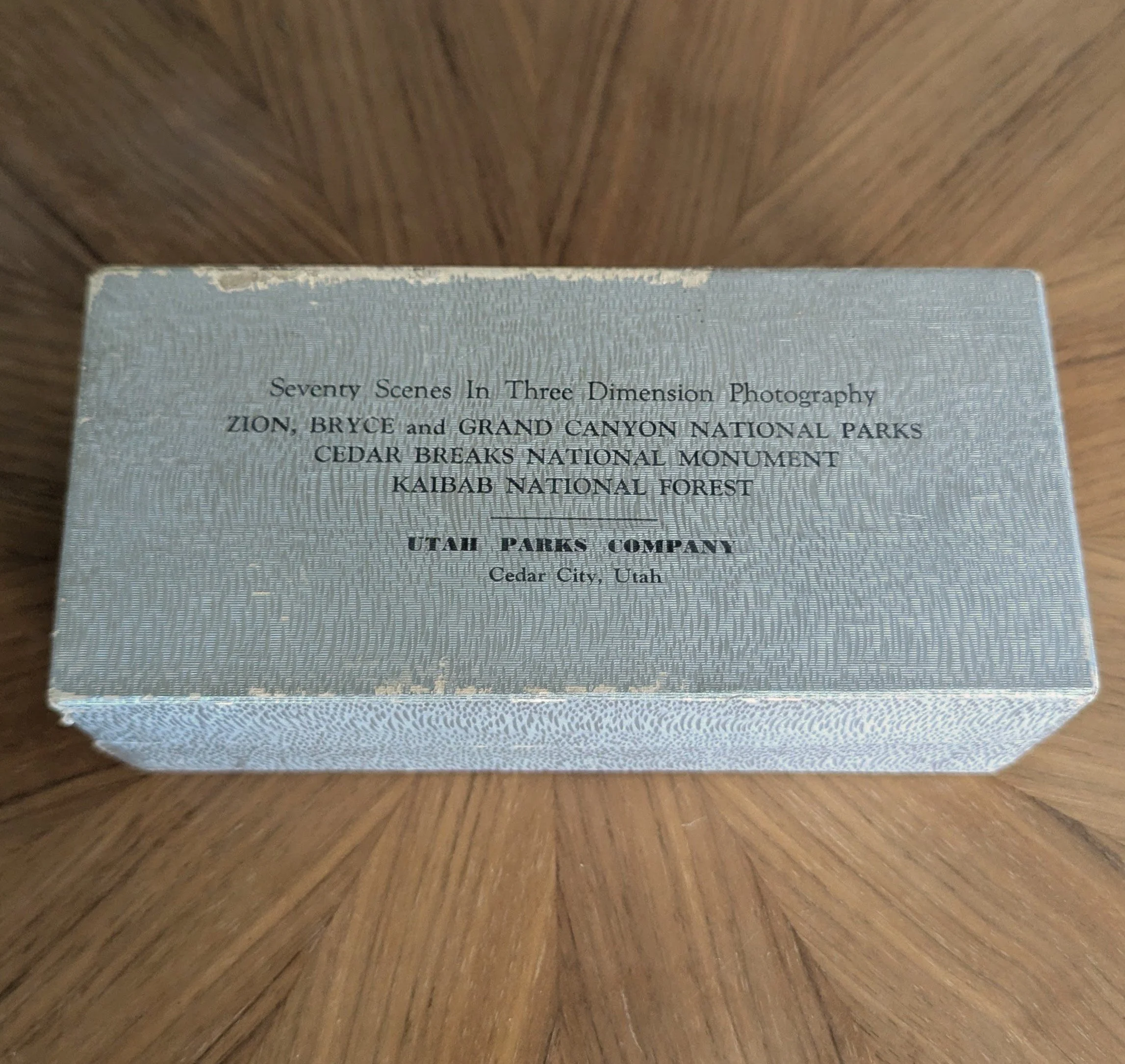
Utah National Parks
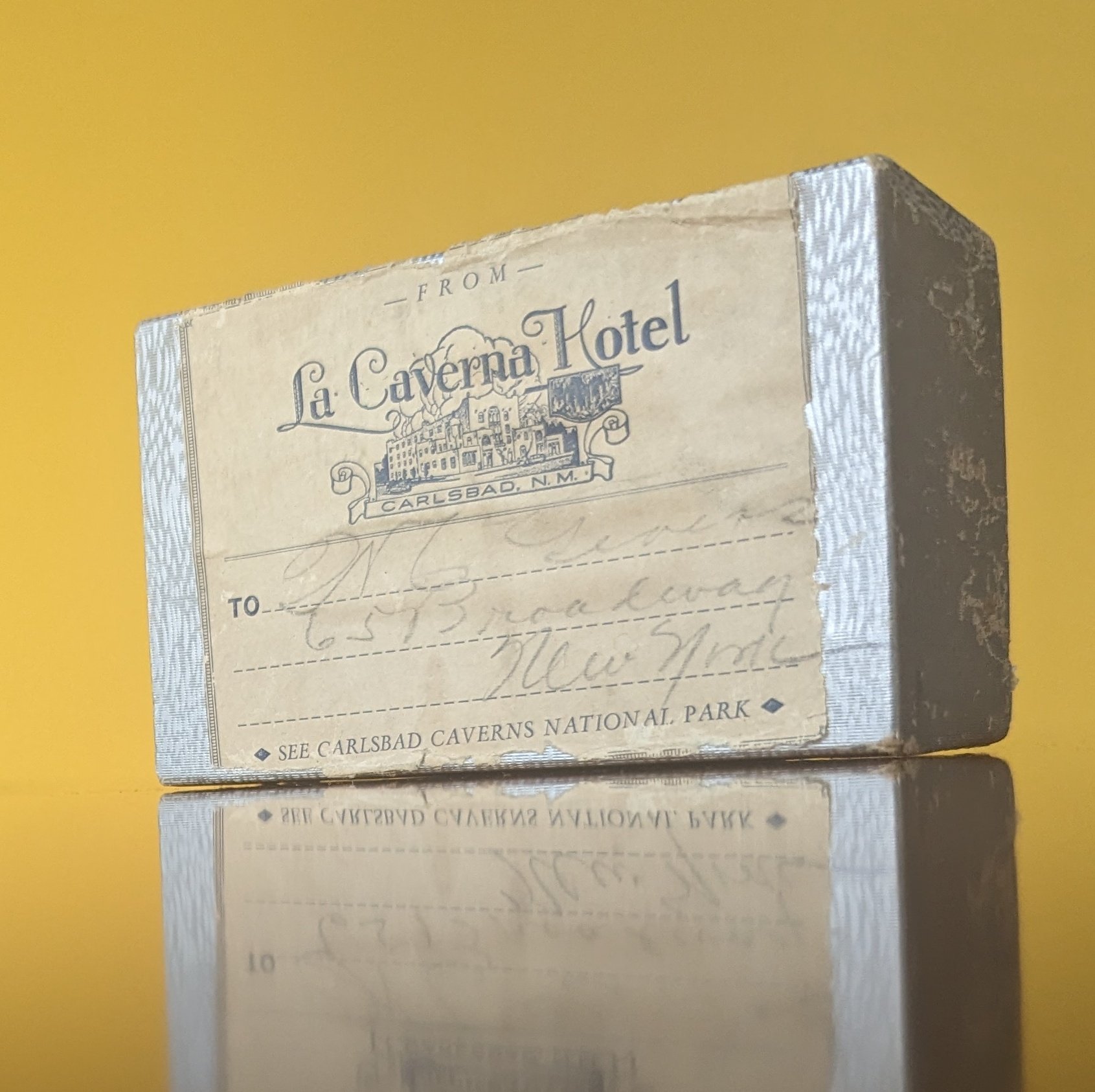
La Caverna Hotel
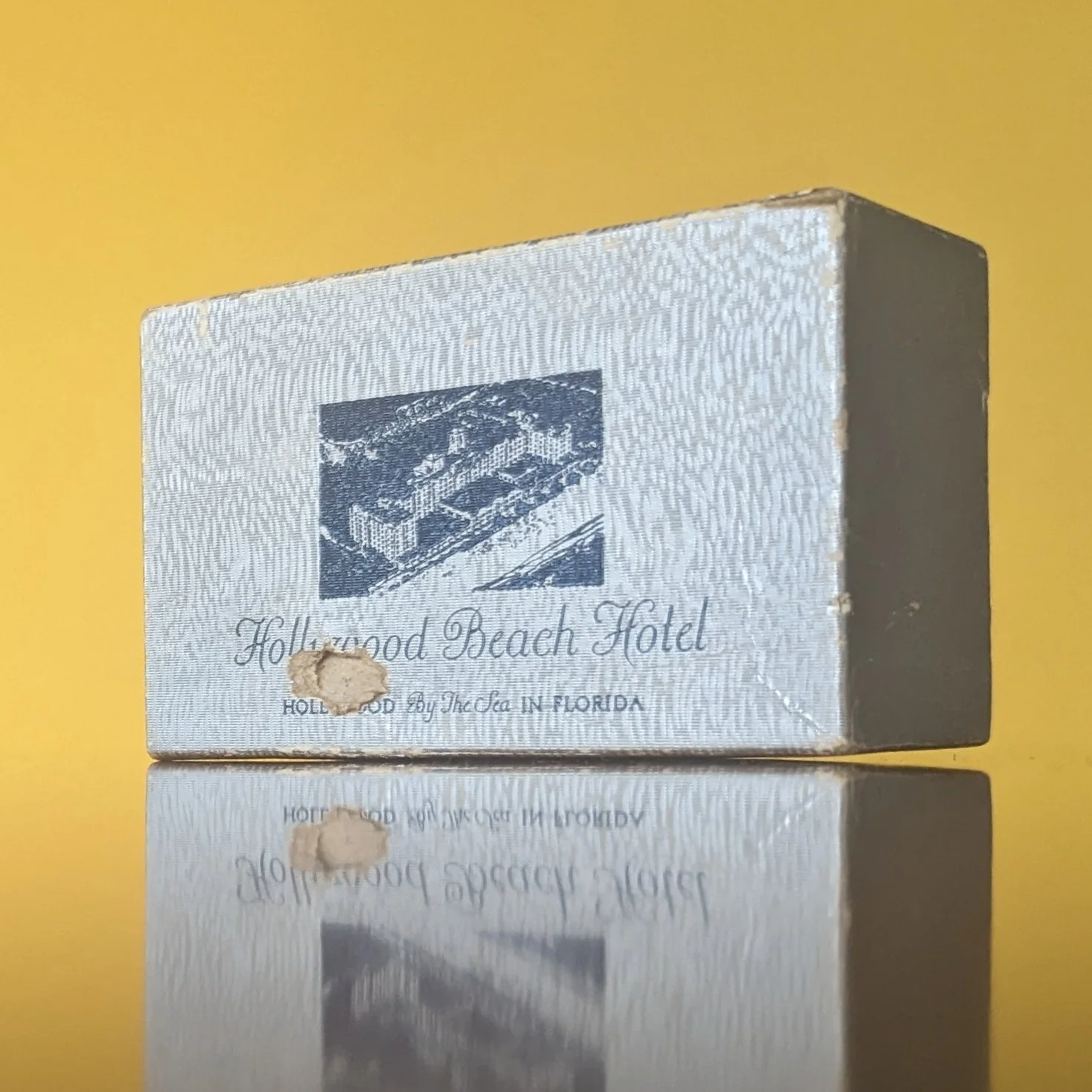
Hollywood Beach Hotel
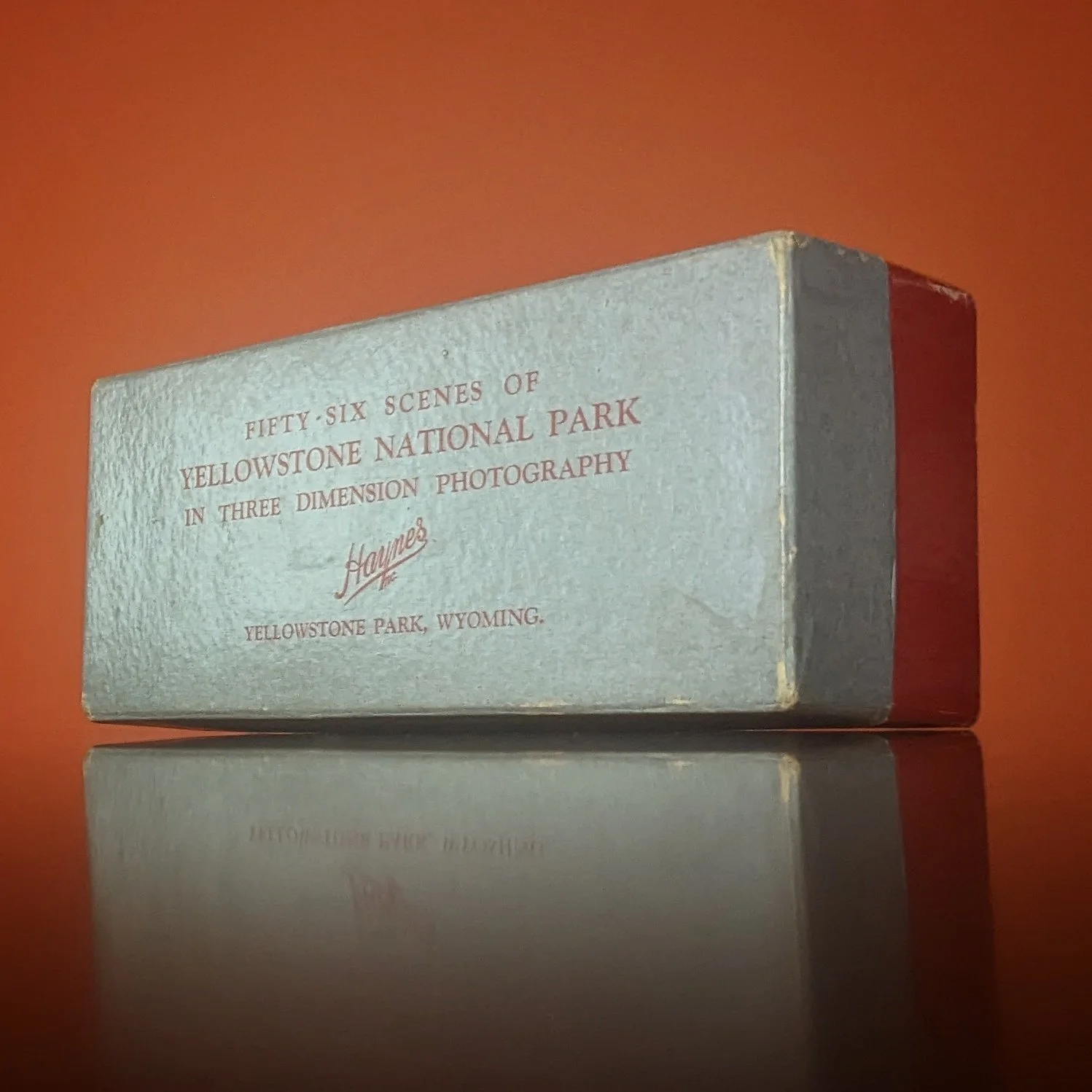
Yellowstone National Park
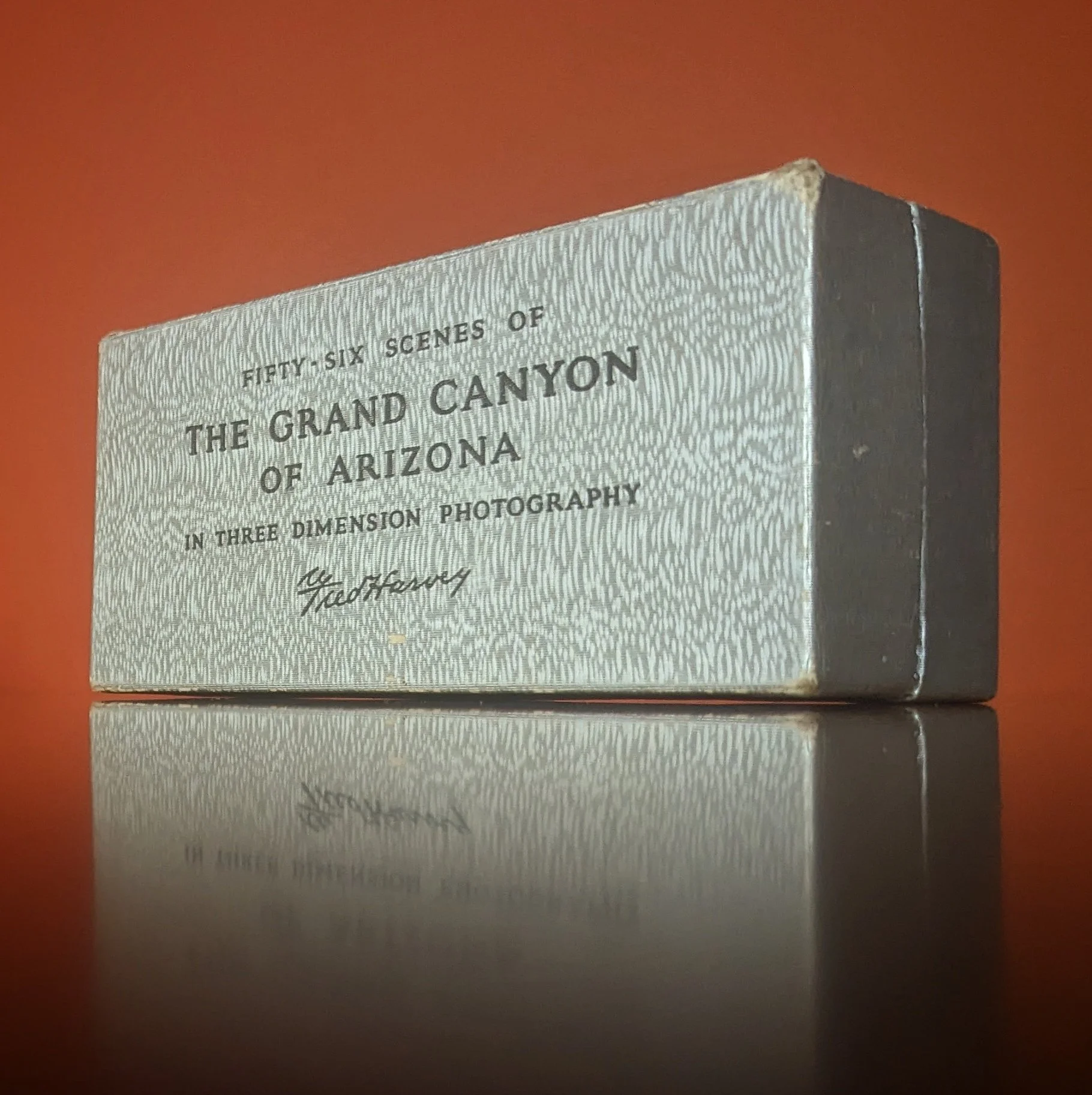
Grand Canyon of Arizona
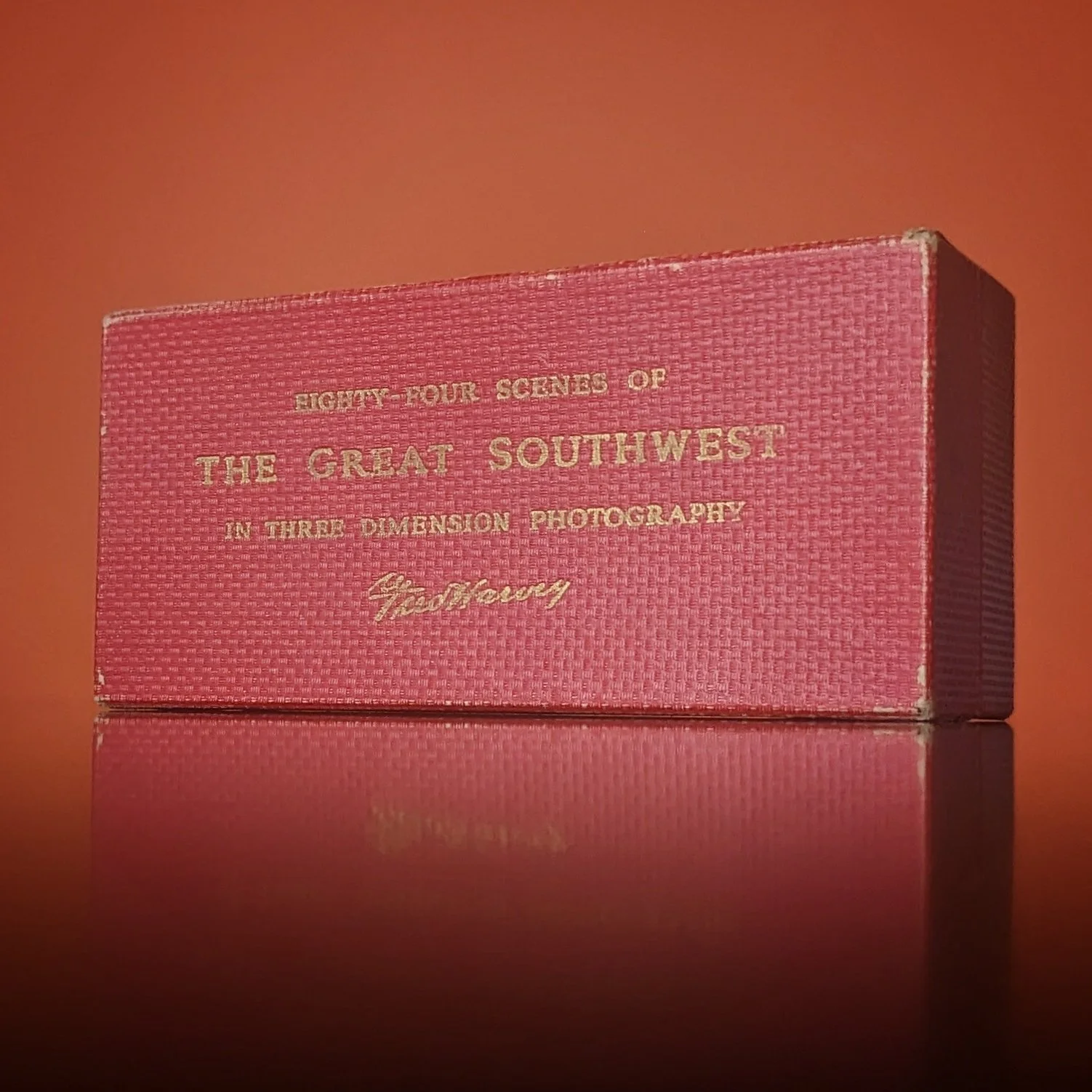
The Great Southwest
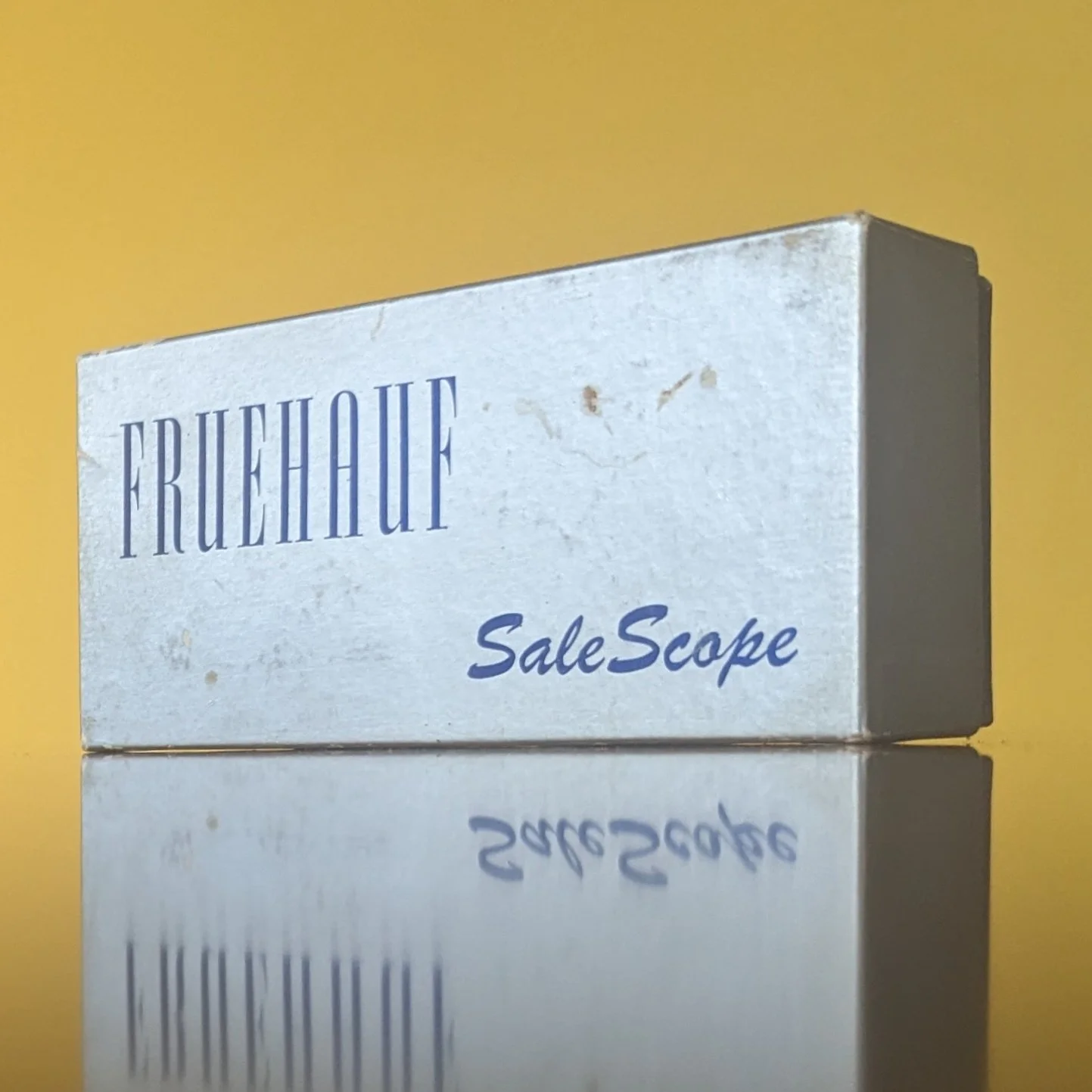
Fruehauf
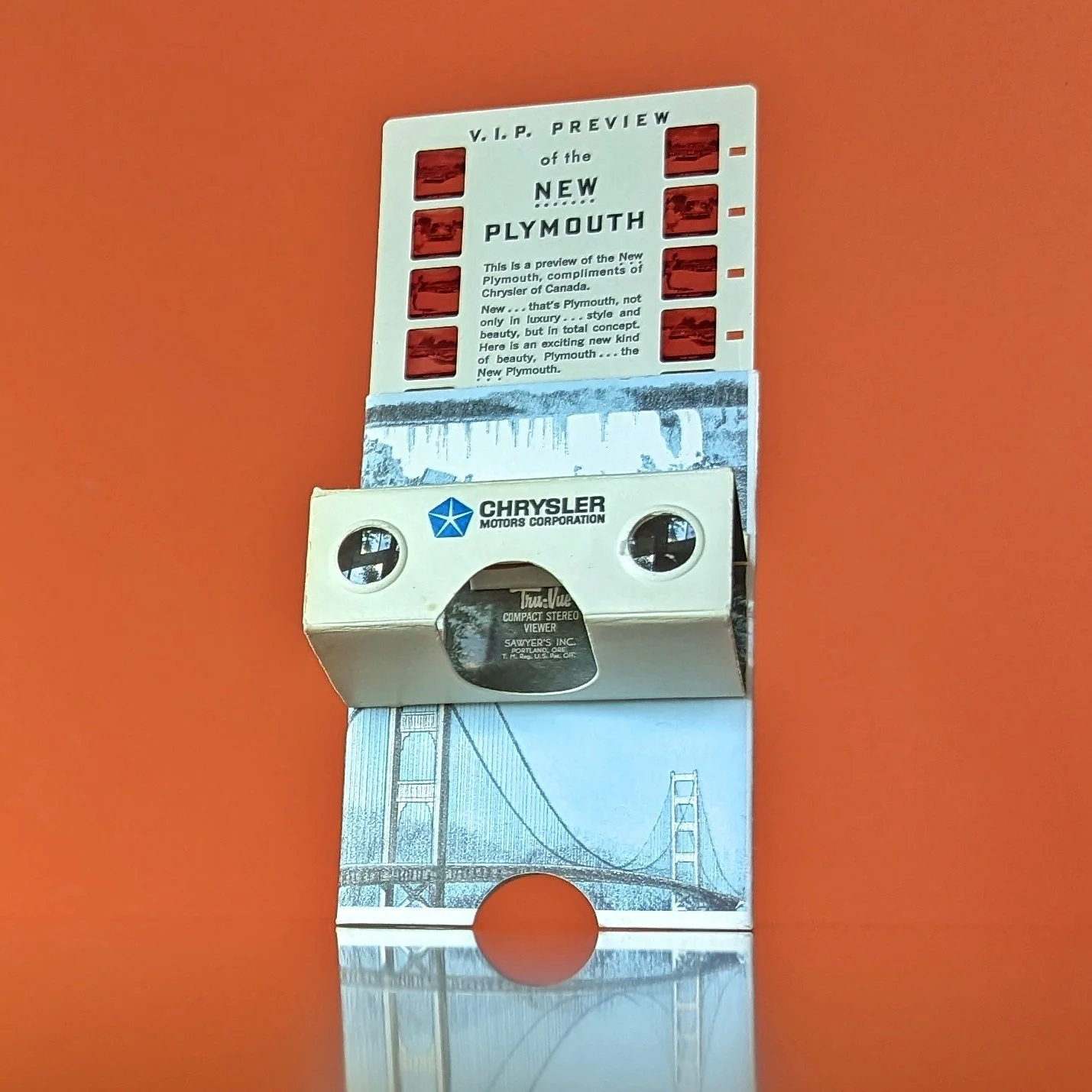
Chrysler of Canada

Consolidated Edison
Factory Stock
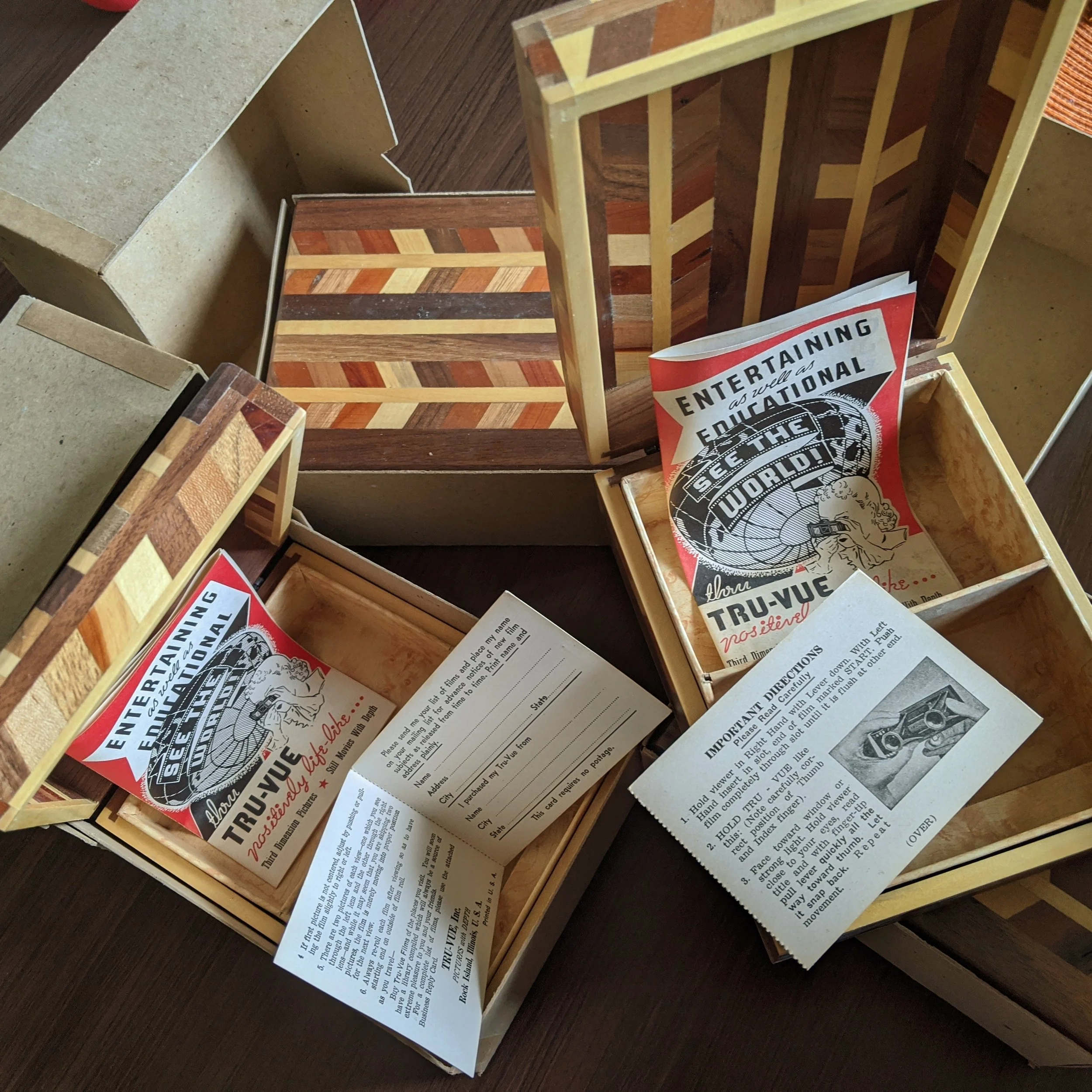
Inlaid Wood Cases
Found in a warehouse, these unused inlaid-wood film library cases were individually packaged in cardboard boxes and included promotional material.
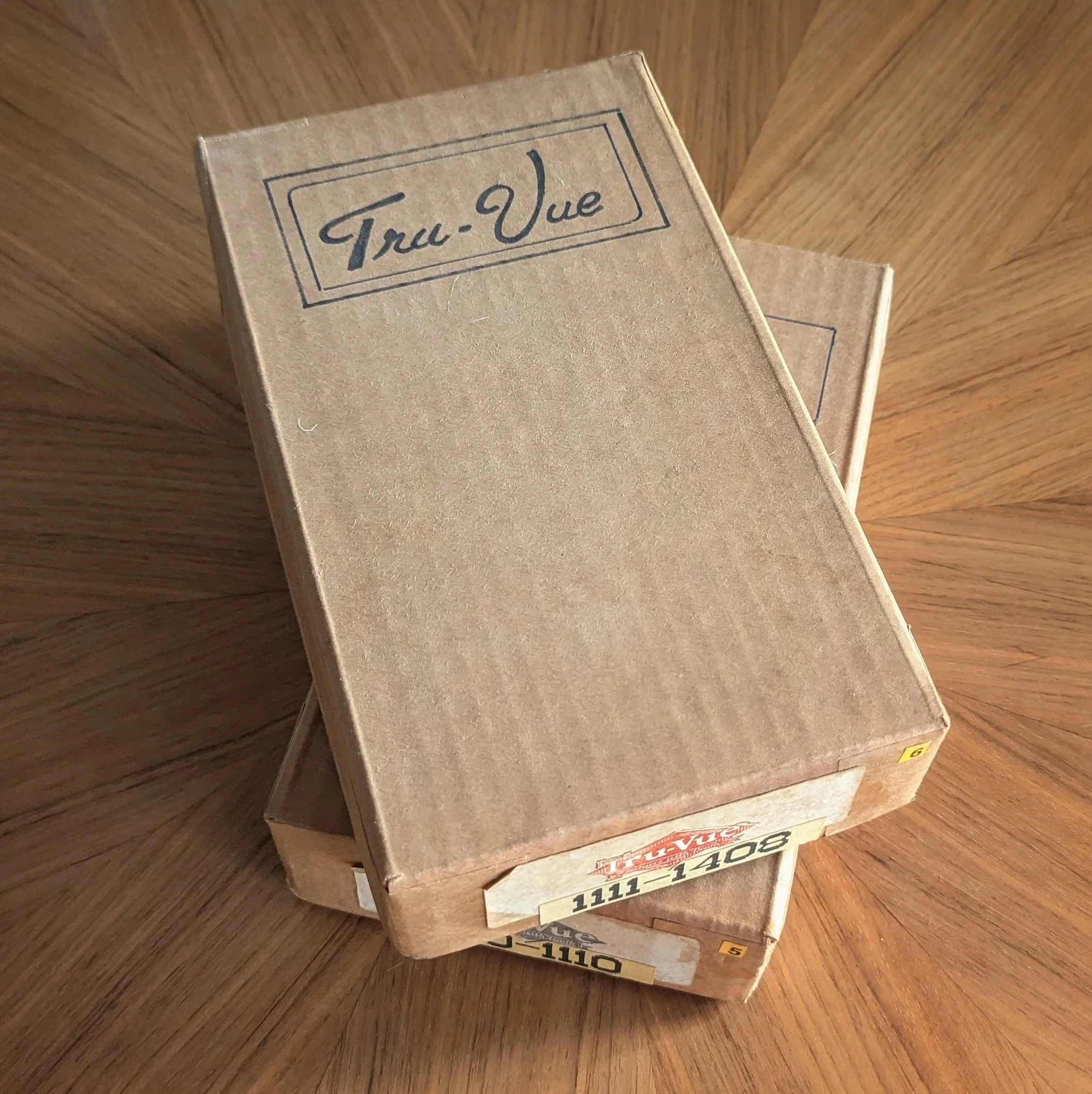
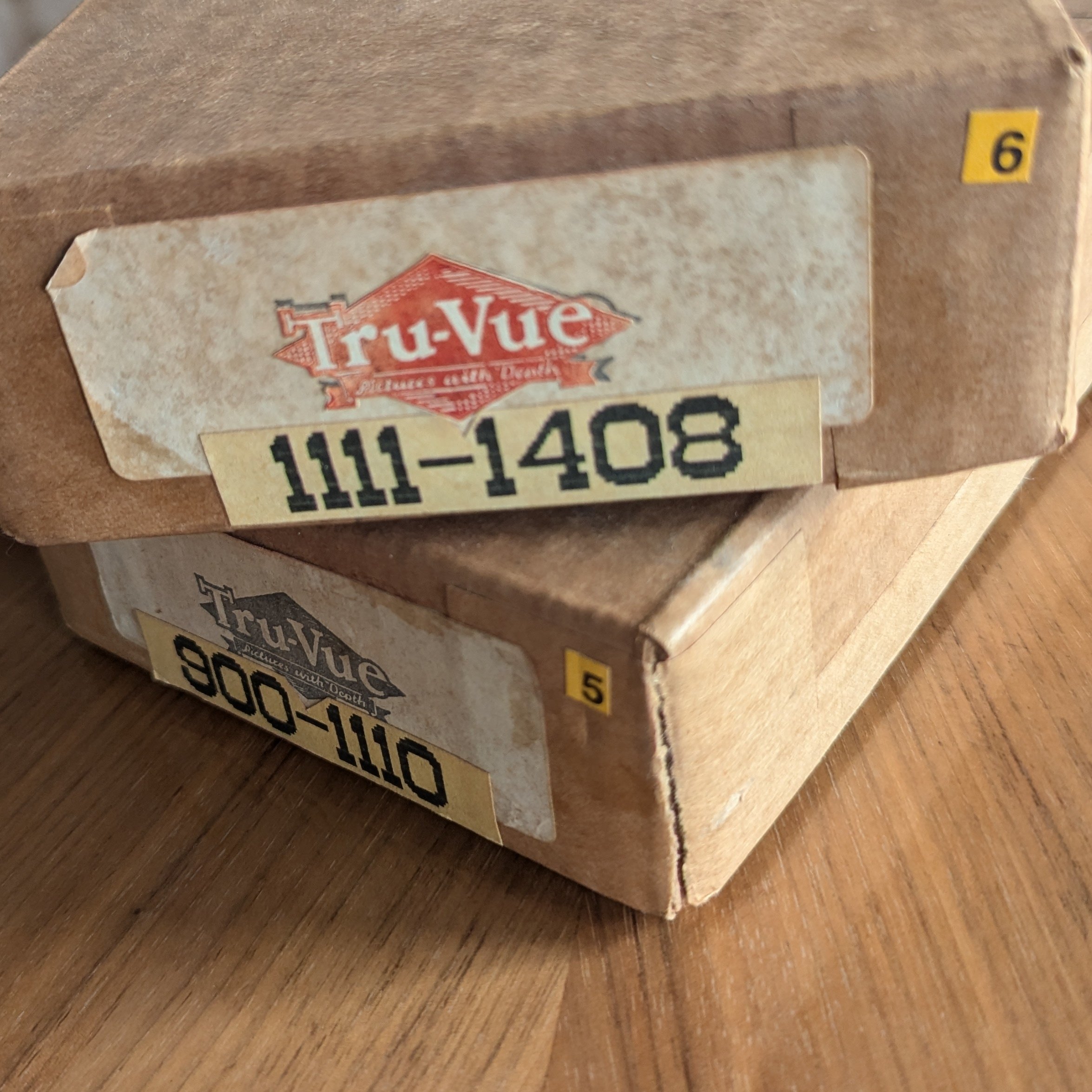
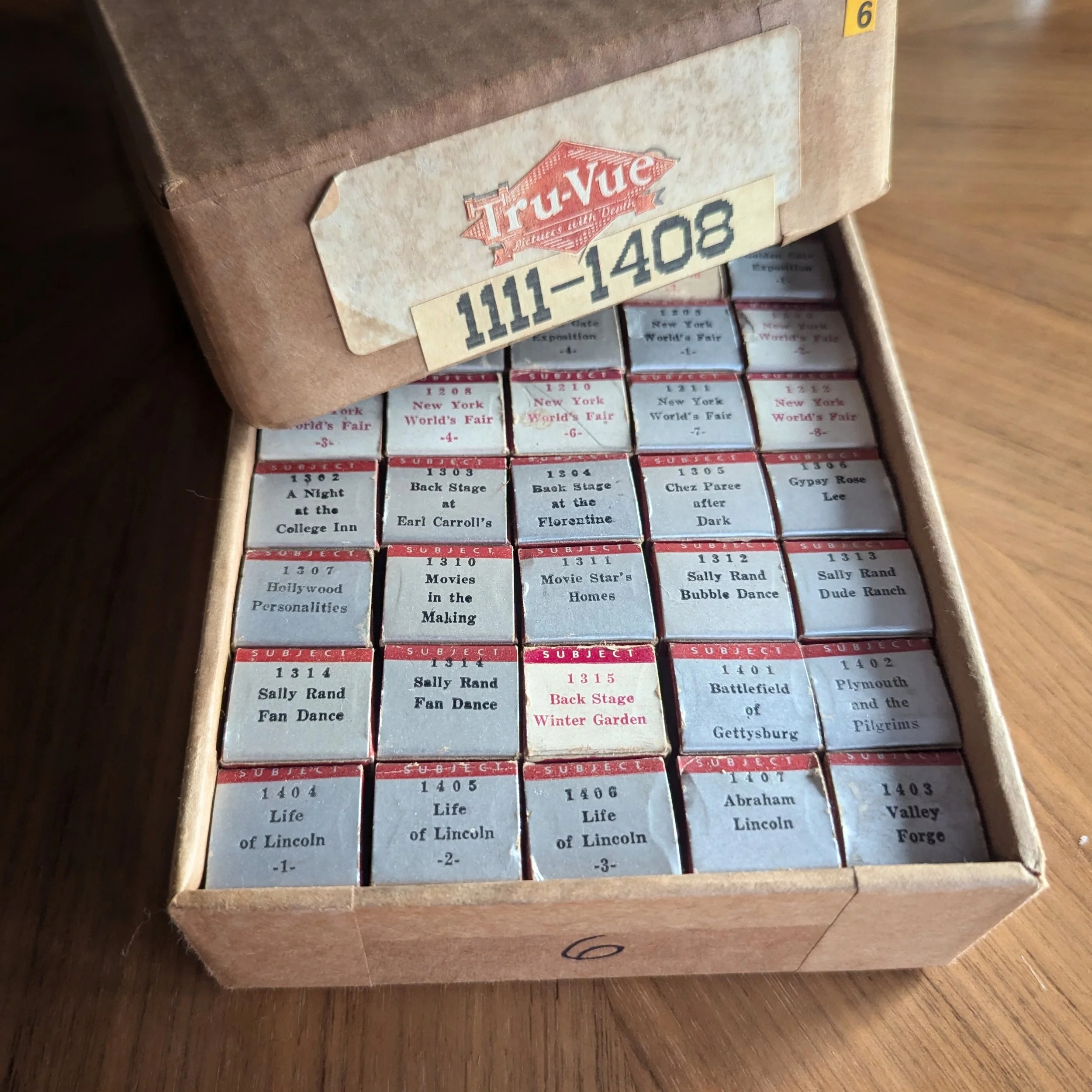
Tru-Vue Film Box Cartons
Indexed Tru-Vue cartons of film.
Walt Disney
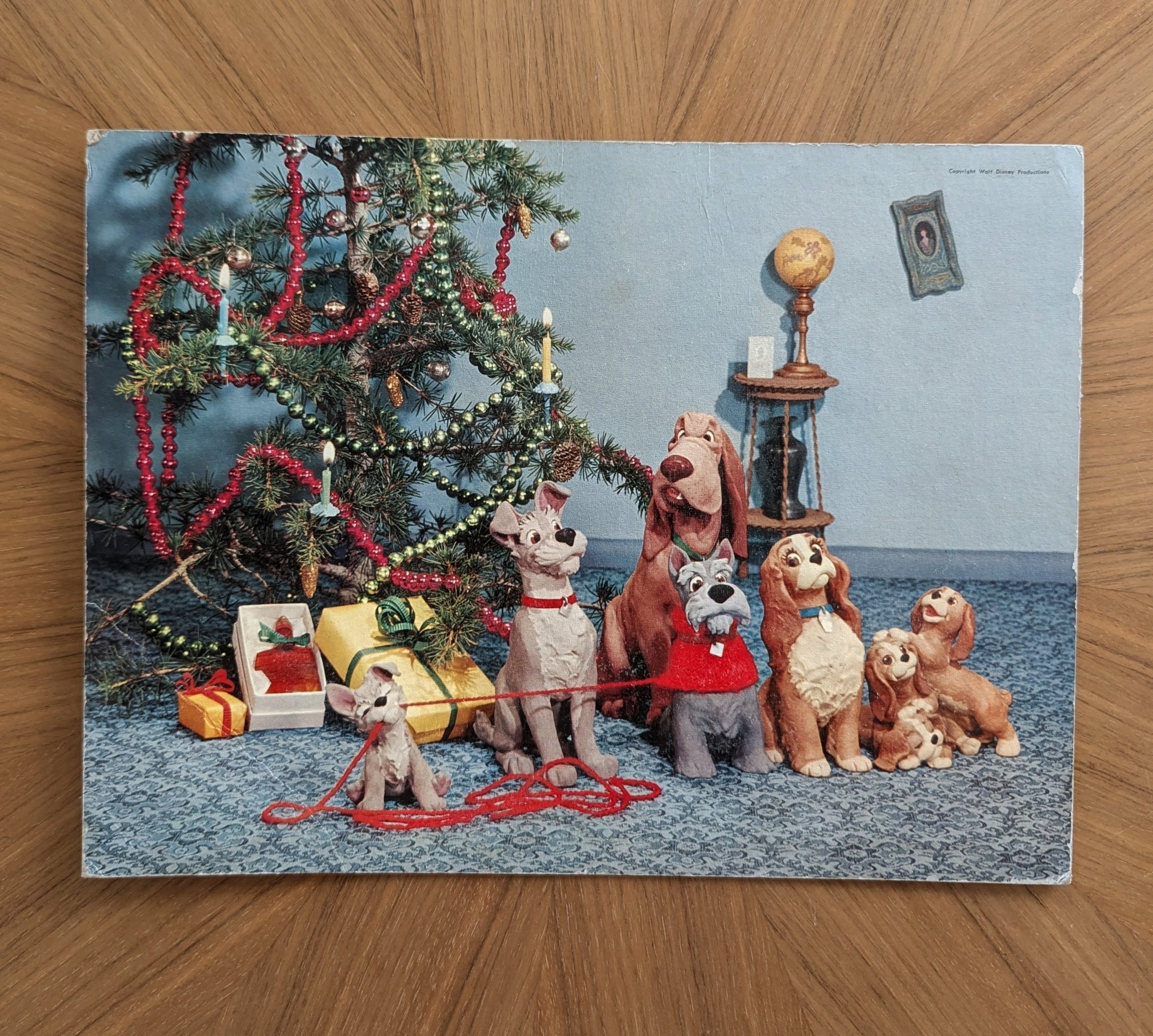
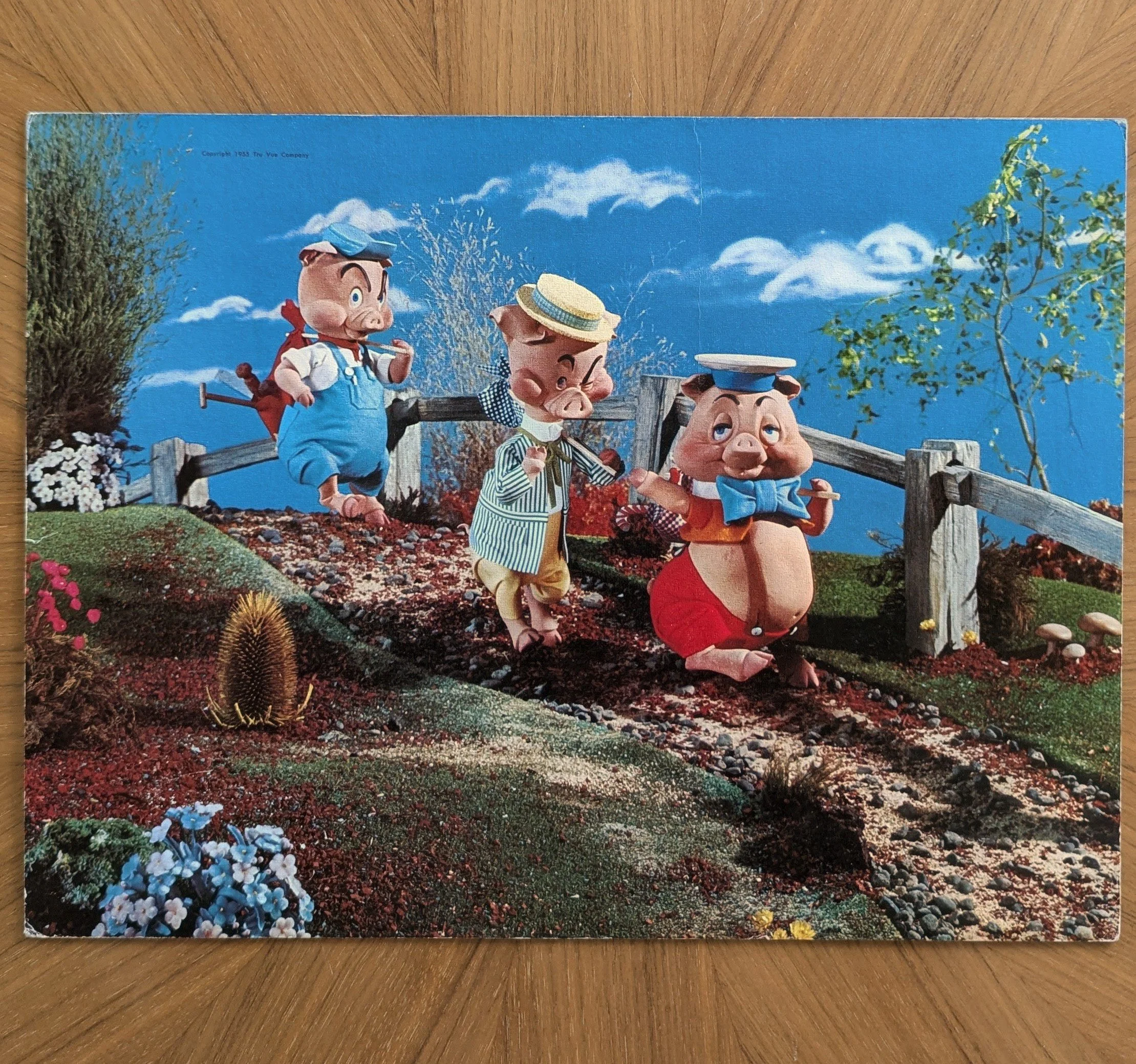
We’ll end this section with a couple of cool items in our collection: colorful art boards depicting Disney scenes that were used in Tru-Vue products. We know that part of Tru-Vue’s sales & marketing strategy was the purchase of the rights to use Walt Disney’s cartoon characters. That smart move made Tru-Vue valuable to Sawyer’s and helped ensure Tru-Vue’s continued existence after the sale to Sawyer’s — first as a subsidiary company, then as a children’s brand.
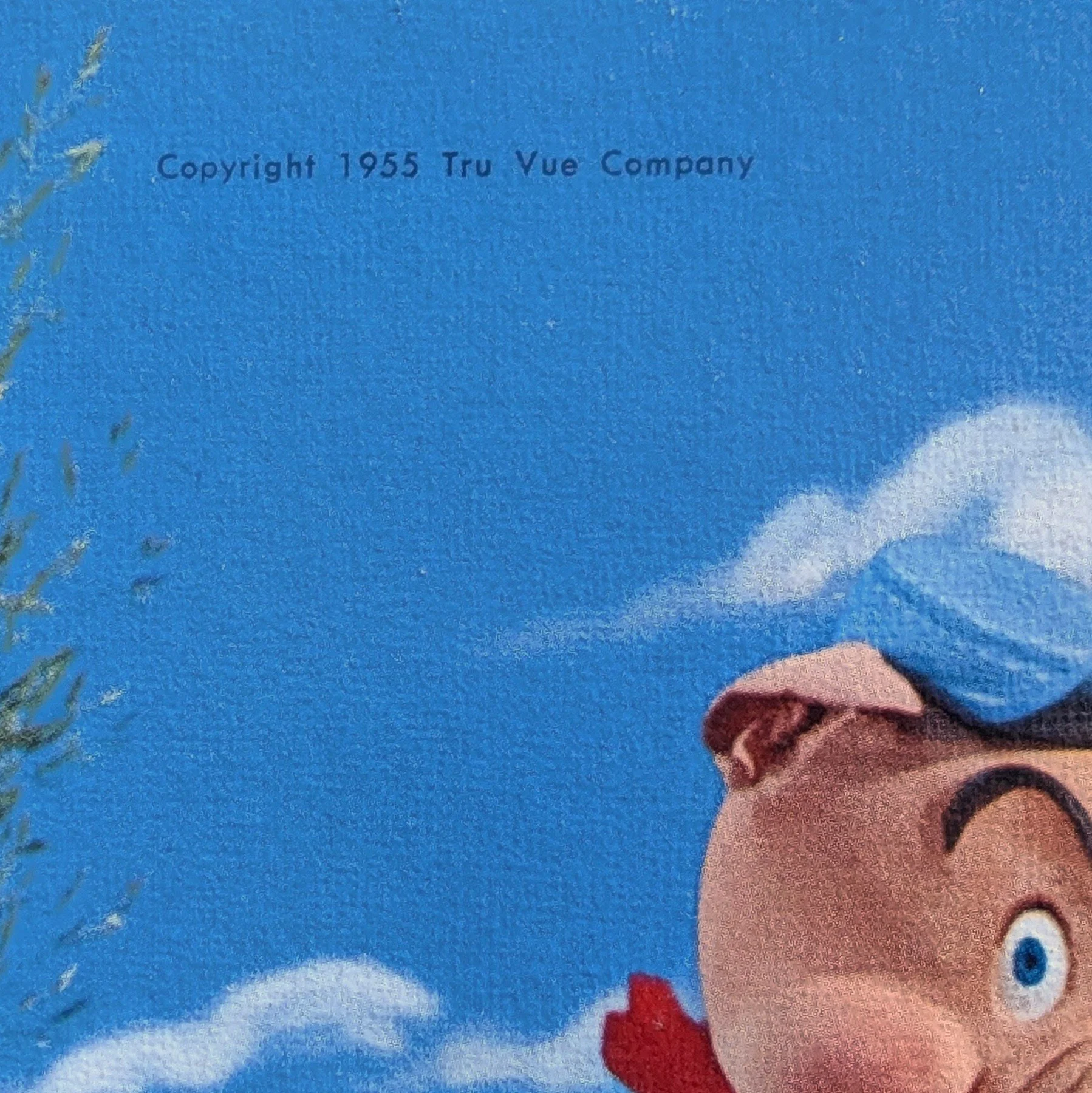
While the Lady and the Tramp board has “Copyright Walt Disney Productions” in the upper-right corner, the Three Little Pigs board has “Copyright 1955 Tru Vue Company” in the upper-left.
Continue to explore our Tru-Vue collection:
Tru-Vue Home | History | Viewers | Filmstrips | Cards | Boxes | Cases | Special Sets | Sales & Advertising