Ephemera Spotlight: Tru-Vue Letters to Hugo Zeiter
In this new Ephemera Spotlight series, we’re opening up the binders, bins, and drawers and sharing interesting 3D-related paper items acquired while building our collection: letters, advertisements, catalogs, and other things that tell stories — or raise questions — that a viewer or stereoview alone might not.
In this inaugural post, we highlight two Tru-Vue letters we acquired years apart. When we got the second letter, the recipient’s name looked familiar. So we dug out the earlier letter and found we were right: both were addressed to Hugo Zeiter, an avid film buff and circus fan who served in the U.S. Army during World War II and later worked for the Civil Service in Okinawa.
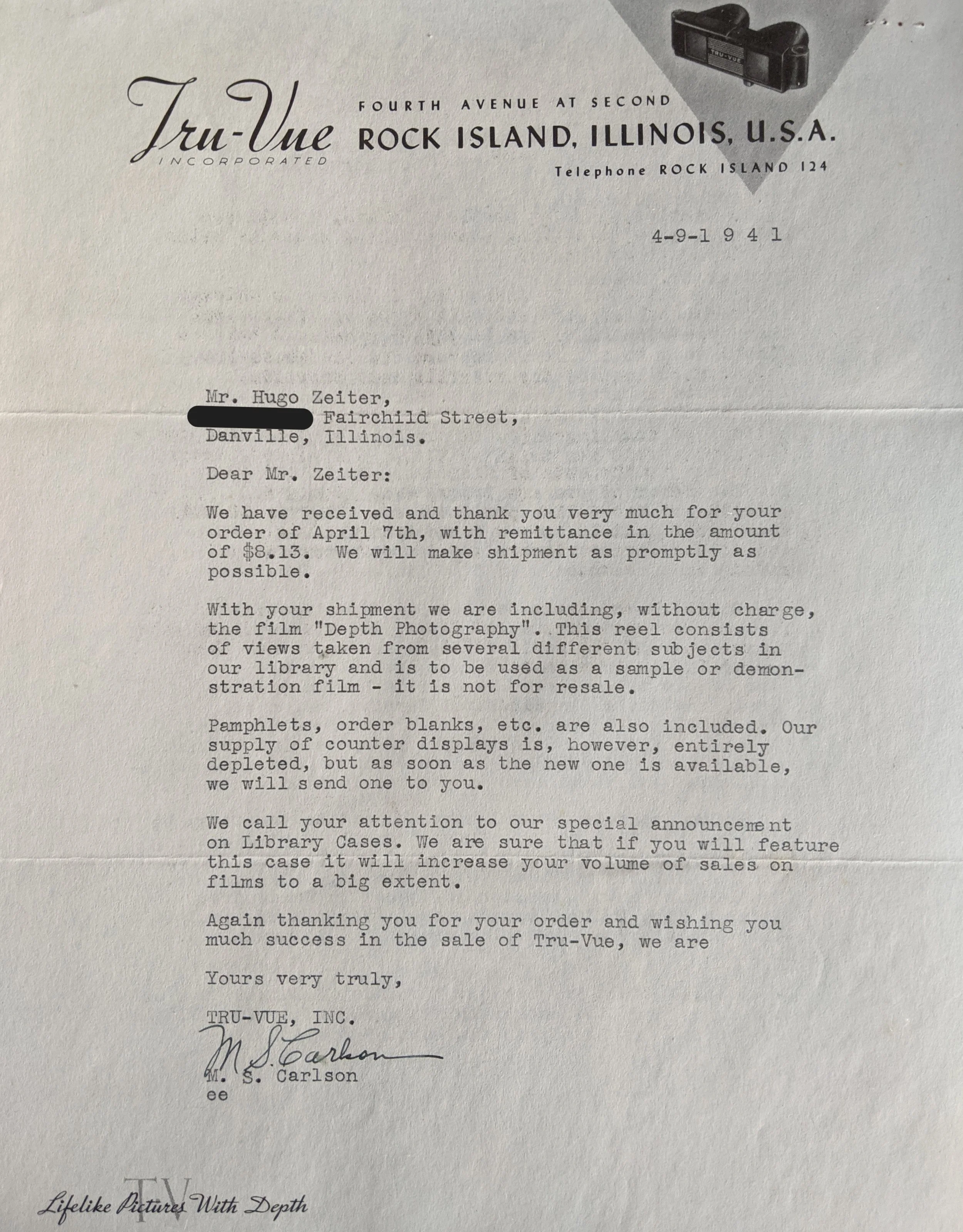
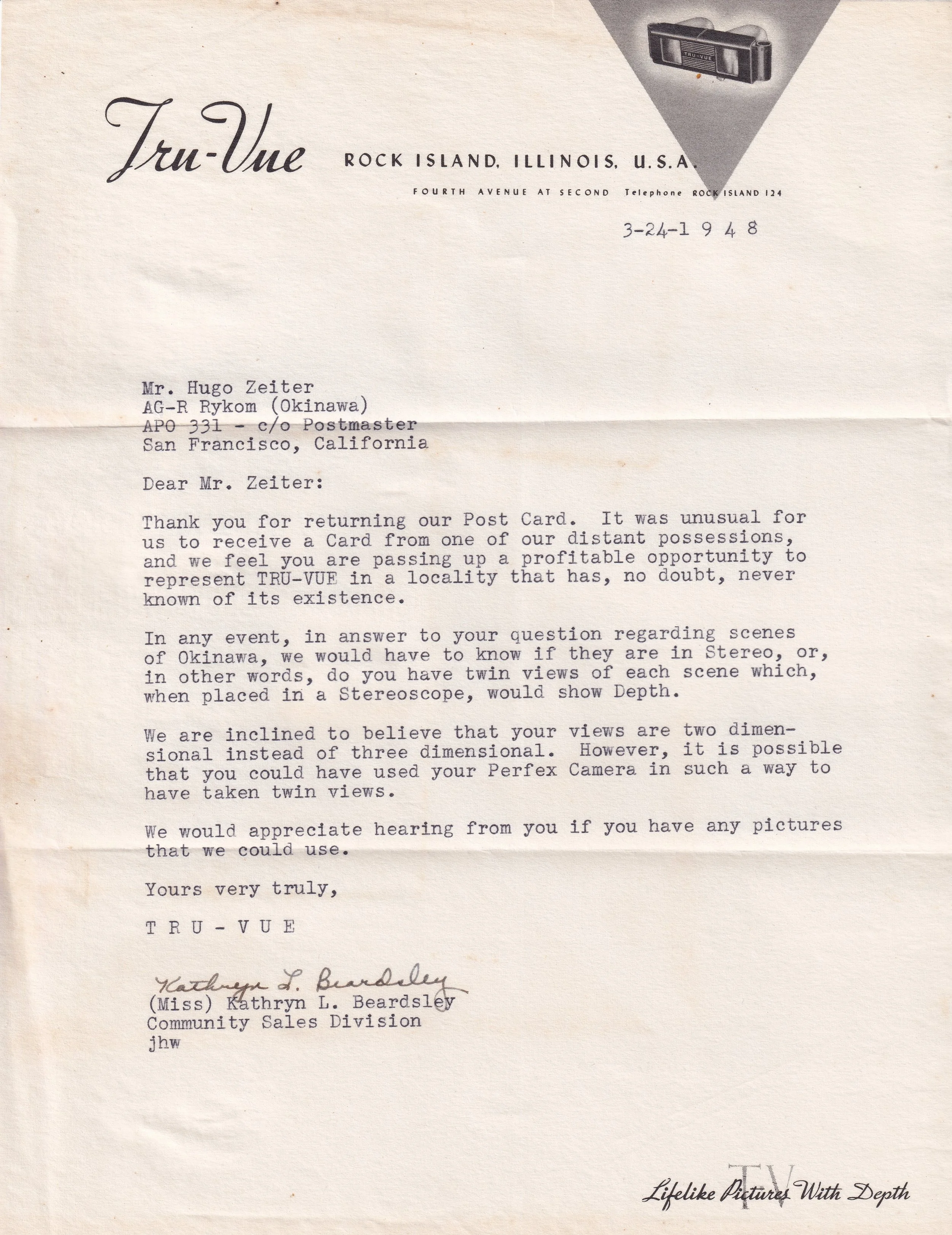
One letter concerns a Tru-Vue order and sales materials; the other, a declined Tru-Vue business opportunity and a question about stereo photography. But together they place Zeiter at two points in a life spent collecting, showing, and noticing things others have discarded or neglected. We bought the letters because they belonged to Tru-Vue’s history. Finding the same name on both led us to some pretty cool stories about this collector.
The first letter, sent to Zeiter’s home in Danville, Illinois, in 1941, is from Tru-Vue executive M. S. Carlson. Carlson thanks Zeiter for an order and includes pamphlets and order blanks, suggesting Zeiter was preparing to sell Tru-Vue films. Counter displays were temporarily out of stock, but Carlson promised to send one when available. He also urged Zeiter to feature Tru-Vue’s library case, which he believed would boost film sales.
Seven years later, a letter from Kathryn Beardsley of Tru-Vue’s Community Sales Division reached Zeiter in Okinawa. Zeiter had apparently decided against selling Tru-Vue there. Beardsley regretted his decision, writing that he was “passing up a profitable opportunity” in a place where people may never have encountered the product.
The more intriguing part concerns photographs Zeiter seems to have offered from Okinawa. Beardsley wanted to know whether he had taken a stereo pair for each scene: two views that would show depth through a stereoscope. She suspected his pictures were two-dimensional, though she allowed that he might have used his Perfex camera to make paired views. The letter ends there, leaving us wondering what Zeiter had photographed, and whether Tru-Vue ever saw the pictures.
Zeiter turns out to have had a remarkable eye for things others had overlooked. In 1947, he sent a film to Chicago’s Field Museum. It was a damaged, incomplete print salvaged from a dumpster and given to him by a friend. Turned out the film was Edward S. Curtis’s 1914 In the Land of the Head Hunters, a film whose sole negative copy was thought to have been destroyed, so it had been largely forgotten. Zeiter did not know its identity when he sent it; he only knew it by a title appearing on one of the surviving reels. His copy became an important source for later versions and restoration work. The timing of that event is interesting: shortly after sending the film to the museum, he left for Okinawa—the address on our second Tru-Vue letter.
Film was one of Zeiter’s big interests. When he passed away at 92, he still had over 900 old movies in his collection. But he was also a huge circus fan, known for his extensive collection of circus memorabilia. And his eye for overlooked things led to a discovery there, too.
While stationed in England during World War II, Zeiter found old vehicles from Sir Robert Fossett’s Circus in a shed near Tiffield. A quarter of a century later, he told Circus World Museum director Chappie Fox about them, though he could no longer remember exactly where the shed was. Zeiter, Fox, and Jack Niblett, another circus fan, figured out how to locate them, and their search turned up seven wagons and three smaller vehicles that seemed to have been undisturbed since Zeiter last saw them 25 years earlier. The Fossett family was happy that someone cared about them and gifted them to the museum. Schlitz Brewing president Robert Uihein paid for the overseas shipping and restoration. They arrived in Baraboo, Wisconsin, in 1969, and several were restored for Milwaukee’s 1970 Great Schlitz Circus Parade. One was a telescoping tableau wagon: turn a crank, and its tall center section rose to reveal carved lions. After sitting in that shed for decades, the wagons were once again part of a circus parade.
When Zeiter passed away in 2007, items from his estate were sold at auction. It’s possible that’s how these letters ended up in the marketplace. If we ever discover that Zeiter had stereo photographs that made it to a Tru-Vue filmstrip — or anywhere else — we’ll let you know!
Sources for Zeiter’s background: obituaries, newspaper articles, and a Rutgers restoration project.